
Texas university student designs AV radar touted to enhance sensing accuracy

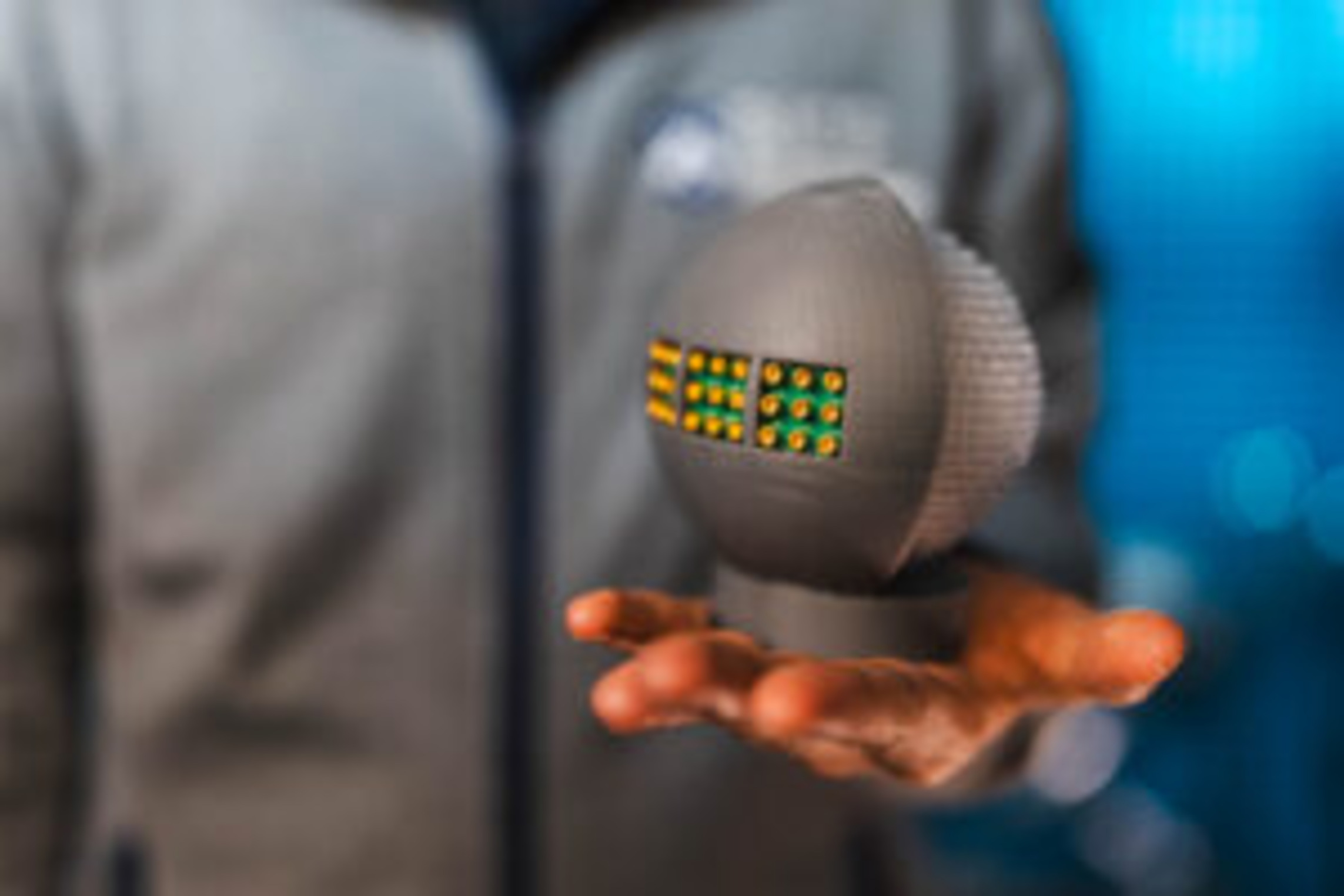
According to Rice University research, EyeDAR, a low-power millimeter-wave radar sensor roughly the size of an orange, could provide radar-equipped autonomous vehicles with critical information about surrounding traffic to extend and enhance sensing accuracy.
Placed at key points, such as streetlights and intersections, the sensors could ensure that AVs never fail to detect emergent obstacles, even when they aren’t within the proper range of onboard sensors or when visibility is severely limited, a Rice University press release states.
Kun Woo Cho, a postdoctoral researcher at Rice University who leads the EyeDAR research project, introduced the technology at HotMobile, the International Workshop on Mobile Computing Systems and Applications, last month.
“Current automotive sensor systems like cameras and lidar struggle with poor visibility, such as you would encounter due to rain or fog or in low-lighting conditions,” said Cho in the release. “Radar, on the other hand, operates reliably in all weather and lighting conditions and can even see through obstacles.”
Radar systems transmit signals in a given direction, and when an obstacle is encountered, information about the obstacle is reflected.
“However, only a small fraction of the radar signal emitted is reflected back, and most of it actually bounces away from the source device,” the release states. “In the context of self-driving vehicles, this means that a large fraction of the radar signal their sensing stack emits scatters away from the vehicle, leaving them with an incomplete view of their surroundings. Pedestrians emerging from behind large vehicles, cars creeping forward at intersections, or cyclists approaching at odd angles can easily go unnoticed.”
Safety concerns have been cited and lawsuits filed across the U.S. regarding AV-involved collisions, some causing injury or holding up emergency services response times.
Using traffic lights, stop signs, or streetlights, EyeDAR can capture radar reflections that would otherwise be lost, the release states. The device’s structure allows it to determine the direction of reflected signals and report that information back to self-driving vehicles.
“It is like adding another set of eyes for automotive radar systems,” said Cho, who specializes in metamaterial antenna design.
EyeDAR’s design is inspired by the human eye, with two main components: a 3D-printed Luneberg lens made from resin which functions similarly to the lens of the eye, focusing incoming signals from any direction onto a focal point on the opposite surface; and an antenna array. The array surrounds the back end of the lens, which functions like a retina to detect the signal and determine its direction.
Conventional radar systems rely on large antenna arrays and complex algorithms to estimate angles, while EyeDAR’s physical design does most of the computation work typically required for direction finding, the release states.
“Our lens consists of over 8,000 uniquely shaped, extremely small elements with a varying refractive index,” Cho said.
In testing, EyeDAR resolved target directions more than 200 times faster than traditional radar designs. It also communicates what it sees without transmitting new signals. Instead, the sensor alternates between absorbing incoming radar waves and reflecting them to the source radar in a form it can interpret as a sequence of zeroes and ones. Cho compared it to linking Morse code.
“EyeDAR is a talking sensor; it is a first instance of integrating radar sensing and communication functionality in a single design,” she said.
The system is touted as being especially useful in dense, high-traffic urban settings.
“However, the potential application space is much wider: EyeDAR could be integrated into robots, drones, and wearable platforms,” the release states. “Networks of these sensors could also share information with one another, allowing each device to see well beyond its own range of sight.”

Cho said she is particularly interested in what the system represents from a computing standpoint. As autonomous systems increasingly interact directly with people, Cho argues that intelligent physical design will have to complement artificial intelligence.
“EyeDAR is an example of what I like to call ‘analog computing,’” she said. “Over the past two decades, people have been focusing on the digital and software side of computation, and the analog, hardware side has been lagging behind. I want to explore this overlooked analog design space.”
The research was supported in part by the National Science Foundation.
In April 2025, the National Highway Traffic Safety Administration (NHTSA) announced it would implement a new AV regulation framework that it said would maintain key safety standards and prevent a patchwork of state laws and regulations. In September, NHTSA said it would launch three rulemakings to modernize Federal Motor Vehicle Safety Standards for vehicles with automated driving systems.
Last month, Consumer Reports provided feedback on how NHTSA could use a proposed United Nations Global Technical Regulation (GTR) on Automated Driving Systems (ADS).
The feedback was provided in comments Consumer Reports submitted to NHTSA per its request for input.
The United Nations Economic Commission for Europe (UNECE) Working Party on Automated/Autonomous and Connected Vehicles (GRVA) adopted the GTR during a meeting in January. UNECE says the proposal establishes uniform safety provisions and a harmonized methodology for validating vehicles equipped with ADS, anchored in a safety case approach and robust research and development processes.
Also in February, the House Subcommittee on Commerce, Manufacturing, and Trade spent most of a nearly three-hour markup hearing on a list of transportation and safety-related bills, including debating the Safely Ensuring Lives Future Deployment and Research In Vehicle Evolution (SELF DRIVE) Act.
The SELF DRIVE Act was passed with a 12-11 vote. The bill’s purpose, which is sponsored by Rep. Robert Latta (R-OH-5), is stated to “ensure continued United States leadership in the global automotive and autonomous driving sector, improve road safety, mobility, and accessibility, and create American jobs by creating rules and regulations that relate to the design, construction, and performance of ADS-equipped vehicles and by encouraging the testing and of such vehicles.”
Images
Featured image: The EyeDAR radar sensor
Kun Woo Cho, a postdoctoral researcher at Rice University who leads the EyeDAR research project, is pictured with the radar sensor.
All images provided by Rice University