
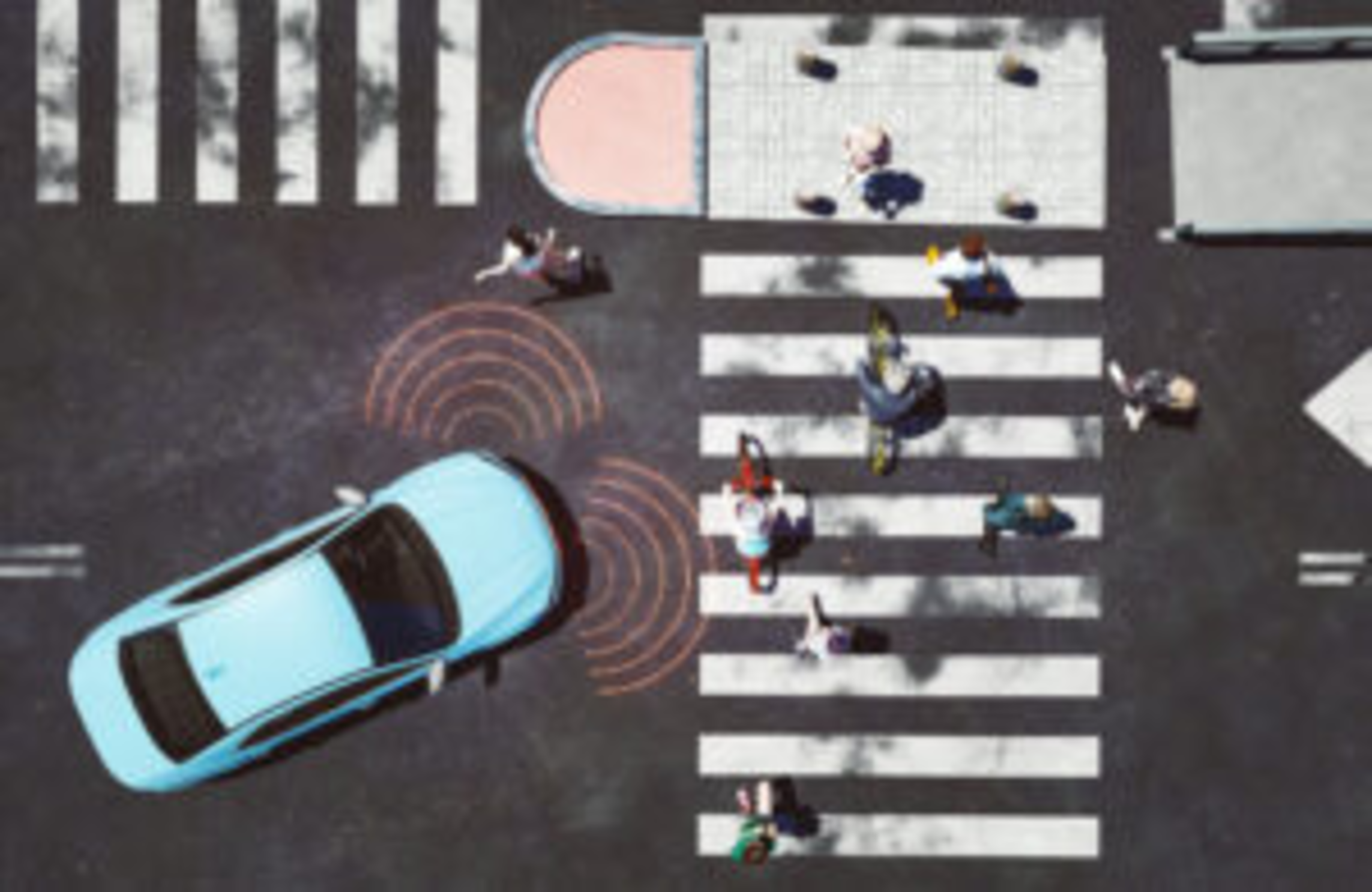
ADAS engineer explains what is needed for autonomous vehicle safety

A diverse mix of sensors is needed for vehicles to truly understand their environment and avoid deadly crashes, Taylor Gage, automotive ADAS engineer at Texas Instruments recently told trade publication Fierce Sensors.
Safety of the Intended Functionality (SOTIF) is needed before engineers can enhance public safety and expand the environments where vehicles with higher levels of autonomy are allowed to function, Gage said.
“Automotive safety has historically been all about preventing technical failures, such as power loss or overheating systems, but autonomy changes everything,” Gage said. “As human intervention in driving decreases, systems can work exactly as designed but still result in unsafe or even deadly conditions. This is because while there might not be any hardware or software faults, the real risk has gone unaddressed: misunderstanding the environment.”
Engineers must focus on sensor limitations, situational ambiguity and operation edge cases to create autonomous vehicles that are safe for everyone, he said.
He described SOTIF as the “real bottleneck” to higher autonomy.
Gage gave an example of how roads under construction can confuse cameras. Old lane markers can overlap lanes and a camera is left to decide on following the clear lane markers or avoid collision with another vehicle.
Earlier this year newly opened “flex lanes” on I-17 in Arizona caused issues for vehicles with advanced driver assistance systems (ADAS), such as lane assist.
Local news reported that extra dashing on the lanes caused systems to incorrectly signal to drivers that they were heading the wrong way or drifting out of the lane.
Gage gave another example of a person on a skateboard traveling at faster than running speed. He said a computer could deduce that the speed is not naturally possible and the radar could discard the person, leading to a collision.
Another scenario is referred to as “high dynamic-range,” he said. This is described as when a very reflective object is near a much less reflective object, such as a person standing next to an 18-wheeler.
“This introduces issues in radar and LiDAR systems, which prioritize high-intensity signal returns and often filter out the significantly less reflective objects entirely,” Gage said. “In situations like these, the safety of vulnerable road users is compromised as the car may drive dangerously close to the pedestrian.”
Another example includes municipalities using illusionary schemes to trick drivers into slowing down, he said. This could include crosswalks painted to look like 3D concrete columns in middle of the road.
“The problem for autonomous vehicles is that this will trick cameras too,” Gage said. “Now as you’re cruising down the road, your camera system suddenly says it sees massive objects blocking the path. Do you slam on the brakes? Do you swerve? Relying on a single sensor to make these decisions can quickly put you in dangerous situations. If you have a variety of sensors, however, you can face virtually any situation with confidence.”
A camera’s strength is object classification, and the strength of radar is object detection, Gage said. The camera could send out a warning about the crosswalk and the radar could determine that there is no object and no drastic action should be taken.
Gage calls this “consensus-based decision making.” He said this solves the problems inherent to the weakness of any one modality.
SOTIF is leading designers to think outside of the box, Gage said.
“Too often, it’s all too easy to zoom in on technical debugging and failure analysis, chasing functional safety (ISO26262) without consideration of the world and its real conditions,” Gage said. “Through the SOTIF design process, engineers and designers will consider the strengths and weaknesses of their individual systems, identifying edge cases where everything is running fine at the sensor level, but the vehicle is approaching or already in a hazardous situation.”
When announcing its Snapdragon Ride Pilot, BMW noted that the system follows SOTIF.
The software stack is developed with multiple layers to give suppliers flexibility, BMW said during its September announcement.
This includes a 360-degree perception using a camera-based vision stack for object detection, surround view, lane recognition, traffic sign interpretation, parking assistance, driving monitoring, and mapping.
“Perception performance is enhanced through low-level perception using bird-eye-view (BEV) architecture and new methods for information extraction from fisheye cameras,” the release says. “The low-level perception between camera and radar is designed to reduce tracking latency, optimize system performance in active safety scenarios, and detect complex urban intersections.”
Porsche addressed SOTIF in a paper last year titled “Mastering complexity: Integrated safety process for modern vehicle systems.”
Market Hudec, Porsche Engineering senior manager of System Safety, writes that SAE Level 3 autonomous vehicles depend more on SOTIF.
“SOTIF comes into play when it is a matter of mastering performance limits for automated driving on the highway,” the paper says. “For example, vehicle detection must be designed in such a way that all other vehicles around or approaching the vehicle, including all motorcycles, are detected.”
Inherent performance limits of the sensors may not correctly detect certain narrow silhouettes and approach trajectories under unfavorable light or weather conditions, the paper says.
“Although the hardware and software are working flawlessly, this could cause the function to initiate a lane change that could result in a collision risk with an overtaking motorcycle,” the paper says. “In this case, the SOTIF processes stipulate that the design must be analyzed and validated across all operating scenarios and that the weaknesses identified are corrected with the next design iteration (specification update followed by implementation update). For example, additional cameras and lidar sensors could be installed in the rear section or the sensor fusion algorithms could be optimized.”
LG also has voiced that future trends in autonomous driving will be centered on the fast-growing areas of SOTIF.
LG previously said SOTIF is “becoming increasingly important as the entire auto industry seeks to incorporate and expand the use of various advanced technologies in their vehicles, including artificial intelligence (AI), high-definition maps, sensor data interfaces, and cybersecurity applications.”
Gage will speak on SOTIF at Sensors Converge 2026 at 2:30 pm May 6. The conference runs May 5-7 at the Santa Clara Convention Center. Registration for the expo and conference online.
Image
Photo courtesy of gremlin/iStock