
Maryland committee hears bill that could fine shops for not meeting state calibration requirements

The Washington Metropolitan Auto Body Association (WMABA) was the lone voice of concern during a Maryland legislative hearing for a bill that would penalize collision shops for calibrations that don’t meet the bill’s requirements and require licensing or training.
The requirements and licensing (or training) programs aren’t fully clear, as there appears to have been a scramble to rework the bill, SB 789, prior to the Judicial Proceedings hearing held Wednesday.
Originally, the bill seemed to require OEM tools and procedures for calibrations but a flurry of amendments that hadn’t been provided to the full committee or interested parties have found the support of insurance, LKQ, and Safelite. The bill was still presented as supporting OEM procedures but the specific wording is unknown.
John Pica, a lobbyist for calibration company Sensi Auto Technologies, said during the hearing that the bill currently requires licensing but that has been changed in amendments. He said the fiscal note was high because of the licensing requirements and the bill will be changed to require training.
He also said language obligating insurance companies has been removed along with the expectations of new vehicle dealerships.
A copy of the amendments were not available during the hearing. It seemed groups like the American Property Casualty Insurance (APICA) and Safelite had copies of the expected amendments as those testifying for the groups said their opinion changed from opposed to supporting the bill because of the amendments.
Pica also mentioned that the bill included amendments made after conversations with Safelite.
Yet, a Senator noted that the committee wasn’t provided copies of the amendments before or during the hearing. It also appeared that not everyone testifying was given a copy of the amendments.
It’s unknown exactly what bill language any of those in the room were testifying on.
However, the original bill, filed by Sen. J.B. Jennings (R-District 7) on Feb. 2, states it would establish requirements for calibration services, including creating standards and licensing requirements for individual businesses that perform calibrations.
The original bill requirements would include controlled environment maintenance that meets or exceeds OEM calibration specifications including maintaining tools and equipment needed to perform calibrations to OEM specifications. Shops would also be required to perform post-repair scans and keep records of all scans and calibrations.
Insurance companies would be banned from denying any calibration recommendations by OEM procedures or position statements or requiring repairs that conflict with these documents, according to the original bill. Yet, if Pica’s comments are accurate this is likely removed from the bill per the amendments that have not been filed.
The bill also includes language about notifying consumers about calibrations and documenting procedures completed.
While the majority of the language obligated repair facilities to meet OEM specifications, the proposal also would have given the state of Maryland, in consultation with the Maryland Insurance Administration, the authority to adopt regulations to implement the subtitle, including:
-
- Standards for ADAS calibration training programs
- Automotive repair facility inspection standards
- Technical standards for calibration equipment
Per testimony, it appears that a penalty portion of the bill remains, which would fine repair shops up to $5,000 per violation of the bill.
“We have reputable body shops that do not perform necessary calibrations because the dashboard light is not on or because they do not want to engage in a fight with insurance companies over the coverage,” Sen. Jennings said during the hearing.
He said if a repair is done improperly the bill calls on the repair facility to be subject to litigation.
“Liability falls on the business that performs the work, not the consumer or the insurance company,” Jennings said. “Senate Bill 789 ensures that when calibrations are performed, they are done correctly, consistently and safely.”
Jennings said the bill is about safety and accountability.
Jordan Hendler, WMABA executive director, said multiple levels of agency would need to be created to oversee the licensing of calibration businesses.
She asked how the licensing would work and how would the state ensure that those who inspect businesses are knowledgeable on calibrations.
We have questions about aftermarket modifications and whether the consumer would have the choice to wave their calibration validation, especially if paying out-of-pocket.
Hendler noted that some of the language in the amended bill implies that the repair is an insurance-driven transaction, rather than a consumer protection issue.
“Unlike other states, this unfairly penalizes the repairers and has unequal accountability of the insurers who consistently pressure shops for the lowest possible reimbursement rate, such as for mobile or parking lot calibrations even when the OEM requires the level floor,” Hendler said.
She added that there are federal efforts to address the repair of ADAS systems in the works. She said it is not necessary for the state to legislate the issue.
The ADAS Functionality and Integrity Act, recently approved by a U.S. House subcommittee, would give the National Highway Traffic Safety Administration (NHTSA) the authority to develop calibration guidelines for advanced driver assistance systems (ADAS).
Maryland’s bill appears to have been lobbied for by Sensi Auto Technologies, a Maryland Company. Pica was joined in testimony by the company’s co-owners, Christi Boyle and Don Reynolds.
Reynolds said that ADAS systems save lives daily, but only when calibrated correctly after repairs.
“Maryland faces a growing safety and consumer protection gap,” Reynolds said. “National data shows 55% to 57% of vehicles require a calibration,” Reynolds said, likely referring to recent data from Revv. “Yet, only 23% receive one.”
He added that 98% of modern windshields require a camera calibration but only 42% are documented
A study from Ascential Technologies found that 42% of calibrations performed by shops were done incorrectly, he said. These vehicles often went back to consumers without dashboard warnings to alert drivers, he said.
“[The bill] elevates the professionals who are already doing this work correctly while creating a level playing field across the entire industry,” Reynolds said. “The federal government mandated these life-saving systems, but it does not regulate how they must be repaired after a crash. That responsibility falls to the states and Maryland has an opportunity to lead here.”
Steve Dawson, Hunter Engineering, also spoke in favor of the bill saying that his company works to make sure that calibrations are completed properly.
Hunter’s Ultimate ADAS has been approved for use by multiple OEMs, such as Toyota, Lexus, Honda, Acura, Nissan, Infiniti and Subaru.
Dawson said improper calibrations can be dangerous. This includes causing vehicles to apply breaks when they are not needed or causing vehicles to not break in ways they are designed to.
Sen. Mike Mckay (R-1) asked if the bill would increase insurance premiums or lengthen the time for repair.
Reynolds said there has been progress on the insurance side with State Farm, GEICO and Allstate releasing calibration programs this summer.
The repair industry has been vocal that calibration costs are dynamic and standardized pricing created by the insurance companies doesn’t encompass the total cost to do a proper repair with OEM tooling, procedures and trained technical labor. For example, industry officials told Repairer Driven News in April they felt pricing pressure from State Farm following its rollout.
Last year, State Farm also sent an email to its National Glass Program requesting they provide a recalibration failure report when requesting the authorization for OEM glass if the installed non-OEM windshield can’t be calibrated. Yet, multiple OEMs procedures include the use of OEM glass for a proper repair, with Volvo and GM releasing statements in recent years.
Reynolds did add that insurance support is not perfect but is improving.
McKay followed by asking if calibrations will put small family owned repair shops out of business.
“I think what we’re seeing is an aging independent body shop community that’s facing very major challenges around labor affordability, health care for their employees, in a world where a lot of people don’t want to go into that work anymore,” Reynolds said. “We’ve seen major consolidation in the body shop world.”
Reynolds said that first and second generation body shop owners face a challenge with the newer technology.
“They’re craftsmen and they’re very good at what they do and then we introduce all levels of technology and those things get missed, and not purposefully they just get missed,” Reynolds said.
Reynolds said there are a lot of players not performing calibrations “anywhere near what OEM recommendations or requirements are.”
He added that calibration companies, like his own, can help certify space or do the calibration if it is sublet to them.
Sen. Chris West (R-42) asked Reynolds about if glass repair shops were following OEM procedures after the passage of a 2023 law that required OEM standards be used when calibrating glass.
Reynolds said there are players in the Maryland market who are not following the law.
“Based on my opinion as a professional in the industry, that the bill didn’t go far enough to change the behaviors of what’s happening out there,” Reynolds said.
He said that is why this bill was expanded to include the entire repair industry and penalties were added to it.
West responded, “All we can do is pass bills and if people don’t pay attention to them, then we have to come back later on and put some teeth into the bills to make sure people do pay attention.”
Sen. Mary-Dulany James (D-34) echoed concerns she said WMABA provided in a written statement
“It looks like the state’s going to jump into this very technical, highly complex area of advanced driver assistance systems, yet, the state itself does not currently have the level of expertise or the depth of knowledge that comes out of this industry,” James said. “So to try to regulate it before they’re really prepared to understand it and fully appreciate it would be challenging.”
Hendler’s written statements notes that modern vehicle technology changes every six months, or less. This includes new sensor arrays, LIDAR systems and camera elements that are introduced with every new model year.
“State regulations are notoriously slow to update,” Hendler writes. “By the time a state agency drafts a regulation regarding a specific calibration “tool” or “environment” (Section 15-1104), that technology may already be obsolete.”
Government oversight would “inevitably” be two to three years behind the OEMs, she says.
Hendler adds that the state would have to hire master technicians at salaries the state likely cannot match.
“If the state cannot provide an expert to oversee the experts, the license becomes a meaningless ‘rubber stamp’ that adds cost to the shop without adding any actual safety verification for the consumer,” Hendler says.
She asks how a Motor Vehicle Administrative Judge could decide if a static calibration was performed correctly on a 2026 electric vehicle, if the judge has never seen the car’s proprietary software?
Jennings responded that the licensing will be taken out of the bill, with a focus on training. However, he didn’t provide details on what that process would be. Pica noted that it could be similar to a process used by the security guard industry.
Bryson Popham, lobbying for Safelite, said the bill is intended to address problems with certain facilities not giving adequate consumer notice disclosures when a vehicle is in need of a calibration.
He added that he hoped amendments of the bill will remove objections made by other groups previously.
Safelite spent $30,000 lobbying Maryland issues according to disclosures filed with the state for the last lobbying cycle from May to October 2025.
Nancy Eagen, American Property Casualty Insurance Association, (APCIA) said the organization was signed up to speak against the bill but said it would support the bill with the proposed amendments.
APCIA spent $69,000 in lobbying during the last disclosure cycle in the state.
LKQ, AAA Auto Alliance and the International Advanced Vehicle Technology Education and Credentialing Coalition all gave statements in support of the bill.
LKQ spent $59,000 and the AAA Auto Alliance spent $17,900 lobbying in Maryland, according to documents from the last disclosure cycle.
Disclosure documents did not show any lobbying money spent by Sensi Auto Technologies, Hunter Engineering, WMABA, or the International Advanced Vehicle Technology Education during the last lobby cycle.
Image
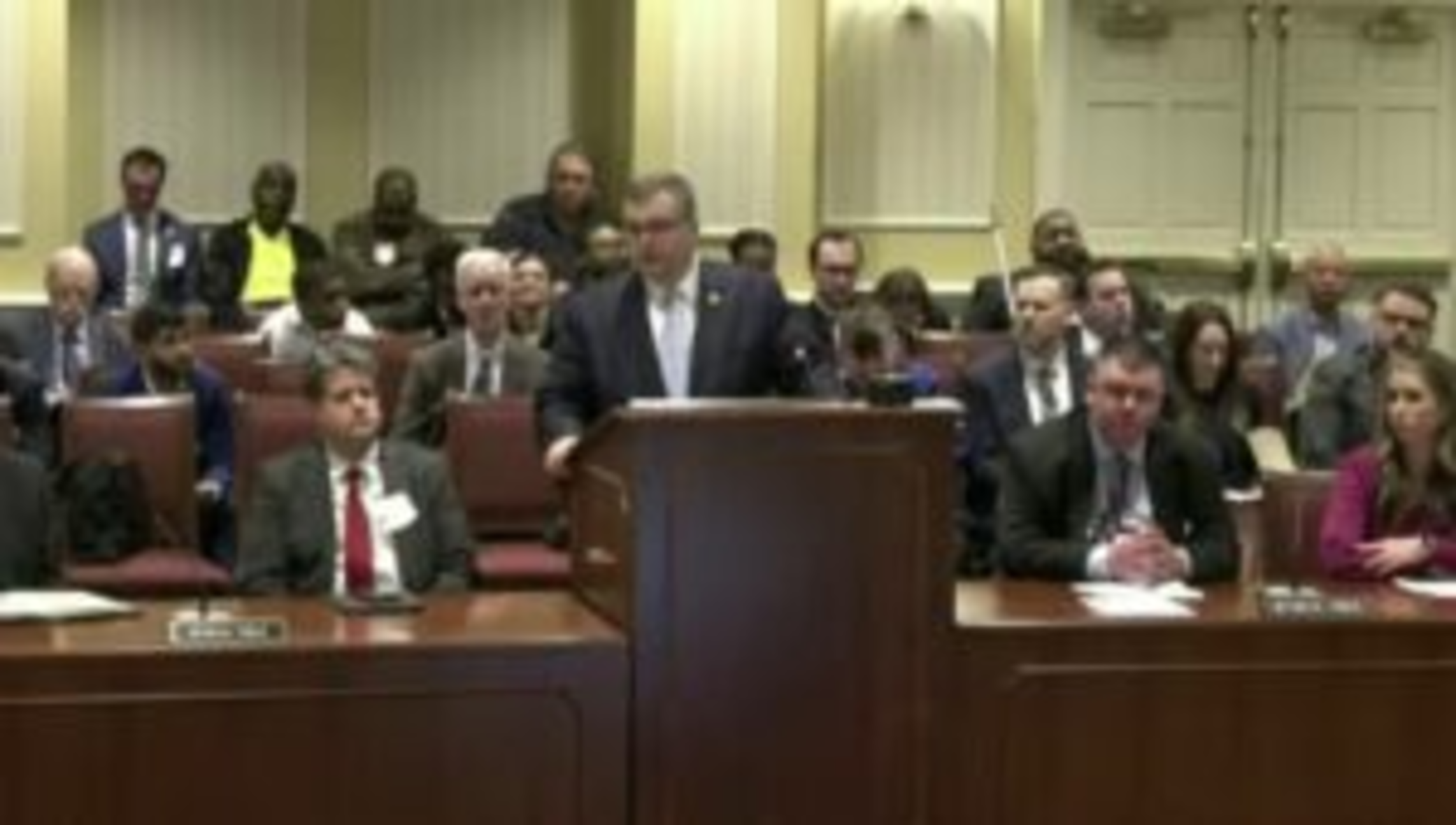
Photo of Sen. J.B. Jennings (R-District 7) speaking during Maryland Senate Judicial Procedures Committee/Youtube screenshot.