
Steering columns: Law mandates they collapse, OEMs require inspections

The U.S. government mandates that vehicles have energy-absorbing steering columns, said Mike Anderson, owner of Collision Advice, during the Society of Collision Repair Specialists (SCRS) OEM Collision Repair Technology Summit Session I at the 2025 SEMA Show in Las Vegas.
He said that because of this, OEMs are required to use collapsible steering columns, which protect passengers’ chests and sternums.
Automakers also use the design to deploy airbags, he said.
“Understand, the government mandated this because it saved lives,” Anderson said. “Most, not all, but most OEM manufacturers are going to state in the electronic service manuals or their repair procedures that you need to inspect steering columns after the vehicle has been in a collision.”
Data from a recent “Who Pays for What?” survey shows that about 41% of shops are reimbursed for inspecting or measuring steering columns.
“What’s more concerning to me is not the reimbursement piece, but the fact that 30% to 40% of people have never asked,” Anderson said. “If they’ve never asked, it leads me to believe that they’re probably not doing it.”

While most OEMs require a safety inspection, each manufacturer’s requirements differ.
Some manufacturers, such as Volvo, use a sight glass, he said. Repairers can look up through the glass and see if there is a yellow or orange mark.
“If you see the mark, you know it’s collapsed,” Anderson said. “But other OEMs don’t have a sight glass like that, and they require you to take and remove the steering columns and inspect them.”
He said an extensive safety inspection is most common with domestic and Asian manufacturers.
Anderson said NSK is a predominant global producer of steering columns. The company uses two resin pins on the inside of the steering column. He said in the event of impact, the forces shear the resin pins, causing the steering column to collapse.
“There’s no way you can visually see if they’re sheared because they’re internal,” Anderson said.
He provided multiple OEM procedures that require steering column inspections, including ones from Subaru, Chevy, Nissan, Lexus, Stellantis, and BMW.
BMW typically requires the complete replacement of the steering gear assembly if there has been a strong impact, Anderson said.
“BMW has a very clear statement that says that if the steering box replacement work, which is required for safety reasons, is refused by the customer and insurance company for cost reasons, a memorandum to that effect must be drawn up and countersigned by the party bearing the cost of the accident repair,” Anderson said. “If the carrier doesn’t want to pay for it, or the customer refuses to pay for it, then the shop has to have the consumer sign this document.”
Andrew Batenhorst, Pacific BMW Collision Center body shop manager, said he has the disclaimer printed and ready to go in his office.
“That’s how often I see it,” Batenhorst said. “Technically, if you look at it closely, there is a place for the insurance adjuster to sign. I give that to them every time. I have yet to have an adjuster agree to sign that document.”
He agreed with Anderson that it is a major friction point in the industry. He said that it can be difficult to get third-party payers to understand that it is a required operation.
“This is the number one most challenging thing that I face,” Batenhorst said. “I’ve replaced hundreds of steering racks at this point in my career, after all the BMWs I have fixed.”
Gerry Rosenbarker, Mohawk Collision team general manager, said his shop deasls with some difficult carriers.
“They look at them as diagnostics because they’re inspections,” Rosenbarker said. “Our argument is they’re actually part of the repair procedure. You can’t repair this vehicle properly and correctly and safely without following all of these inspections.”
Both Batenhorst and Rosenbarker said the best way to address the pushback from third-party payers is to educate consumers.
“Have those conversations with your customer upfront, explaining what these safety components are,” Rosenbarker said.
The constant conflict led Batenhorst to create a display prop of a steering gear. He said the gear came from a 2020 BMW X7 that didn’t have a core charge, so he was able to keep it.

He uses the gear in his showroom to educate customers and adjusters on why the steering gear needs to be replaced.
“There are two different electric motors that are belt-driven inside the casing, and they have very precisely machined teeth on the gears,” Batenhorst said. “These steering gears are not designed to take a shock load laterally without that, then chipping the teeth off.”
The motors won’t operate correctly once the teeth have been chipped off, he said.
“The problem is that none of that is visible from the outside,” Batenhorst said.
Batenhorst said that many people are visual learners, and the display prop can help teach the need for repair in a way that others can understand more easily.
Rosenbarker said he also provides adjusters and customers with a visual of the work. He said there typically are enough vehicles disassembled in the shop for adjusters to view the steering gear that way.
“We’ve always got steering columns on the benches,” Rosenbarker said. “We’re doing the measurements. A lot of the same things apply to different manufacturers.”
Tyler Foote, a collision technician for Mohawk Collision, said about 10% to 20% of steering column safety inspections find that the columns need to be replaced.
“If it’s a substantial hit, you can almost guarantee there’s probably going to be a problem with the column,” Rosenbarker said.
He said likely 1 out of 4 inspected should be replaced.
Those driving the vehicle wouldn’t know that a steering column needed to be replaced until it didn’t function in the next accident, he said.
Batenhorst said a collapsed steering column causes other issues outside of safety, such as incorrect alignment.
Images
Embedded photo of Andrew Batenhorst, Pacific BMW Collision Center body shop manager, showing audience members his steering column prop. (RDN)
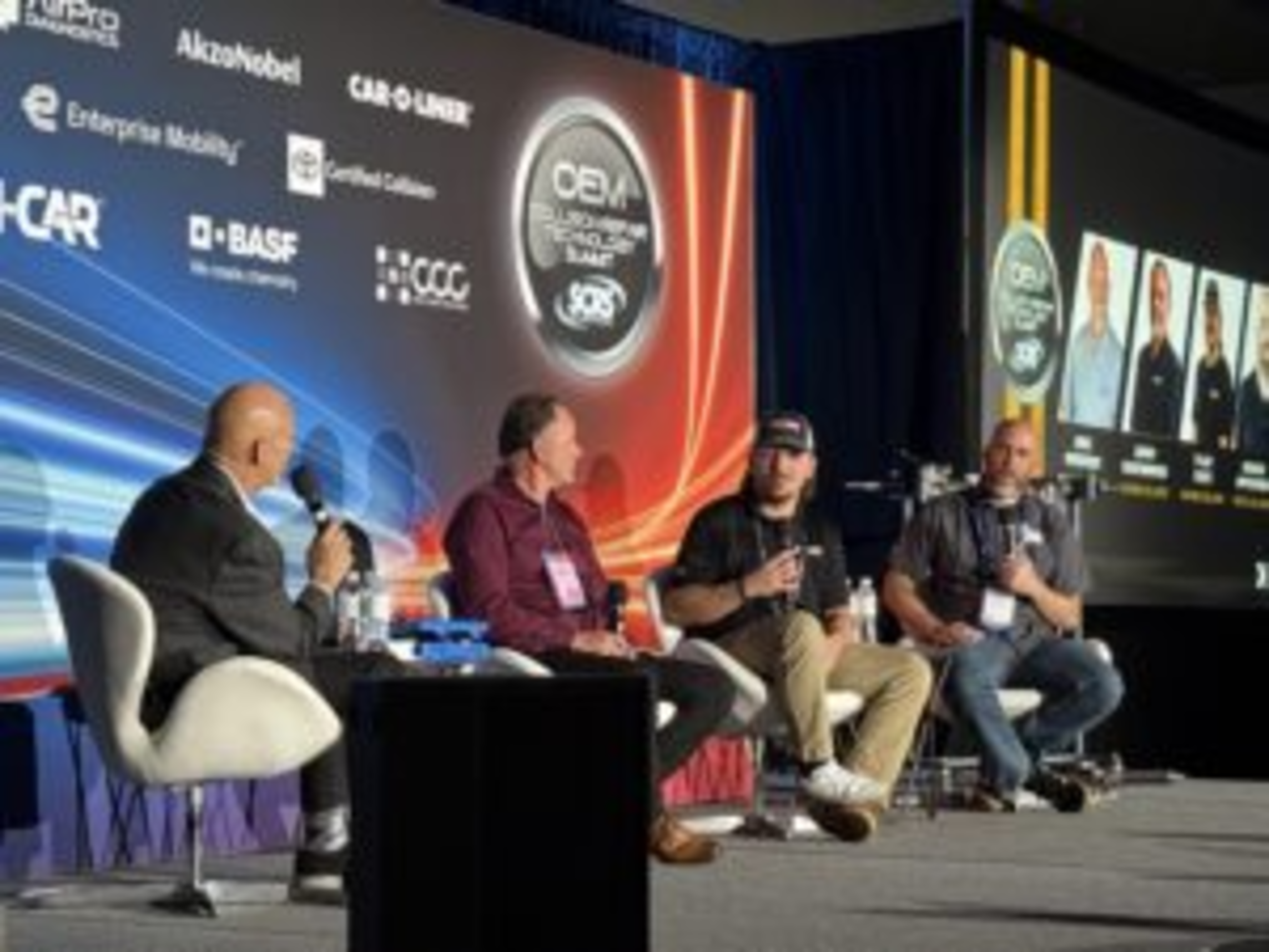
Feature image of Mike Anderson, Collision Advice owner, Gerry Rosenbarker, Mohawk Collision team general manager, Tyler Foote, a collision technician for Mohawk Collision, and Batenhorst during OEM Summitt I at the 2025 SEMA Show in Las Vegas (RDN)