
Airbags: OEMs call for removal and inspection; Are insurers paying?

Most, if not all, OEM manufacturers state that an airbag needs to be removed and inspected following a collision, said Mike Anderson, owner of Collision Advice, during the Society of Collision Repair Specialists (SCRS) OEM Collision Repair Technology Summit Session II at the 2025 SEMA Show in Las Vegas.
He said that in a recent “Who Pays for What?” survey, about 49% of shops say they are getting reimbursed for airbag inspections most of the time. However, he said that there is a 10% decline in insurance companies refusing to pay for the operation.

During the presentation, Anderson reviewed multiple OEM procedures, including those from Ford, Subaru, Toyota, and Lexus. While not mentioned, GM reworked its inspection documents in recent years.
Anderson said that shops won’t find something wrong every time they do an inspection.
“I think one of the reasons shops don’t find more is because shops are not doing it,” he said.
Tyler Smith, owner of Rick’s Paint and Body, told the audience a story about how he found airbags partially separated on the backside after performing a safety inspection on a Lexus.
He said the procedures for the vehicle required removal of the airbag, along with airbag sensors and mounting, for inspections after a collision.
The airbags were separating and bulging, with stitching coming loose, and the brackets were bent, Smith said.
There were no warning lights or diagnostic codes that indicated the airbags were not working, he said. The safety inspection is what determined the deformities.
Gerry Rosenbarker, Mohawk Collision team general manager, added that it’s not uncommon for airbags to have issues without warning lights or DTCs.
Smith said he held a first responder event to deploy the four airbags; however, only one of the four airbags deployed.
“Had he never done that, and that consumer had been in that vehicle when it was in an accident, what could have happened? You fill in the blanks,” Anderson said.
Anderson said safety inspections must be completed, whether paid for by the consumer or the insurance company.
“When that consumer comes and signs your authorization form, they’re signing this piece of paper that says, ‘I trust you to fix my vehicle safely and properly,’” Anderson said. “But you also need to understand if they have a third-party payer refuse to pay you for this, and you don’t do it, that does not remove you from the liability.”
Smith said that he was recently dropped by an insurer that accounted for 27% of his business because he refused to stop doing safety inspections.
He said the insurer removed them after a year-long conversation, which included his shop providing documentation about the need for the procedures.
Following the presentation at SEMA, Repairer Driven News was notified of a repair facility that was suspended from a direct repair program in November for documenting the denial of safety inspections and asking the consumer to sign it.

The insurance company had already informed the consumer that they were denying these expenses. After the vehicle was delivered, the repair facility was advised that they were suspended for 30 days, pending review for potential removal from the program due to the disclaimer.
On Smith’s Lexus, it took about six months to get that insurance company to provide reimbursement for the airbag. This didn’t include labor or one-time-use parts, he said.
Anderson said one-time-use parts are often lost in the conversation about safety inspections. He said there’s an OEM that says if a door is replaced, the airbag sensor must be replaced.
“Well, this one manufacturer sold approximately 13,000 of those doors,” Anderson said. “This year, they’ve sold less than 78 airbag sensors.”
Rosenbarker said almost all manufacturers require some sort of inspection on airbags, and when you disassemble an airbag and remove it, it is common for there to be one-time-use components.
Once the airbag is out, Rosenbarker said he is looking for any damage on the backside, burn marks, and anything out of the ordinary, such as deformations.
“If you have that mechanical ability, you kind of know what I mean by that,” Rosenbarker said. “You’re looking for anything that may be partially deployed.”
Anderson responded that when it comes to the airbag inspection process, it isn’t often clear what constitutes a good or bad airbag. He added that OEMs providing photos in their procedures could be helpful.
Tyler Foote, a collision technician for Mohawk Collision, and Rosenbarker, said the mechanical hours to complete the inspections could take between eight and 12 hours, depending on the vehicle.
Rosenbarker said he involves customers in the conversation about the inspection and costs early in the repair process.
“We give them the information,” Rosenbarker said. “I have no problem printing out actual procedures, highlighting things, letting the customer read it for themselves.”
Most customers have purchased the vehicle with safety in mind, he said.
Smith said he also educates customers upfront. He said customers have expressed considerable concern about the costs due to increased premiums they’ve been paying in recent years.
“They feel that that’s their insurance company’s responsibility,” Smith said. “We help coach them, tell them to reach out to the insurance company. We’ll do it on a three-way call. We’ll get them involved at that point in time, depending on the carrier. Sometimes we have good luck with that.”
The panelists agreed that nearly 15% of the vehicles they inspect, which have no airbag deployment, have issues with their airbags.
Image
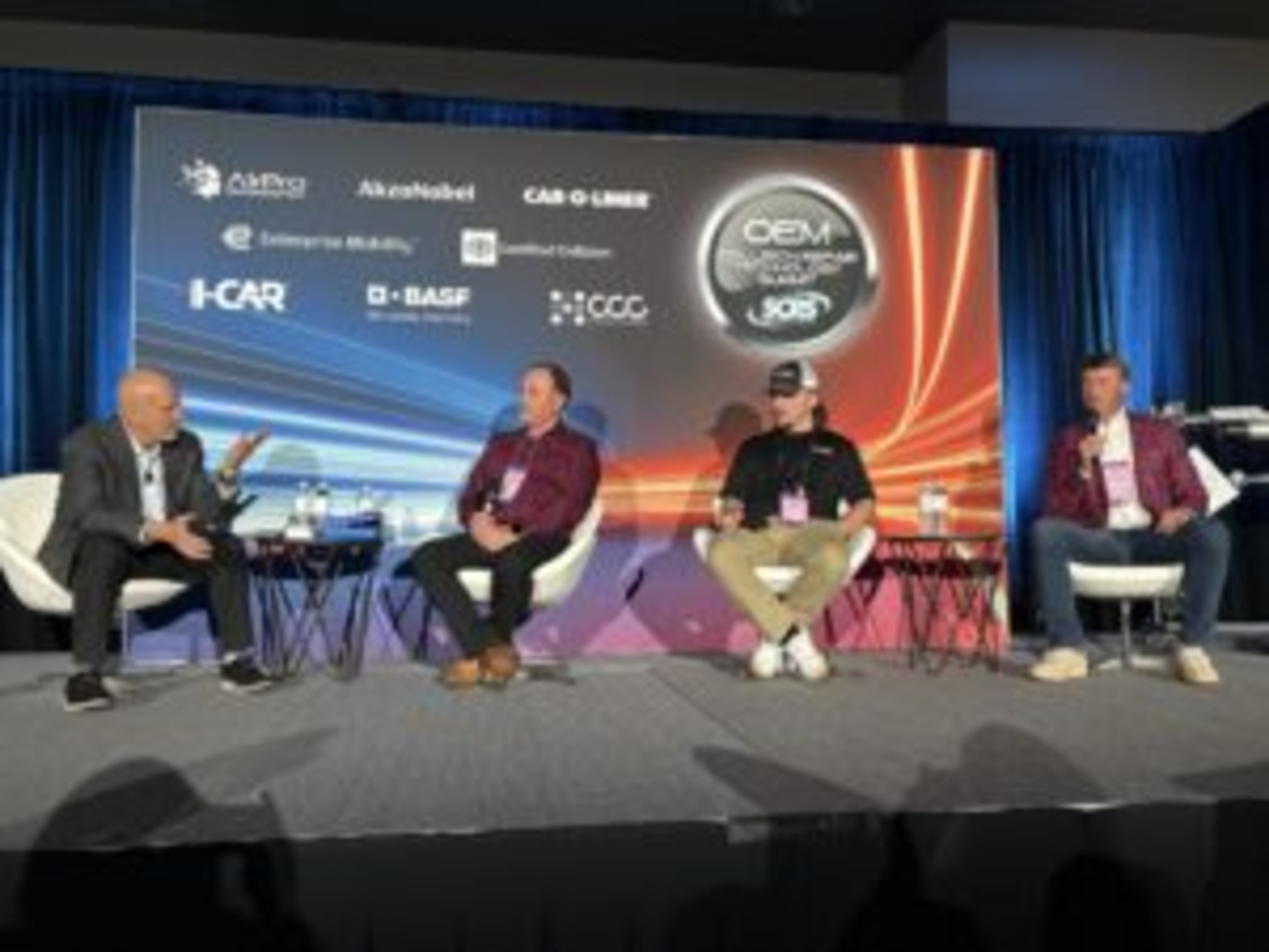
The panel of speakers at the Society of Collision Repair Specialists (SCRS) OEM Collision Repair Technology Summit Session II at the 2025 SEMA Show in Las Vegas. From left to right: Mike Anderson, Collision Advice owner, Gerry Rosenbarker, Mohawk Collision team general manager, Tyler Foote, a collision technician for Mohawk Collision, and Tyler Smith, owner of Rick’s Paint and Body. (Teresa Moss/RDN)