
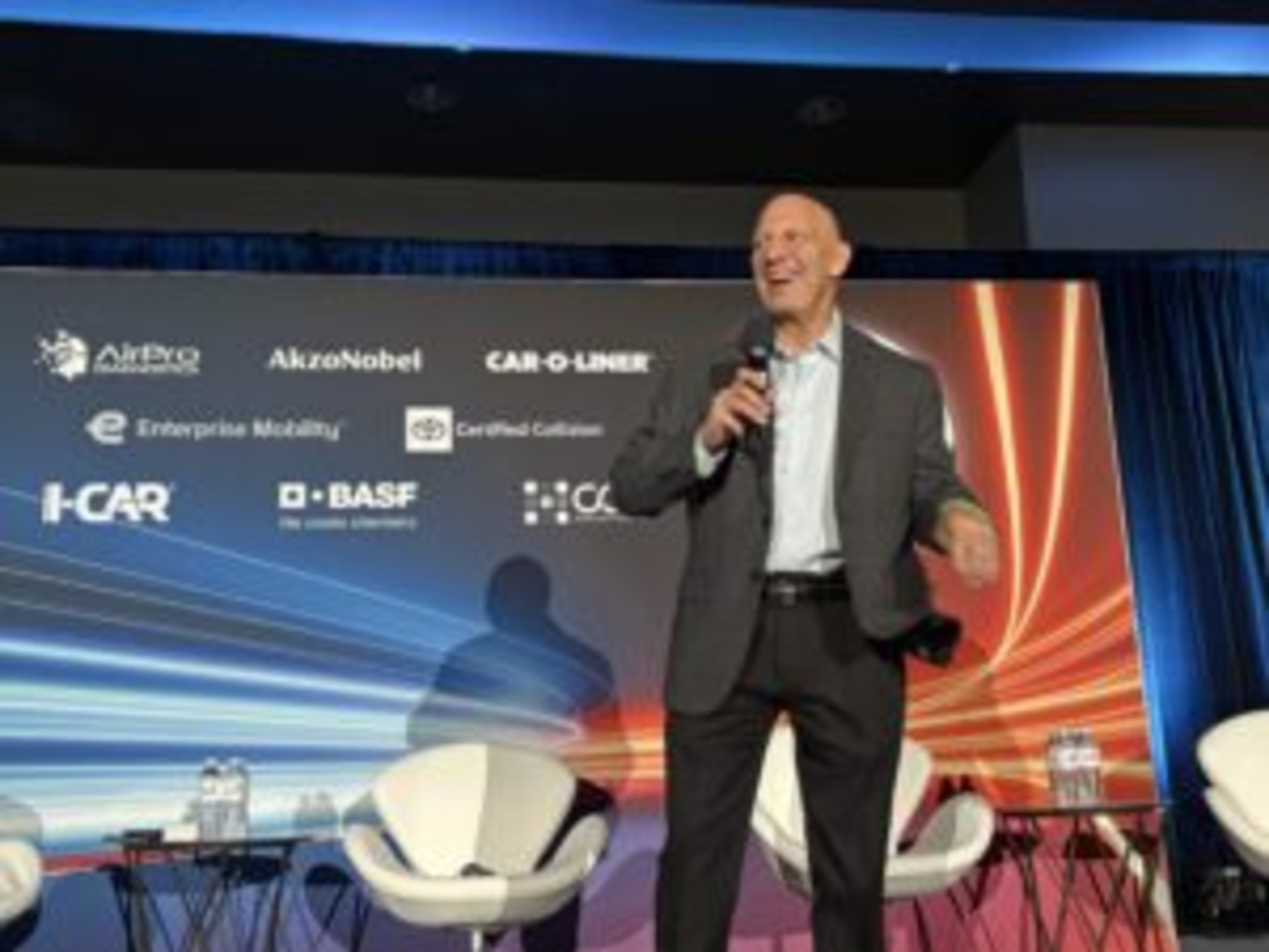
SEMA panels discuss complexity of safety inspections and where to find help

Mike Anderson, owner of Collision Advice, recently delved into the world of safety inspections and why they are the No. 1 issue that keeps him up at night.
“It is the single biggest friction point in our industry,” Anderson said during the Society of Collision Repair Specialists (SCRS) OEM Collision Repair Technology Summit at the 2025 SEMA Show in Las Vegas.
Data collected by Collision Advice shows that mechanical labor hours average about 1.6 to 1.8 hours per state, Anderson said. He said the data is collected from direct repair program (DRP) and non-DRP shops, unlike most data that focuses solely on DRP shops.
“I can tell you, as an industry, we’re not performing safe and proper repairs,” Anderson said about his observation of the data.
Mechanical labor hours encompass a wide range of procedures, including but not limited to scans, calibrations, battery connect and disconnect, alignments, and safety inspections, he said.
Anderson said when he writes an estimate with everything that automakers specify to perform a safe and proper repair, he sees an average of about six or eight mechanical labor hours per estimate.
Repair shops must review OEM procedures or owners’ manuals to see how each vehicle should be inspected. Anderson said this could also require special tooling such as force gauges, dial indicators, torque wrenches, and angle measurements.
Learning the proper procedures is not an easy chore, panelists relayed during three different panel discussions.
Tyler Foote, a collision technician for Mohawk Collision, said the business he works for has dedicated researchers to look up safety inspections.
Gerry Rosenbarker, Mohawk Collision team general manager, added that inspection procedures for a GM vehicle could be between 300 and 400 pages, if printed off.
“It makes quite an impression with an adjuster when he walks in your shop, and you hand him an encyclopedia,” Rosenbarker said.
The panelists agreed that there’s no training on how to perform safety inspections.
Foote said he learned how to do inspections by taking procedures home and reading them.
Rosenbarker said it takes someone with a strong mechanical ability to comprehend how each OEM provides information.
“Sometimes it’s three, four technicians all getting together and all reading it,” Rosenbarker said. “And everybody’s kind of looking it over, and then sometimes it’s reaching out to someone like yourself [Anderson].
Andrew Batenhorst, Pacific BMW Collision Center body shop manager, added that others in his market call him from time to time to ask questions about the procedures for safety inspections. He said there would be value in BMW offering a class on safety procedures.
“It is a growing concern that I relay back to BMW every opportunity that I get,” Batenhorst said.
Dealership service departments, which insurance companies often call to verify the need for procedures, are significantly lacking in education on the inspections, panelists said. Rosenbarker and Batenhorst estimated that 1% are knowledgeable or equipped to complete inspections.
During a SEMA Collision and Refinish Stage panel discussion held by SCRS to recap the OEM Summit sessions, Justin Lewis, president of Accurate Auto Body, said he’s personally driven to dealerships to sit down and show them the OEM technical pages about safety inspections.
However, Rosenbarker said it’s not just service departments.
He said during a recent OEM certification inspection, the inspector came in and took photos of three or four vehicles from which steering columns had been removed.
“He said, ‘This is the first shop out of 130 shops that I’ve been through that are all certified, that I’ve actually physically seen columns out of the cars,’” Rosenbarker said.
Rosenbarker said there’s a lot of gray area for interpretation when reading safety inspections.
Anderson said that he recently launched an eLearning Module for Nissan/Infiniti service advisors for this reason. The education tool teaches mechanics in the service departments about safety inspections on the steering columns. He said he’s also working on a similar project with another Asian manufacturer that he didn’t name.
I-CAR also offers multiple services focused on safety inspections through its Reparability Technical Support (RTS) portal on its website, Anderson said.
The “Ask I-CAR” option through the portal provides repairers the ability to ask questions about procedures and get answers quickly, he said.
“If you were to read an OEM repair procedure that required the airbags to be inspected and you weren’t sure if the severity of the accident on the vehicle that you were working on was enough to warrant this, you could submit that question to I-CAR,” Anderson said. “I-CAR will get involved to help you reach out to the OEM and get that answer.”
Bud Center, I-CAR director of technical products and curriculum, said during the recap SEMA Stage discussion that the cycle time for I-CAR to provide answers to questions is under two hours.
“They are really fast at getting back to you with what you need,” Center said.
I-CAR is working on vehicle-specific training for safety inspections in 2026, Center said while on an OEM Summit panel. He said this could include short videos that focus on specific issues.
The portal also offers an “SRS Inspection Feedback” option, Anderson said. He said any shop receiving pushback from an insurance carrier on performing an inspection could submit the case to I-CAR.
“I-CAR can start to build a case file on this, and they could possibly get involved with the carrier to see if they can assist you with getting paid for the right thing,” Anderson said.
The site was launched five years ago and has fewer than 96 inquiries, Anderson said.
Center said the site was launched after conversations with OEMs to prove that more education was needed.
Despite the low response, he said I-CAR continues to have conversations with OEMs. I-CAR will be holding a virtual summit on safety inspections with repairers and insurance companies on Dec. 4, he said.
“The idea is to get with the insurers and collision repairers and to understand the friction point from each side, each perspective, and then be able to take this back to the OEMs to continue that conversation,” Center said.
He said the portal will show you information on safety inspections and the items that need to be replaced, depending on the type of collision or damage.
I-CAR is in conversation with some OEMs about creating training on scanning tools that assist with identifying safety inspections. He said that because of the copyright data, I-CAR can’t access their tools and use them for training without permission.
A majority of the audience raised their hands when asked if they would send their teams to an OEM training on scan tools.
Center spoke to the importance of safety inspections during the SEMA Stage recap panel, saying, “Every time I think that these are a little intrusive or doing too much, we will see where someone had a minor impact, and then they find a damaged reinforcement bar behind the instrument panel.”
Rosenbarker said it is time for a “real” conversation about safety inspections between the OEMs and insurance providers.
“We’ve talked about this for years,” Rosenbarker said. “They all have connections with each other. If everybody is serious about protecting our mutual customers, we all have to get on the same page.”
He said the industry has been discussing this issue for years.
“I’m not a fan of doing all these, but if the company that’s engineering/designing these vehicles and crash testing, is saying, ‘OK, this has to be done,’ well, then the payer, whether it’s the customer [or] the insurer, really needs to be on board,” Rosenbarker said.
Shops also need to be educated, Rosenbarker said.
“It comes down to a moral thing,” Rosenbarker said. “Where are we going as an industry? Because if we’re not doing this, to me, it says, ‘Well, we really don’t care. We’re just worried about getting cars in and out, calling it a day, and moving on.’”
During the SEMA Stage recap, Danny Gredinberg, DEG administrator, asked panelists how a shop culture is created that focuses on safety inspections.
Batenhorst said it needs to be co-developed with the repair team and a system of accountability created.
“It is not something you can slow roll into and do it eventually,” Center responded. “There is the liability, the exposure that you have on every vehicle you repair when you are not doing these inspections. We all know at least one person who is a former multi-shop owner who is no longer in this business because of one of these post-collision safety inspections that was not performed.”
Batenhorst said there also has to be a culture created within the industry.
“Of course we are going to be the black sheep if there are only 5% or 3% of the shops in a given market actually asking for it, doing it, documenting it, and providing it,” Batenhorst said.
Center said shops often think inspections are too invasive, and they don’t think they’ll find an issue often enough.
“A shop owner in the audience, he heard me present on this not too long ago,” Center said. “It caught his attention and then [he] went back and started doing inspections on vehicles and found something almost immediately.”
Lewis said OEMs could help shops by making the procedures for safety inspections easier to understand.
Batenhorst added that some sort of standardization between OEMs would be helpful, similar to how all high-voltage cables are orange.
Anderson closed the OEM Summit by saying that not doing safety inspections is not an option.
“Using the carriers’ lack of reimbursement is not a valid reason for not performing the procedures,” Anderson said. “If you, as a collision repairer, think they’re too invasive, communicate through I-CAR.”
I-CAR should have 1,000, 2,000, or 5,000 inquiries so that the industry can have a conversation, Anderson said.
Anderson said repairers should reach out to somebody in the industry for help if they don’t know how to do something.
“The biggest reason the carriers don’t pay for it is because the dealership service department says you don’t need to do it, or a certified shop does not do it right,” Anderson said. “I think it means for the OEMs, if you want us to do it, then hold people accountable for not.”
The three OEM Summit sessions held during SEMA focused on steering column, airbag, and seatbelt inspections.
Image