
Repairers are navigating a minefield of information when calibrating vehicles

Repair businesses are facing an information minefield when calibrating vehicles following a collision, said Danny Gredinberg, DEG administrator, during a Collision Industry Conference (CIC) meeting in Las Vegas earlier this month.
“The reality is we’re getting lost out there when it comes down to researching these procedures; digesting and understanding what it takes to perform a calibration,” Gredinberg said. “Whether you do that work in-house or if you sublet that out, it doesn’t matter.”
When polled, 72% of the CIC crowd said estimators or repair planners are researching ADAS requirements. Another 17% said an AI scanning diagnostic tool is doing that work, 6% said a human is using a diagnostic tool, 6% said they don’t research, and 3% said a technician is performing the research.
Human researchers must use time management, Gredinberg said.
“Do we have the time in our day to research the number of ADAS systems that each car has?” Gredinberg said. “Do we have the time in our day to step away from that customer or that insurance company that we’re working with?”
He added that humans also need continuous training, a clear understanding of procedures, and how to navigate a decision tree.
Figuring out the correct keywords for each automaker can also be daunting, he said. For example, the word “calibrate” might not work when searching some systems.
“You may have to think about some other keywords that you’re going to use, or use that decision tree to get to know where that information lies within that system,” he said.
James Rodis, OEM Calibration process, procedure, and training manager, said staff at his company are trained on only a few brands, with the training spread throughout.
“We cover a lot of brands, so we want guys that are experts in certain brands instead of saying, ‘Hey, you’re going to do a Kia now and then you’re going to do an Audi later,'” Rodis said. “That’s not the best way.”
Rodis said typically, training focuses on certain manufacturer groups, such as American manufacturers, because the companies tend to follow the same logic.
Researchers have to know the right keywords for each brand, he said.
Ashley Kovick, owner of Capital Collision Center, said staffing is difficult in her market, so using tools helps save time.
“Ultimately, we have to check that data against what the OEM says to make sure there isn’t something missed,” Kovick said. “That tool might not be updated yet, so you always have to reference back to the OEM to make sure that you’re not missing something.”
Jesse Parks, collision director at Freeman Collision, said his company has 21 OEM certifications and is working on its 22nd. Training on OEMs is split similarly to Rodis’s shop because varying language, navigation trees, and systems among automakers make it too burdensome for a researcher to know each one.
Time is given for researchers to verify the information.
“I’ve seen in other organizations, sometimes their schedules are so tight that people don’t really have the time to do the research,” Parks said.
Third-party software is used for brands that the business doesn’t fix often, he said. However, he said it is only used as a preliminary assessment. The OEM procedures are looked up in the next phase.
“In my opinion, there’s really no substitute for the OEM, and we find so many discrepancies between any third-party,” Parks said.
Gredinberg said the advantage of automated research is that it can create standardization, making keyword searches easier. However, there is room for error, sometimes a false sense of confidence, and the origin of the information can be unknown.
“If you work on a broad range of parts, like Jesse’s shop over there, a blind spot monitor may be called something else to another company, like lane keep assist or lane change assist,” Gredinberg said.
He said one of the biggest struggles for researchers is understanding what each manufacturer calls a piece of technology.
Parks said administrative duties are increasing in the repair space, and automation can help with those tasks.
“It’s almost impossible not to keep up with some of the technology,” Parks said.
However, he said there is missing information or information that hasn’t been updated. He provided an example of a tool that didn’t list a process for ride height identification.
Another example is when calibrations are listed that an update later removed, he said.
Rodis said his business once found that an ADAS tool was eight months behind on updating a Honda statement that required fewer calibrations.
Gredinberg said he believes OEM information is the source or the “Bible” for how to fix a vehicle the right way.
“A lot of the third-party companies out there provide that OEM level of information, but it comes down to how often it is updated,” Gredinberg said. “To James’ point, it may be eight months behind, or maybe it is a few days behind. Procedures can change overnight.”
Parks collected data on three different aftermarket tools for the panel.
The first case study ran reports on the 2022 Ford Bronco. It found that two of the three companies captured everything that the manufacturer required.
“This is just to show you that this is not just an opinion; that it is actually happening,” Gredinberg said regarding missed calibrations. “We have to start thinking about what we’re researching with.”
A second case study ran reports on the 2025 Chevrolet Trax with two aftermarket tools and found that seven calibrations were missed that the OEM required.
Gredinberg noted that the missed calibrations could have been identified in a general section by the companies, but they were not clearly identified in the scrub.
He said anyone using these tools still needs to verify the information with OEM procedures every time. He added that shops also need documentation to prove that it was verified and the right repair was completed.
Kovick said her company has an in-house server that keeps all of its repair research. She said each customer has a file, and the research for their vehicle is saved there.
“If there was an update, we can show this is what we had access to on this day, and be able to have that to work to fall back on,” Kovick said.
Parks said some third-party providers are promising to save that data, but that could be risky if you end up in court.
“It’s very difficult to prove that we did it if we don’t have anything that we saved at the time,” Parks said. “I personally don’t want to be in [that] position.”
He added that he prints all his documents.
Gredinberg said shops also have to consider whether calibration work will be completed in-house or subletted.
The decision comes with a question about the return on investment of purchasing equipment and creating a space with the right lighting and level floor, he said.
Kovick said her business doesn’t have the space to do it in-house and must depend on sublets.
Parks said it is understandable that some businesses can’t perform calibrations in-house, but they still must verify that calibration is completed correctly.
“In my state, and I’m sure it’s the same in most states, if I choose to sublet out a process to another organization, I’m still responsible for what they did,” Parks said. “My commitment is to my customer. It’s my job to make the car safe. If they do me wrong, it is still on me.”
Rodis said his company works to provide all of the documentation needed to prove that a calibration was completed correctly.
“We’re going to supply somewhere around 30 to 40 pieces of documentation, whether it’s photos, whether it’s ‘Hey, here’s what the manufacturer says needs [to be] completed,’” Rodis said.
Every photo is reviewed to verify that the process was completed correctly, he said. He added that shops should also be checking the documentation to ensure it meets all requirements.
Kovick said her shop reviews all documentation, including photos and scan reports, and then the vehicle is driven by whoever is running the vehicle scans.
Rodis reiterated that documentation and scans can show that everything was completed correctly, but vehicles still require test drives.
“It’s not 2 minutes. It’s not 5 minutes. It’s an extended drive,” Rodis said. “And we’re going to make sure that everything acts the way that it should before we release it.”
Parks added that shops must also find out the technology vehicles are equipped with before test drives.
Image
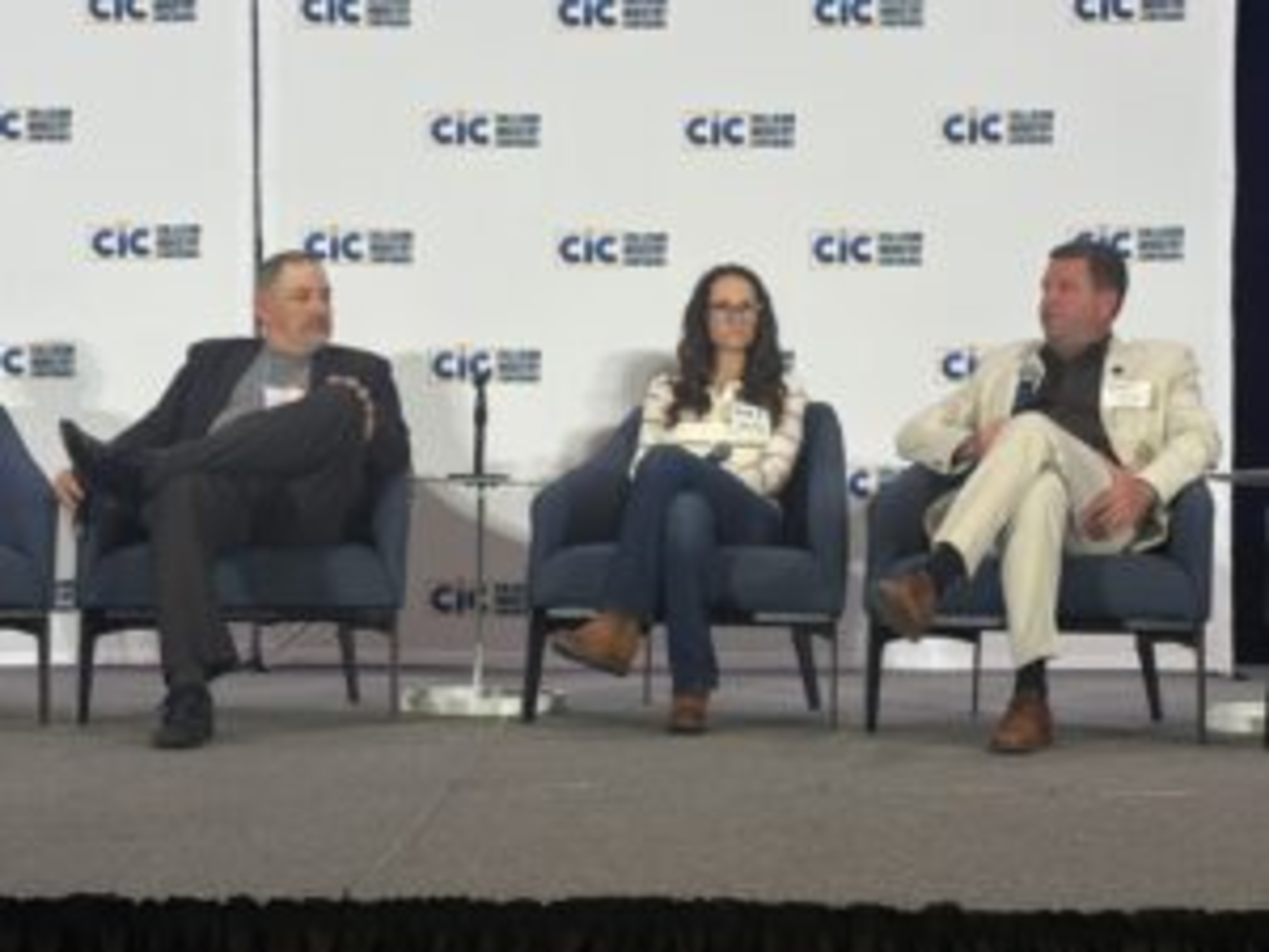
Jesse Parks, Freeman Collision; Ashley Kovick, Capital Collision Center; and James Rodis, OEM Calibration, discuss ADAS research during a CIC meeting at the 2025 SEMA Show. (Teresa Moss/Repairer Driven News).