
Washington collision industry asks for stronger steering regulations in rule change

The Washington Office of the Insurance Commissioner (OIC) released its second pre-publication draft for rule changes in claims handling, and collision professionals have voiced concerns that some of the language could promote steering.
Justin Lewis, president of the Washington Independent Collision Repair Association (WICRA), sent comments to the OIC about language in the rule that requires insurers to use a “competent” vehicle repair person if preparing an estimate.
“Competent” is defined in the rule as “the person has the subject matter expertise, relevant training, and experience to make valuations and decisions relating to the repair process.”
“While the definition of competent is a big step toward accountability, the language creates a serious risk of misuse,” Lewis said. “Specifically, insurers may designate their contracted Direct Repair Program (DRP) facilities as their competent vehicle repair person. DRP facilities operate under contractual obligations with insurers to contain or reduce repair costs in exchange for referral volume. These agreements restrict the scope of recoverable repair operations, parts, and procedures — including those directly tied to structural integrity and passenger safety.”
Written comments from Jeff Butler, a licensed public adjuster and appraisal umpire, also noted that the rule requires insurers to provide claimants with a list of repair facilities that will complete the vehicle repairs for the estimated cost of the insurer’s prepared estimate. It also advises insurers that they may be responsible for any additional amount above the insurer’s estimate.
Butler went on to write that, “While seemingly neutral, these provisions institutionalize insurers steering claimants to their own DRP shops by:
-
- “Creating the illusion of consumer choice
- “Using DRPs as a de facto monopoly
- “Discouraging consumers from independent shops through intimidating advertisements.”
It is also common practice that supplements result in a final claims settlement, above insurance-written estimates. Nothing in the rule ensures that the shops listed as willing to complete the repairs for the prepared estimate amount, won’t end up charging more at the completion of the repair.
Micah Strom, Northwest Auto Care Alliance (NWACA) collision chair, wrote comments that aligned with Lewis and Butler.
“Many consumers are unaware of their right to choose their own repair facility,” Strom wrote. “They place their trust in their insurer, believing the insurance company has their best interests in mind. Unfortunately, that trust is frequently exploited. Time after time, our NWACA members experience consumers arriving at the shop of their choice to have their vehicle repaired, then they submit it to the insurance. At that point, they experience claim processing delays, sometimes for weeks; misinformation about shop warranties, repair practices, or out-of-pocket costs. They are then pressured to have their vehicle repaired at one of the insurance ‘preferred’ or DRP shops that they did not choose.”
Lewis explains in his letter that his shop was previously in multiple DRPs with major insurance companies.
“The [DRP] area managers made their message clear: follow their pricing models, not the manufacturer’s guidelines, or risk being removed from the program,” Lewis says in his comments.
As a DRP, Lewis says his shop was told to ignore OEM guidance in favor of shortcuts that reduce costs but increase risk. Yet, his shop was 100% liable for the shortcuts.
“We ultimately walked away from the DRP model because we refused to compromise our standards,” Lewis says in his comments. “Once we did, insurers began steering work away from us — not due to lack of skill, but because we wouldn’t follow their cost-driven playbook.”
DRP shops are not free to act as competent professionals because they are contractually bound to insurer interests, Lewis says.
Washington Administrative Code (WAC) lacks anti-steering protections, and the rule could unintentionally enable insurers to steer consumers toward their contracted DRP facilities, Lewis writes.
“This concern is not theoretical — our member shops report frequent instances of consumers being pressured by their insurers to transfer their vehicles, even after they have already selected a repair facility of their choice,” he says.
Butler also says in his comments that he has witnessed attempts to steer so that insurance companies can set and control auto repair market pricing.
He attached an example of steering made by Allstate via email to a claimant in June. The email instructs the consumer to check their repair facility to make arrangements for potential out-of-pocket expenses, such as labor or material rates that differ from the amount Allstate is authorized to pay.
Lewis asks for a modernized WAC that requires insurers to honor the claimant’s choice of repair facility. The rule should also require insurers to provide a statement to consumers informing them they have the right to choose. He adds that the rule should keep insurers from limiting the payment if the claimant selects a non-preferred facility.
Butler points to the historical context of the issue, including the 1963 case United States v. Association of Casualty & Surety Companies. The 1963 consent decree came from the case, which prohibits insurers from channeling business to select shops, he writes.
The Decree was an agreement between the insurance industry and the US government to forever refrain from practices that were established as anti-competitive means of steering, price fixing and depressing and controlling automobile material damage repair costs.
Lewis also requests that the WAC be modernized, noting anti-steering laws in California, Minnesota, Rhode Island, North Carolina, and Oregon as examples.
As a neighboring state to Washington, Oregon’s code 746.280 states that insurers cannot require repairs at a specific facility and may not limit the cost of repairs necessary to return the vehicle to pre-loss condition.
Lewis asks that the OIC revise the language of its rule to clarify that a competent vehicle repair person must be independent of insurer cost control agreements and must adhere to OEM repair procedures and recognized training standards, such as I-CAR Platinum, across all roles.
“By making these changes, the OIC can ensure this rule enhances accuracy and accountability without inadvertently empowering steering practices that harm consumers, stifle competition, and compromise repair safety,” Lewis writes.
Strom’s letter supports Lewis and Butler in their request for changes to the rule’s language.
“Vague provisions are not enough — insurers will always find a way around them or blatantly ignore them,” Strom writes. “Washington must adopt strong, enforceable rules that explicitly prohibit insurers from directing, influencing, or misleading consumers in any way regarding their choice of repair facility.”
Images
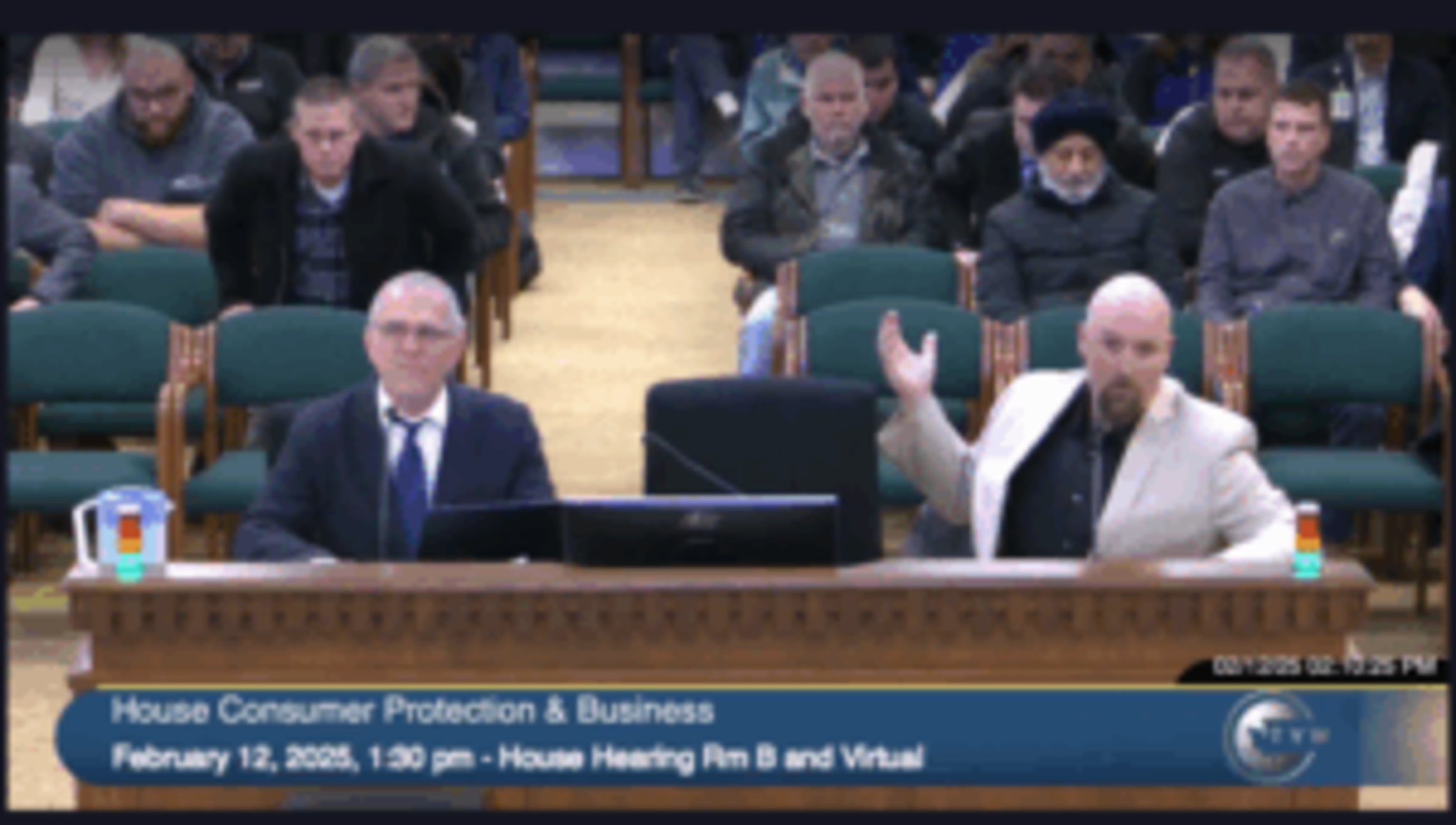
Featured photo: Jeff Butler, a public and independent adjuster who owns Collision Consulting of Washington, and Justin Lewis, president of the Washington Independent Collision Repair Association (WICRA), testify during the Washington House Committee on Consumer Protection and Business public hearing Feb. 12, 2025.