
Nissan testing inter-car communication with ProPILOT Assist to reduce traffic congestion

Nissan is testing a solution to traffic jams, making commutes safer and more efficient, with ProPILOT Assist-equipped vehicles that use inter-car communication.
Through a partnership with Contra Costa Transportation Authority (CCTA) and the University of California, Berkeley, a team at Nissan’s Advanced Technology Center – Silicon Valley (NATC-SV) is working to help reduce congestion.
Called Cooperative Congestion Management (CCM), the program is designed to smooth traffic by optimally coordinating vehicle speeds, according to a press release from Nissan.
Computer simulations established the concept, indicating travel times could be reduced by 18% and fuel economy could improve by up to 42%.
“Our goal is to eliminate the waste of stop-and-go traffic,” said Zvi Guter, who is leading the project, in the release.
In typical traffic patterns, drivers often follow too closely, the release says. This prevents them from seeing slowing traffic ahead, leading to hard braking when approaching the slower traffic and “stop-and-go waves.”
“Stop-and-go traffic is often due to the imperfection of human driving behavior,” Guter said.
The CCM trial uses data from one “probe” vehicle to help others keep an appropriate distance and speed. The “probe” vehicle supplies congestion data to vehicles trailing 30 to 60 seconds behind it. In response, the vehicles gently adjust their speeds in advance of the traffic jam, creating a smooth buffer for trailing cars, the release says.
CCM relies on ProPILOT Assist, Nissan’s semi-autonomous driver assistance technology, which is available on most U.S. models. 
During 600 miles of testing on Interstate 680 in the San Francisco Bay Area, vehicles with CCM software logged 85% fewer hard-braking incidents and 70% less time stopped in traffic. It also reduced the incidence of vehicles following too closely, risking rear-end collisions.
Backed by an Automated Driving Systems grant from the U.S. Department of Transportation, CCTA oversaw project design, coordination, and data collection to evaluate how Nissan’s technologies can improve traffic flow, enhance safety, and reduce congestion on one of Contra Costa County’s most congested corridors.
“Our testing indicates CCM doesn’t just make commuting more comfortable and efficient, but safer, too,” Guter said.
The team says ProPILOT Assist has been critical to the project’s success, thanks to its sophisticated array of cameras and radar sensors.

“One of the biggest challenges was demonstrating the effectiveness of the system in traffic with just a handful of controlled vehicles,” said Jerry Chou, a senior researcher at Nissan’s Silicon Valley office, in the release. “The success of the trial, even with a small number of controlled vehicles, demonstrates how the system can begin to influence collective traffic behavior and provides a glimpse of potential future benefits.”
Another substantial challenge was adjusting for human behavior. For example, when one of the test vehicles begins gently slowing down ahead of a traffic jam, its driver might try to override the system and “fill the gap” between it and upcoming traffic.
“In order to make this more acceptable to the human driver, we’re trying to enhance the vehicle interface to let the driver know why we’re slowing down,” said Joy Carpio, a researcher at Nissan’s Silicon Valley office, in the release.
The team noted that educating people about CCM and helping them understand how it can help them save time and money is critical.
“It requires cooperation. If drivers don’t accept the solution, it will be difficult to implement,” Carpio said.
“The hope is that by using more common technology like 4G LTE to communicate, CCM can easily scale up to accommodate more users,” Guter said.
For the next phase of the project, the team will research how the average driver interacts with the system.
“We want our system to seamlessly account for human behavior,” Carpio said.
Guter added, “It doesn’t just have the potential to make Nissan drivers safer and more comfortable – it has a positive impact on the transportation system as a whole… The hope is that by using more common technology like 4G LTE to communicate, CCM can easily scale up to accommodate more users.”
Images
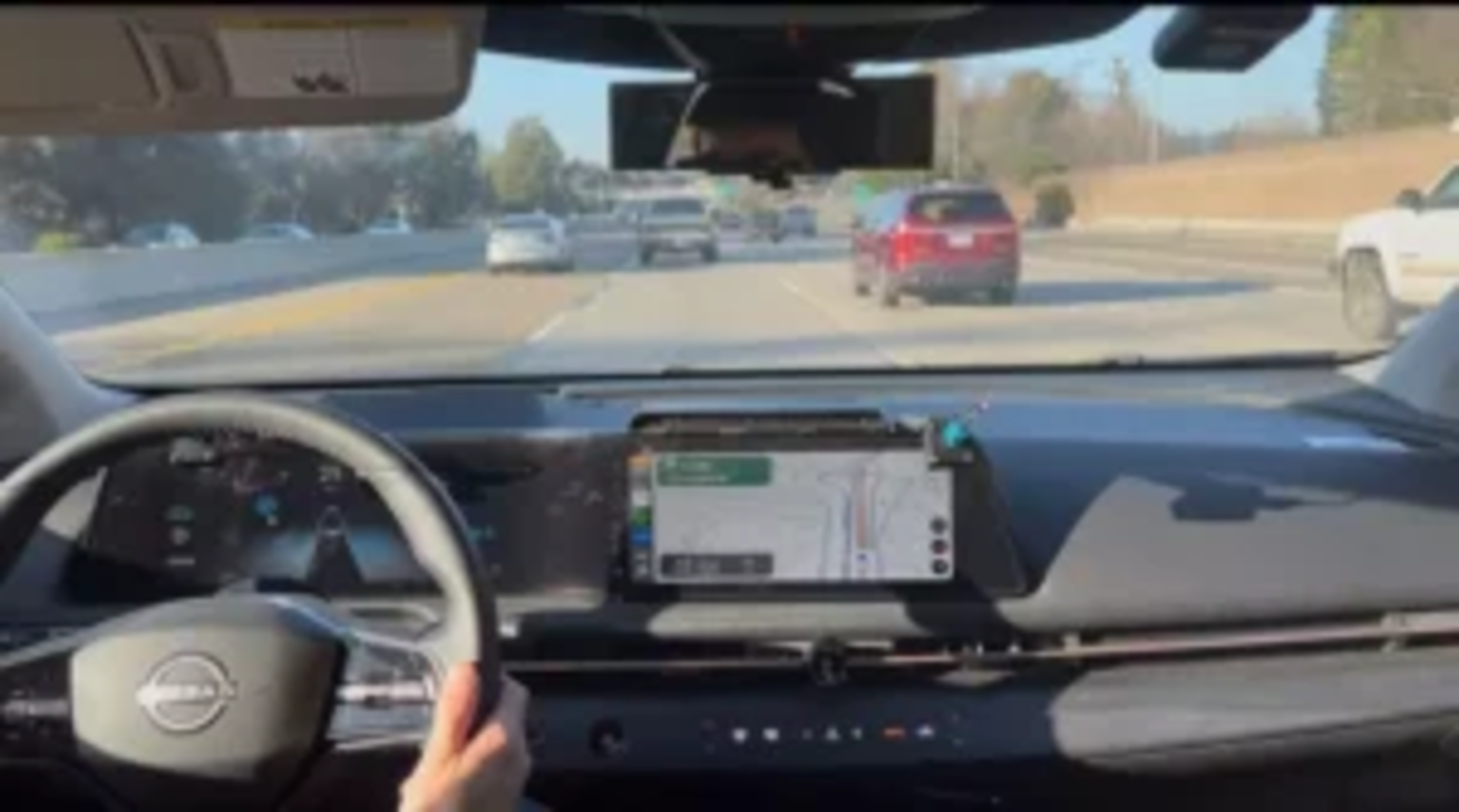
Featured image: A view from inside a CCM-equipped Nissan Ariya during testing on I-680 in the San Francisco Bay Area.
Data from a “probe” vehicle allows following vehicles to adjust their speed, smoothing traffic by reducing inefficient stop-and-go patterns.
Real-world testing showed Cooperative Congestion Management reduced hard-braking events by 85%.
All images/graphics provided by Nissan