
Four companies announce strides in AI development, including a humanoid robot and smart city infrastructure

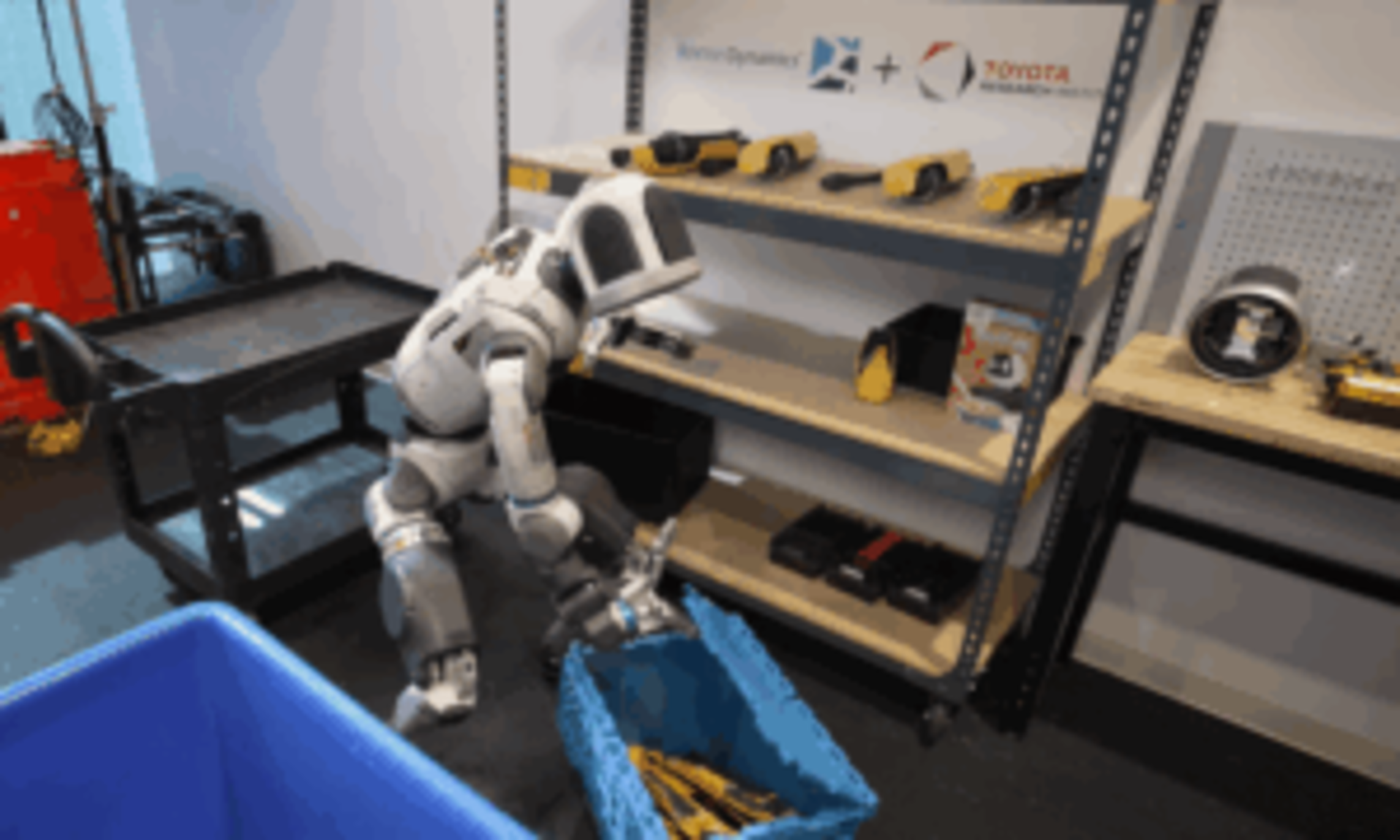
Boston Dynamics and Toyota Research Institute (TRI) say they’ve made a significant step forward in robotics and artificial intelligence research by demonstrating a Large Behavior Model (LBM) that powers the Atlas humanoid robot.
Also in the field of AI development, AEye has announced a strategic partnership with Blue-Band to accelerate smart city infrastructure.
Atlas can now perform a long, continuous sequence of complex tasks that require combining object manipulation with locomotion. By adopting LBMs, new capabilities that previously would have been laboriously hand-programmed can now be added quickly and without writing a single new line of code, according to a joint press release from the companies.
The humanoid uses whole-body movements, including walking, crouching, and lifting, to accomplish a series of packing, sorting, and organizing tasks.
Throughout the sequences, researchers interject unexpected physical challenges mid-task, such as closing the lid of a box and sliding it across the floor, requiring Atlas to self-adjust in response. Humanoids that have demonstrated this capability before typically separate the low-level walking and balancing control from the control of the arms for manipulation. However, in this project, a single LBM has direct control of the entire robot, treating the hands and the feet almost identically.
“This breakthrough is the result of the October 2024 joint research partnership between Boston Dynamics and TRI, which was designed to leverage their combined strengths and expertise to accelerate the development of smart robots,” the release says. “The result reaffirms the incredible potential of AI technologies in developing general-purpose humanoid assistants.”
Scott Kuindersma, Boston Dynamics robotics research vice president, adds, “This work provides a glimpse into how we’re thinking about building general-purpose robots that will transform how we live and work. Training a single neural network to perform many long-horizon manipulation tasks will lead to better generalization, and highly capable robots like Atlas present the fewest barriers to data collection for tasks requiring whole-body precision, dexterity, and strength.”
The goal of the project is to find answers to fundamental questions about humanoid robots and LBMs to advance the field’s understanding of large models for whole-body control, including advanced manipulation and dynamic behaviors.
“One of the main value propositions of humanoids is that they can achieve a huge variety of tasks directly in existing environments, but the previous approaches to programming these tasks simply could not scale to meet this challenge,” said Russ Tedrake, TRI senior vice president of LBMs, in the release. “Large Behavior Models address this opportunity in a fundamentally new way – skills are added quickly via demonstrations from humans, and as the LBMs get stronger, they require less and less demonstrations to achieve more and more robust behaviors.”
AEye plans to integrate its Apollo lidar technology with Blue-Band’s Integrator-AI platform to deploy fully integrated, next-generation traffic infrastructure capable of detecting objects up to 1 kilometer away and bringing together sensing, computing, advanced 3D perception, and AI to deliver real-time insights.
The partnership builds on AEye’s July 2025 launch of OPTIS — an autonomous system that delivers high-resolution 3D perception and real-time responsiveness, according to an AEye press release.
“OPTIS was built to turn perception into action,” said Matt Fisch, CEO of AEye, in the release. “By integrating Blue-Band’s AI platform, we’re extending OPTIS’ capability to interface directly with traffic control systems, providing real-time analytics to enable lifesaving and congestion-reducing actions at traffic intersections.”
Kevin Yorke, CEO of Blue-Band, added, “Partnering with AEye brings the power of long-range lidar to our platform, enhancing our ability to provide intelligent, scalable solutions for traffic management and urban mobility.”
The companies plan to initially focus on traffic monitoring, incident detection, and infrastructure intelligence and, in the future, accelerate the shift toward safer, smarter, and more adaptive cities.
Repairers can also learn more about AI during a Repairer Driven Education (RDE) session, hosted by the Society of Collision Repair Specialists (SCRS) during this year’s SEMA Show in November.
On Nov. 4 from 2:30-4 p.m., BodyShop Booster’s Ryan Taylor will provide a firsthand demonstration of AI during “AI Robots are coming: Humanoid meet and greet.”
The session description states that during the interactive and hands-on class, attendees will see how AI can be leveraged in a body shop setting to streamline operations, enhance precision, and potentially change the guest experience with humanoid robots from international markets.
“AI is advancing at an unprecedented pace, transforming industries, interactions, and revolutionizing the way we work,” the description states. “This year marks a significant milestone, as agent-based AI technologies have reached a level of sophistication where tasks that once required immense human labor and resources can now be completed in a fraction of the time — often in mere minutes — and with greater efficiency.”
Early bird specials on RDE registration are offered here through Sept. 26.
Images
Featured image of Atlas provided by Toyota