
GM using CT scanning to improve quality

GM uses CT scanning to detect porosity and prevent air bubbles or pockets in castings, according to a new press release.
“This technology allows GM to make faster, smarter manufacturing decisions, improve product quality, and reduce waste,” the release says.
General Motors’ Bedford Casting Plant in Indiana has been using CT scans, similar to the type doctors use to identify medical conditions, to detect defects in castings since 2019.
Both sand and die casting technology is used by GM to make a variety of automotive parts, the release says. The Bedford team uses high-pressure die casting (HPDC), a process where liquid metal is rapidly poured and injected into dies made of steel to create metal parts.
“The metal cavity fills in milliseconds with a total cycle time of about 60 to 90 seconds for most parts,” the release says. “The casting is removed from the die and machined to its final specifications to ensure the part meets specified dimensions.”
Bedford pours more than half a million pounds of molten aluminum daily to make cylinder blocks, transmission cases, structural components and EV drive unit housings for Chevrolet, Cadillac, GMC and Buick vehicles, the release says.
GM uses CT scanning and digital machining to ensure quality and consistency before shipping the castings to other GM facilities to create complete propulsion components.
Corey Beechboard, Bedford’s senior process engineer, discovered that utilizing CT scanning and digital machining could reduce instances of defects and increase part quality, the release says.

“Using this technology allows us to react faster and make smarter choices,” Beechboard says. “Another benefit is we aren’t wasting castings, so we can elevate our confidence level in the parts we produce.”
Beechboard started at GM last year and now leads the charge in implementing CT scanning and digital machining at Bedford, the release says.
“With my experience in analyzing data, I’m confident that when I find a defect, it will actually be there and ensure results are accurate,” Beechboard says.
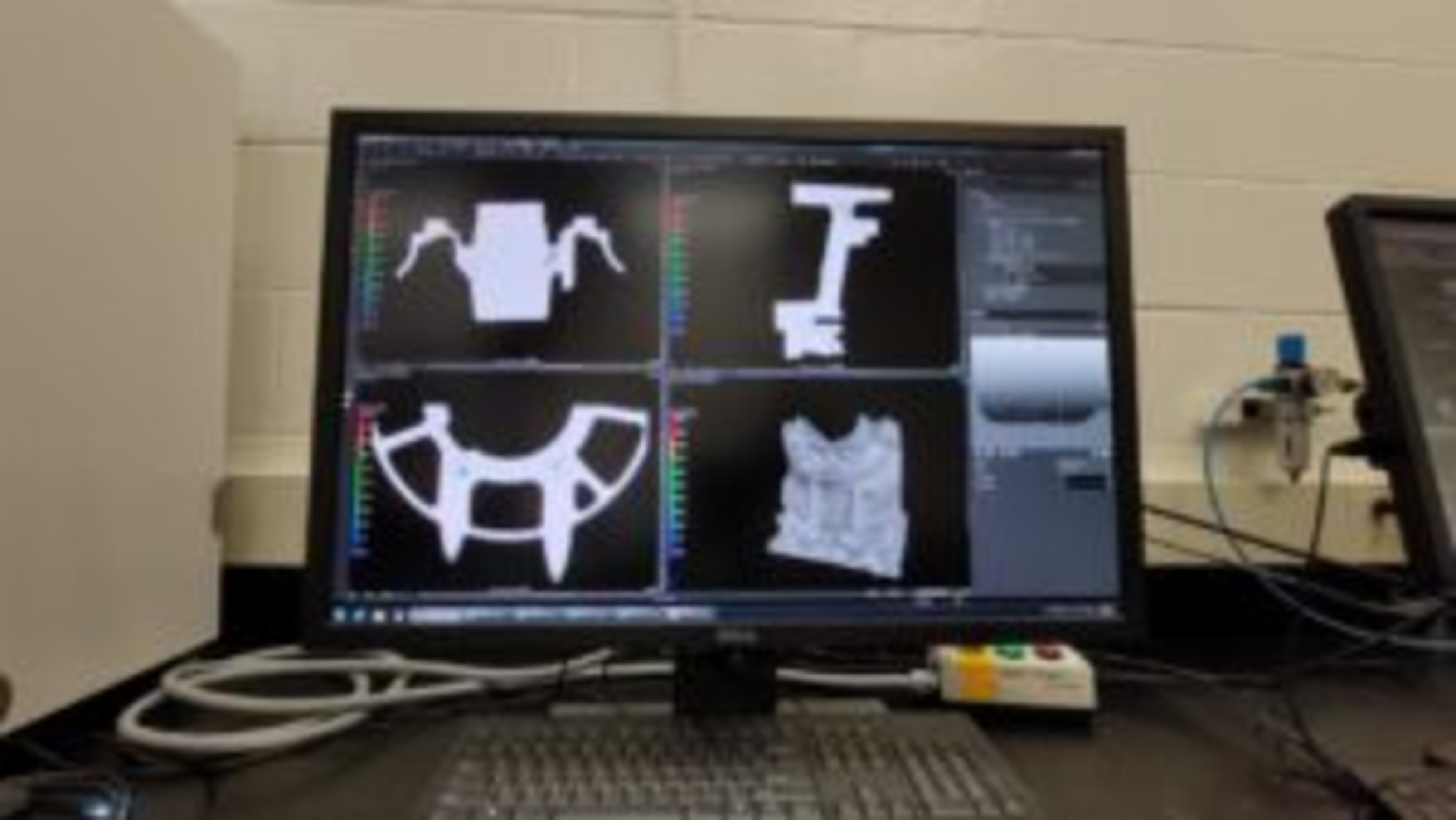
The CT scanner creates a 3D image of the castings that are then used to create digital images for analysis, the release says. It also provides a multi-layer look inside a component, as opposed to an X-ray, which is only a single layer.
“It sounds odd, but humans are less ‘dense’ than the metal parts we scan at GM,” says Alan Weaver, GM engineering group manager of measurement systems. “The scanners we use are even more powerful and detailed.”
The scanning allows Bedford to perform quality checks 50% to 70% faster, the release says. It is currently operating the CT scanner up to 18 hours per day, scanning parts for themselves and other casting facilities in GM.
CT scanning is also being used in other areas of business, such as EV battery diagnostics at battery labs across the GM Global Tech Center in Michigan and fuel cell scanning at the Pontiac Engineering Center. Expansion of the tech is currently planned in coming months.
“Right now, we’re making the highest quality castings we’ve ever produced,” says Carl Holmberg, engineering manager at Bedford. “We’ve had other sites send us components and say, ‘hey, can you guys scan this for us?’ So now we’re trying to help the rest of the company with this new technology.”
Mercedes-Benz performed the first vehicle manufacturer X-ray of a crash test last year.
The X-ray device can capture 1,000 razor-sharp images per second and views details about injury and damage that have previously been unseen, a release says.
“In the milliseconds of the actual impact time, the X-ray system shoots around 100 still images,” the release says. “Combined into a video, they provide highly exciting insights into what happens inside safety-relevant components and in the dummy’s body during a crash. In this way, it is possible to observe in detail how the thorax of the dummy is pressed in or how a component is deformed.”
In partnership with Fraunhofer-Society, Mercedes used the X-ray camera to record a left-side impact on a vehicle carrying a female dummy at Ernst Mach Institute.
IMAGE
Feature image courtesy of GM. Inside photo of Corey Beechboard, Bedford’s senior process engineer, courtesy of GM.