
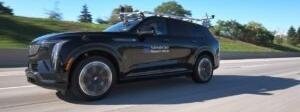
GM plans ‘eyes-off’ driving for most popular selling SUVs, trucks

GM plans to extend “eyes-off” autonomous highway driving beyond its EV lineup to its gas-powered vehicles, including full-size SUVs and light-duty pickups, in upcoming years, according to a press release.
“The promise of personal autonomy is giving people their time back,” the release states. “By pairing our centralized compute architecture with rigorous real-world validation, GM is moving from an initial limited debut to widespread availability across our most popular trucks and SUVs, making trusted autonomy available to everyday drivers.”
The automaker announced last year that it would launch “eyes-off” autonomous highway driving on its Cadillac ESCALADE IQ in 2028. It plans to expand the technology to its highest-volume and best-selling vehicle lineups following the Cadillac ESCALADE IQ.

“Our vision is to build vehicles that can drive themselves or their occupants anywhere they need to be,” the release states. “This includes a future where your vehicle can handle mundane tasks for you, like heading out into bumper-to-bumper traffic to pick up groceries or dry cleaning, giving you valuable time back.”
Reuters reports that, currently, GM’s Super Cruise and Tesla’s Full Self-Driving (Supervised) control steering and speed in certain settings. It adds the systems can sometimes be hands-free but require the driver to remain attentive.
Only a few automakers have introduced eyes-off systems, including Mercedes-Benz. However, service typically is limited to small geographic areas at low speeds, according to the article.
GM points to its new central compute architecture that decouples software from physical hardware as one advancement that helps it push autonomy forward.

“It’s designed to provide a common computing, network, software, and interface foundation across a broad portfolio while allowing each vehicle to retain the hardware and controls required for its specific purpose,” the release adds.
A liquid-cooled central compute unit (CCU) is another advancement.
GM says it has 40 times more compute capability, which can support AI and autonomy. It adds that the computing hub consolidates autonomy, active safety, chassis, and propulsion software onto a single, high-speed core.
Regional zonal hubs also replace complex wiring harnesses by aggregating sensors and actuators into an “ultra-fast data backbone,” according to the release. The hubs are connected by high-speed ethernet, which supports 36 times more data than previous systems, it adds.
The technology can also be innovated continuously, the release states. It adds that improvements validated on one model can be deployed across the portfolio via frequent over-the-air updates.
“By integrating the full autonomous driving stack — from newly developed ultra-high-resolution, ultra-low-cost radar to frontier machine learning architectures — our autonomy platform can scale efficiently across popular retail lineups,” the release states.
GM says it is using data collected from 1.2 billion hands-free miles driven by Super Cruise customers. The company’s engineering teams are combining real-world data collection with frontier AI and machine learning tools, the release states.
“We’ve built a continuously compounding flywheel, including data from retail vehicles where customers have opted in, to operating hundreds of data collection vehicles collecting 1 million miles per month of full-rate, multi-sensor data across diverse weather, traffic patterns, and edge cases,” the release states. “This scale helps us learn from what drivers do well and anticipate where challenges can arise.”
Reinforcement learning builds on real-world data by allowing the system to generate new experiences and learn from those.
For example, different versions of merging onto a busy highway can be simulated. The release adds that the software can control the merging vehicle and surrounding traffic, learning through repeated interactions when to yield, adjust speed, or enter a gap.
In closed loop, multi-agent training, the vehicles and simulators continually challenge one another.
“As the driving policy improves, scenarios become more demanding — creating an adaptive curriculum that builds resilience to the variation of real-world roads,” according to the release.
GM’s stack drives more than 3 billion virtual miles daily, the release states. It adds that the virtual vehicle travel about 1,200 miles per day. It would take about 2.5 million vehicles to match the virtual daily output, it states.
“Our vision, Concept Horizon, showcases a future where autonomous highway driving transforms the cabin into a space to relax, work, and unwind,” the release states. “Built around human needs and informed by our research into how passengers use longer autonomous journeys, Concept Horizon is designed to understand context, respond at the right moment, and create greater calm and confidence. Grounded in the trust GM drivers have placed in Super Cruise — more than 1.2 billion hands-free miles across nearly 750,000 vehicles — it points toward a future where every journey is more productive, restorative, and human.”
Image
Photos courtesy of GM