
Hyundai on child safety seat education

Hyundai recently joined the Children’s Hospital of Philadelphia (CHOP) to highlight the program’s impact and provide families with hands-on safety education.
“Every parent and caregiver deserves access to reliable information and resources that help keep their children safe while traveling,” said Benjamin Michajlyszyn, Hyundai Motor North America safety test and investigations laboratory director, in a Hyundai press release. “Our work with Children’s Hospital of Philadelphia helps connect families with expert guidance and hands-on support, making child passenger safety education more accessible throughout the community.”
According to the National Highway Traffic Safety Administration (NHTSA), nearly half of child safety seats are installed incorrectly or used improperly.
NHTSA says the most common misuse errors are:
-
- Harness too loose
- Chest clip too low
- Incorrect recline angle
- Loose vehicle belt installation
- Using after a vehicle crash
- Expired seat
Securing children properly in age- and size-appropriate car seats can reduce the risk of fatal injury by 71% for infants younger than 1 year old and by 54% for 1- to 4-year-olds, according to NHTSA’s data.
Last week, Hyundai Hope, Hyundai Motor America’s corporate social responsibility initiative, donated $50,000 to CHOP’s Car Seat Safety for Kids program.
The investment supports child passenger safety education, car seat inspections, and resources for families in the region, according to the release.
“CHOP’s Car Seat Safety for Kids program teaches families how to properly install and use child safety seats through education, inspections, and one-on-one guidance from certified child passenger safety technicians,” the release states. “During child safety seat check events, technicians inspect seats for expiration dates, manufacturer recalls, and proper fit while providing hands-on instruction to parents and caregivers. Families in need may also receive replacement seats, helping to ensure children travel safely. Hyundai’s support helps expand access to these critical resources and reinforces safe transportation practices for children across the community.”
Hyundai says Hyundai Hope is committed to the principle of “progress for humanity and the goal of improving the well-being of society.” It dedicates time and supplies resources to nonprofit organizations to help support the health and safety of individuals and positive growth in communities.
Since 2022, Hyundai’s support has helped CHOP provide more than 21,000 new car seats and booster seats to families in need and has helped conduct more than 2,600 child safety seat inspections, according to the release.
“Child passenger safety is one of the most important steps families can take to protect children every time they travel,” said Gina Duchossois, CHOP’s injury prevention manager, in the release. “Hyundai’s support enables us to provide personalized assistance to caregivers, helping ensure more children are riding safely in the right seat for their age, size, and stage of development.”
In August, Hyundai Hope also made $25,000 donations to child safety seat programs in Massachusetts and Washington, as well as in Metro Detroit last month and Washington, D.C., in July.
A new law took effect in Colorado earlier this year that requires insurance policies to cover the replacement of child restraint systems involved in a collision. It also requires insurers to ask a claimant if a child restraint system was in the vehicle at the time of a collision.
Colorado Gov. Jared Polis signed HB 25-1179 into law in April 2025. The Colorado Division of Insurance’s Department of Regulatory Agencies later issued a guidance bulletin to insurance companies.
Several presentations given at the 2025 SEMA Show highlighted the importance of post-collision seatbelt, steering column, and airbag inspections.
Collision Advice’s Mike Anderson said repairers must inspect the seatbelt webbing and mounting locations. For example, this includes the latch systems — the triangle piece that mounts to the package tray where child safety seats are installed.
“Every single vehicle manufacturer says seatbelts must be inspected after a collision,” Anderson said. “Sometimes it’s not limited to just the seatbelt that was in use during the accident, but any seatbelts as well that were not in use, as well as child safety seat latches or the tether points.”
Images
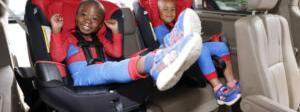
Featured image: Children are properly secured in car seats during a car seat safety event at the Middleman Family Pavilion at CHOP in King of Prussia, Pennsylvania, on Oct. 17, 2026. (Credit: Hyundai)