
Lucid seeks review of Fifth Circuit affirming Texas direct sales ban

Lucid Group has requested an en banc review of a ruling handed down by an appeals court panel in its lawsuit against the Texas Department of Motor Vehicles over the state’s direct sales prohibition.
The United States Court of Appeals for the Fifth Circuit has affirmed a district court’s ruling that Texas law barring manufacturers from selling vehicles directly to consumers withstands scrutiny under the Fourteenth Amendment’s equal protection and due process clauses.
The Sept. 4 appellate court ruling explains that the state law bars motor vehicle manufacturers and their affiliates from owning, operating, controlling, or acting on behalf of a franchised dealer for the same type of car the manufacturer produces. It states that only independent dealers, acting as manufacturers’ franchisees, may sell vehicles directly to Texas consumers.
Lucid sued the Texas DMV after the department told the company it couldn’t sell vehicles at its Plano studio, according to background provided in the opinion. The Texas Automobile Dealers Association (TADA) later intervened as a defendant.
“Lucid brings as-applied challenges to the prohibition under the Equal Protection and Due Process Clauses of the Fourteenth Amendment,” the opinion states. “The district court held Lucid’s claims fail as a matter of law upon review of cross-motions for summary judgment, and Lucid timely appealed. The district court held the prohibition does not violate the Equal Protection and Due Process Clauses because it is rationally related to a legitimate governmental interest.”
The Fifth Circuit stood behind the lower court’s judgment. It notes that precedent from lawsuits filed by Ford in 2001, International Truck in 2004, and Tesla in 2024 doesn’t apply to Lucid’s case because they were “facial challenges” as compared to Lucid’s as-applied claims, leaving the court to determine whether they are legally and factually distinct from the arguments considered in the prior cases.
“Lucid argues Texas’s prohibition should be read as a classification between direct sales manufacturers and franchised manufacturers, as well as a classification between direct-sales manufacturers and independent dealers,” the opinion states. “In other words, Lucid contends it is similarly situated to franchised manufacturers and independent dealers for the purposes of the prohibition, yet it is treated differently from them under the law.”
The Fifth Circuit rejected those arguments, noting it also did in the Ford and Tesla cases; in Lucid’s case, the court ruled it isn’t the same as an independent dealer because its manufacturing and dealership entities are affiliates under the same parent company.
“The crux of Lucid’s equal protection claim is that the prohibition is irrational as applied to a direct-sales manufacturer,” the opinion states. “We rejected this argument in Tesla, finding ‘[t]here is hardly a more quintessential example of vertical integration than a manufacturer’s extending itself into distribution.’…Lucid’s as-applied equal protection claim fails as a matter of law.”
Despite the unanimous three-member panel ruling, two questioned whether the ban is improper economic protectionism.
In his concurring dubitante, or “doubtful” opinion, Circuit Judge Patrick E. Higginbotham cited some history behind the state’s ban, dating back to the 1930s when the Big 3 — General Motors, Ford, and Chrysler — were “leveraging their unequal bargaining power at the expense of their vulnerable dealers.”
“By enacting laws to prohibit manufacturers’ direct sales to consumers, many states sought to protect dealers from intra-brand competition with their own upstream franchising manufacturers, not from inter-brand competition with non-franchising manufacturers lacking contractual privity to dealers,” he wrote. “This elementary distinction between the regulation of intra-brand and inter-brand competition has long been recognized by the High Court.
“…there is simply no historical evidence that Texas’s direct-sales prohibition was motivated by harms related to inter-brand competition. Absent another valid purpose, preventing inter-brand competition is naked protectionism, which we have long held ‘is not by itself a legitimate state interest.'”
Chief Judge Jennifer Walker Elrod wrote in her concurring dubitante that, “Lucid does not simply parrot the legal arguments from Tesla, but points to meaningful differences between Louisiana and Texas’s statutes and between Tesla and Lucid’s businesses.”
“In other words, it offers a true as-applied challenge. However, these differences fail to clear the bar set by the broad language in Tesla, and its holding could apply with equal force here.”
Walker Elrod added that she agrees with Higginbotham in that “this legal regime does not appear to be based on a legitimate concern for consumers’ welfare.”
Higginbotham contends that Lucid’s vertical integration, or control over multiple levels of its supply chain, could lower consumer prices by eliminating double marginalization.
“Double marginalization captures the increase in consumer prices from varied firms in the production and distribution chain exercising their market power to set supercompetitive prices,” he wrote. “Free from the price ramifications of double marginalization, a vertically integrated manufacturer may leverage its market power in the distribution chain to decrease consumer prices.”
Higginbotham added that imposing market restraints on the emerging electric vehicle industry “stifles innovation and technological advancement.”
“[T]he advent of the electric car is significant in its technological prowess and environmental implications,” he wrote. “The electric powertrain is a distinct product from a combustible engine, so none should be surprised that electric vehicle manufacturers have adopted a business model distinct from the franchised manufacturers that have dominated the last century.”
Images
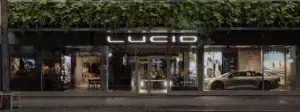
Featured image: A Lucid studio in Zurich. (Provided by Lucid)