
Ford expects Chinese vehicles will enter U.S. market in 5 to 10 years

Ford CEO Jim Farley expects Chinese automakers to enter the U.S. market in the next five to 10 years, Reuters reports he said during an employee town hall meeting Thursday.
Farley recently said that it would be devastating to the American economy if Chinese vehicles are allowed into the country. He’s said that China has enough capacity to cover all vehicle sales in the U.S., with 100 automakers receiving direct government support.
Yet, earlier this month Ford partnered with Chinese Geely Auto to produce next-generation multi-energy vehicles in Spain.
“While the partnership was criticized by some U.S. lawmakers, Ford said Chinese competition in the region was prompting every carmaker to get ‘leaner and smarter,’ which was the goal behind the Geely deal,” Reuters says.
Geely opened the world’s largest automotive testing facility late last year. The 881,894-square-foot vehicle testing center cost $284 million.
As Chinese brands have moved into Europe, automotive brands there have faced falling sales in key markets.
Automotive News reported in April that plug-in hybrid sales by Chinese brands quadrupled in March and now represent 32% of the total European market.
News broke earlier this week that BMW plans to cut 8,000 jobs and will launch a voluntary severance program due to the pressure in Europe.
BMW also reported Thursday that the rapidly deteriorating Chinese market is the main reason the company was forced to adjust its guidance in June.
“In addition, new competitors are also expanding into several markets across Asia-Pacific, Latin America, and Europe,” BMW says in a press release. “These market dynamics, however, are just one aspect of the fundamental changes in our industry.”
While BMW points to Chinese competition as the main trigger, it adds that tariffs, European regulations, and the conflict in the Middle East are also pressure points.
Earlier this month, it was reported that Volkswagen Group is planning up to 100,000 job cuts globally. German software engineers are also struggling to find work as automotive companies in the country are cool on hiring.
Ford is taking steps to compete with China, including turning towards megacasting and a lower-cost EV that would reduce the number of parts used.
The U.S. is also taking steps to keep Chinese vehicles out.
The U.S. Senate Commerce Committee advanced a bill earlier this month that would ban any vehicle equipped with connected software or hardware from China.
The Connected Vehicle Security Act of 2026 is a bipartisan bill introduced by Sen. Bernie Moreno (R-Ohio) and Elissa Slotkin (D-Michigan) in May.
Chairman Ted Cruz said a section of the bill that bans connected vehicles manufactured by any entity with 15% Chinese ownership could keep Mercedes-Benz from selling in the country.
About 20% of Mercedes ownership is by Chinese groups, Car and Driver reports. This includes 9.7% ownership by the founder and chairman of Geely and 9.8% ownership by the BAIC Group.
Moreno responded that the bill is not intended to ban the sale of Mercedes, as he was formerly a Mercedes dealer and his son currently is.
Any car company in America, whether that’s Ford, General Motors, Toyota, or Honda, can compete with any company on earth,” Moreno said. “They can’t compete with an entire country that is set on destroying the Western auto industry.”
The U.S. Department of Commerce’s Bureau of Industry and Security (BIS) also published a rule banning Chinese and Russian-connected vehicle technology last year. The bill would codify the regulation into law and add some additional language.
In 2024, a 100% tariff on Chinese electric vehicles (EVs) went into effect.
It also puts a 25% tariff on EV batteries, critical minerals, steel, aluminum, and ship-to-shore cranes, among other items, according to documents filed by the U.S. Trade Representative.
Multiple media sources have claimed the tariff on EVs is meant to ease concerns about China’s low-cost EVs.
Image
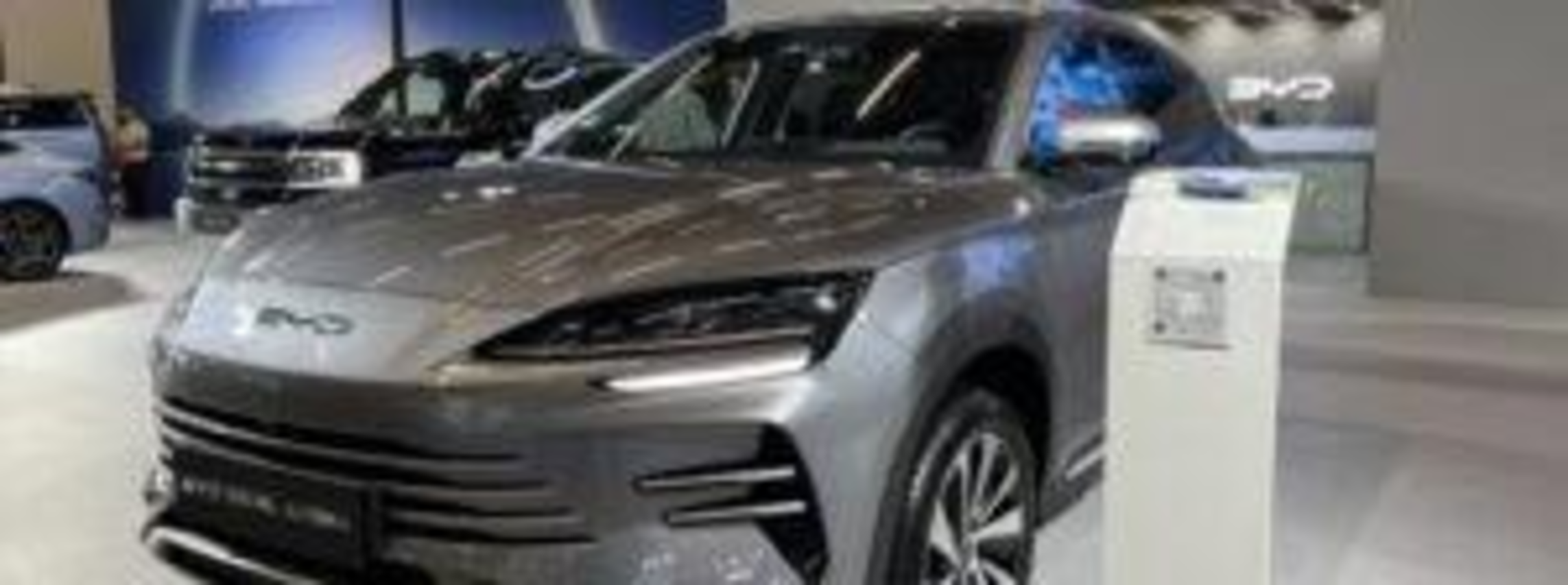
BYD display at Automechanika Frankfurt