
AEye partners with MDOT on live Intelligent Transportation Systems, signs MOU with MoveAWheeL

AEye, a software-defined and high-performance lidar solutions company, says it will showcase a live Intelligent Transportation Systems (ITS) deployment, in partnership with the Michigan Department of Transportation (MDOT), at ITS America 2026 in Detroit this week.
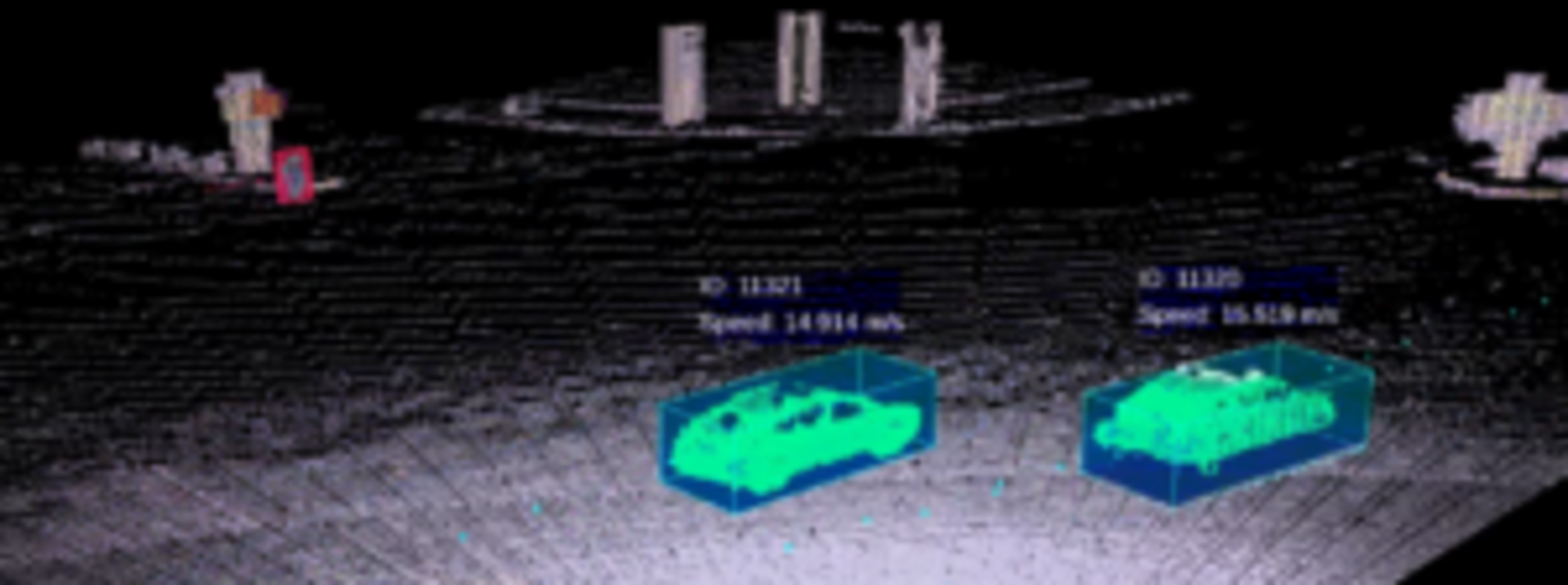
The demonstration highlights how AEye’s OPTIS solution, which combines AEye’s software-defined lidar and real-time infrastructure integration, can improve roadway safety, traffic operations, and situational awareness in urban intersections and highway corridors.
Powered by AEye’s OPTIS platform, the company says the OPTIS solution delivers long-range, real-time 3D perception that enables transportation systems to continuously monitor, understand, and act on roadway activity.
The OPTIS deployment incorporates AEye’s software-defined Apollo lidar, Flasheye’s lidar perception software, and Blue Band’s Integrator-AI solution to deliver an end-to-end system capable of transforming sensor data into actionable traffic intelligence. Apollo is a software-defined 1550-nanometer lidar sensor that AEye says is capable of detecting objects at distances of up to 1 kilometer in a compact form factor designed for behind-the-windshield automotive integration.
“Transportation infrastructure is evolving from passive monitoring to intelligent systems that can perceive, understand, and respond to conditions in real time,” said Matt Fisch, AEye chairman and CEO, in a company press release. “At ITS America, we’re excited to showcase how software-defined lidar and Physical AI can help transportation agencies improve safety, optimize traffic operations, and build smarter, more responsive roadways. Visitors at ITS America will have the opportunity to see how AEye and its partners are helping transportation agencies move beyond traditional sensing toward intelligent infrastructure capable of delivering real-time insights and action across diverse roadway environments.”
AEye also recently shared that it has entered into a Memorandum of Understanding (MOU) with MoveAWheeL, a developer of acoustic-based Physical AI road-surface sensing, to explore the integration of AEye’s Apollo with MoveAWheeL’s tactile intelligence technology for next-generation automotive safety and autonomous driving applications.
The collaboration will focus on enhancing advanced driver assistance systems (ADAS) and autonomous driving capabilities by enabling vehicles not only to detect and interpret objects ahead but also to improve understanding of real-time road conditions that could impact braking, steering, and vehicle control, according to an AEye press release.
“The companies intend to evaluate how Apollo’s long-range 3D perception can pair with MoveAWheeL’s friction-coefficient prediction technology to provide a more comprehensive understanding of the driving environment, particularly in challenging conditions such as rain, snow, and black ice,” the release states.
“MoveAWheeL’s road-surface prediction sensor uses active acoustic sensing to estimate friction coefficients of road surfaces, generating predictive inputs that can help inform acceleration, braking, and stability-control decisions. Together, the technologies are intended to help expand the operational capabilities of ADAS and autonomous driving systems across a broader range of real-world and adverse-weather driving conditions.”
Under the MOU, the companies say they plan to define technical evaluation activities, identify target automotive customer engagements, and explore go-to-market opportunities in select geographies. The MOU is non-binding and is intended to guide the exploratory workstreams, with the terms of any resulting commercial relationship to be outlined in a separate definitive agreement, according to the release.
“Physical AI depends on giving machines the ability to accurately perceive and understand the real world,” said Fisch, in the release. “Apollo was designed to deliver long-range, real-time 3D perception that helps systems see farther and react earlier in complex environments. By exploring the integration of Apollo with MoveAWheeL’s road-surface intelligence, we have the opportunity to create an even deeper understanding of the driving environment, particularly in the adverse conditions where advanced safety systems are needed most.”
Min-Hyun Kim, founder and CEO of MoveAWheeL, added, “While lidar provides the ‘eyes’ for a vehicle to see obstacles, MoveAWheeL provides the ‘tactile sense’ to feel the road. By integrating our Physical AI with AEye’s long-range perception, we are creating a complete safety stack that remains robust even in the most treacherous weather conditions.”
Images
Featured image: How OPTIS sees the world via 3D perception with real-time interpretation and action. (Provided by AEye)