
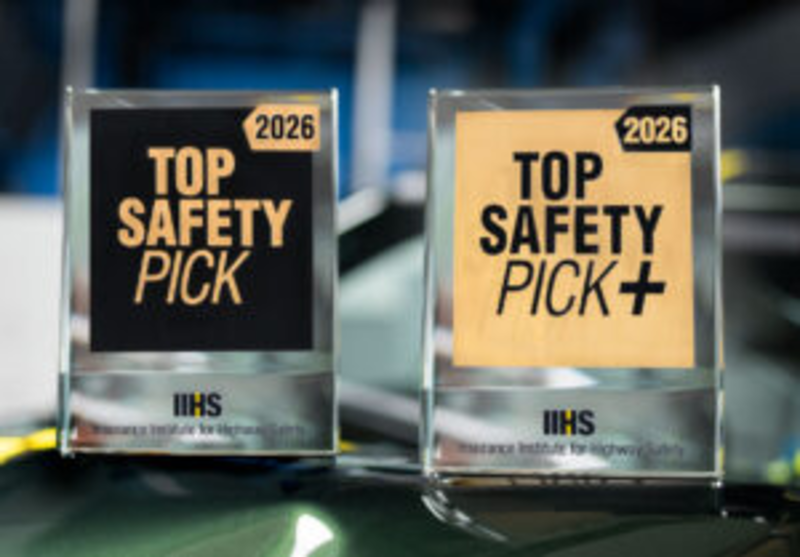
IIHS: Top Safety Pick, Top Safety Pick+ awards show crash avoidance improvement

The Insurance Institute for Highway Safety (IIHS) says that while crash avoidance systems on some 2026 vehicles have improved, it encourages automakers to make further improvements and demands superior protection for back seat passengers, according to an IIHS press release.
The release notes that, even with tougher rules, 63 vehicles qualify this year for IIHS awards so far, up from 48 at the same point last year.
Of the winners, 45 earned a Top Safety Pick+ award and 18 earned a Top Safety Pick.
Many of the awarded vehicles cost below $30,000, showing that strong safety does not have to come with a high price tag, IIHS said.
“This year, we’re asking automakers to make excellent protection for back seat passengers the norm,” said IIHS President David Harkey in the release. “For Top Safety Pick+, we’re requiring crash avoidance systems that are better at preventing pedestrian crashes as well as higher speed crashes with other vehicles.”
IIHS updated its moderate overlap front test in 2022 to emphasize back seat safety. Last year, vehicles needed a good rating in the test to earn a Top Safety Pick+ award; however, only an acceptable rating was needed to earn Top Safety Pick.
This year, a good rating is required for both awards.
The crash avoidance requirements for the base award are the same as last year — an acceptable or good rating in the pedestrian front crash prevention test.
For Top Safety Pick+, however, vehicles must earn a good rating in the pedestrian front crash prevention test and an acceptable or good rating in the updated vehicle-to-vehicle front crash prevention evaluation that was introduced last year. Qualifying front crash prevention systems must also be standard to receive either award in 2026.
As before, good ratings in the small overlap front and side tests are required for both awards, and all trims must come with acceptable- or good-rated headlights.
This year’s winners include a variety of models, ranging from small cars to large pickups and from economy cars to luxury vehicles.
No minicars, minivans, or small pickups earned awards this year. And only two large pickups qualified: the Tesla Cybertruck and the Toyota Tundra crew cab. For many other models in these categories, back seat performance in the moderate overlap test remains a challenge, IIHS said.
SUVs of different sizes make up 35 of the 45 total Top Safety Pick+ winners and 12 of the 18 Top Safety Picks. The cheapest small SUV is the Hyundai Kona, which starts at $25,500. While all three large SUVs cost more than $55,000, several midsize SUVs have base prices under $40,000.
“It’s disappointing that minivans continue to struggle to provide the best available protection for passengers in the back, considering that these are supposed to be family vehicles,” Harkey said in the release. “Based on these results, parents may want to consider some of the more affordable sedans and SUVs that earn awards.”
The biggest change in the award criteria is the addition of the new vehicle-to-vehicle front crash prevention test. The original evaluation, discontinued in 2022, focused on rear-end crashes at lower speeds using only a passenger car target.
The new evaluation includes test runs at 31, 37, and 43 mph. In addition to a passenger car target, it examines performance with a motorcycle target and a semitrailer.
Though the test was not required for an award last year, more than 70% of the 85 model-year 2025 vehicles evaluated earned acceptable or good ratings. So far, more than 77% of 2026 models tested meet that standard. These results show that automakers are making fast progress in crash prevention technology, IIHS said.
“Improving crash avoidance is key to achieving our 30×30 vision of reducing U.S. crash deaths by 30% by 2030,” Harkey said in the release. “Stronger structures and better seat belts save lives, but the safest crash is the one that never happens.”
An IIHS study released in November states that vehicles with a large driver-side blind zone raise the risk of a left-turn pedestrian crash by 70% compared with a small blind zone. Medium driver-side blind zones were associated with a 59% increase in the risk of left-turn crashes. It adds that thick and slanted A-pillars, bulky side mirrors, and tall, long hoods all obstruct the driver’s view.
The field of view through the windshield, which alters the location of the blind zones, also affects the driver’s ability to see, IIHS said.
The Governors Highway Safety Association (GHSA) also announced this week that traffic-related pedestrian deaths fell 10.9% during the first half of 2025, or 371 fewer than in the same period of 2024.
More than 3,000 pedestrians, or an average of 16 per day, were killed during that timeframe, according to a new GHSA data analysis.
GHSA says the 10.9% decline is the largest drop since it began tracking pedestrian fatalities 15 years ago.

“While this recent safety momentum is positive, pedestrian deaths remain above the 2019 level, the last year before a steep rise in dangerous driving behaviors and traffic deaths caused by the pandemic,” a GHSA press release states.
An in-depth examination of original data GHSA collected from State Highway Safety Offices (SHSOs) across the U.S. found that:
-
- The rate of pedestrian deaths remains 2.5% higher than pre-pandemic levels (2,951 in January-June 2019).
- The pedestrian fatality rate measured per 100,000 population fell to 0.90 in 2025 – the lowest decline since 2020.
- Measured by vehicle miles traveled (VMT), there were 1.86 fatalities per billion VMT during the first half of last year, the lowest since 2019.
- The total financial cost of all 3,024 fatalities from January-June 2025 exceeded $40 billion.
Pedestrian fatalities increased in 24 states, decreased in 23 states and D.C, and remained the same in three states for January-June compared to 2024.
Thirty-two percent decreases in Alabama and California, as well as the drops in Maryland, New Mexico, and New York, drove the nationwide count down from 2024, according to GHSA.
“Each pedestrian death is so much more than just a number,” said GHSA CEO Jonathan Adkins, in a press release. “Each one is a family member, friend, or neighbor that no one will be able to hug, see, or share time with ever again. While we are pleased with the progress shown in the data, the only acceptable number of traffic deaths is zero.”
Anderson Abernathy, Michelin Mobility Intelligence’s president and COO, added, “Access to timely, high-quality data is essential to understanding and helping prevent roadway fatalities. We are encouraged by the progress reflected in this report, but the data also reinforces the need for continued collaboration across public and private sectors to improve safety for all road users, especially pedestrians.
“At Michelin, we believe that integrating advanced analytics with cross-sector collaboration can help identify risk patterns earlier and enable more targeted interventions. Turning insight into impact is essential to the USDOT’s Safe System Approach, designed to enhance safety for all road users.”
GHSA says methods to improve pedestrian safety include minimizing pedestrians’ exposure to vehicles, particularly on high-speed roadways; prioritizing visibility between drivers and pedestrians; managing speed and enforcing speed limits; using new technology and data to identify and address challenges; promoting safe road use through education and enforcement; and improving post-crash care.
Using traditional crash databases and new innovative data sources to learn from fatalities and injuries can also inform safety plans, countermeasures, and policy, the release states.
GHSA’s report provides a first look at the pedestrian fatality trends well before the National Highway Traffic Safety Administration (NHTSA)’s Fatality Analysis Reporting System (FARS) data are available.
Later this year, GHSA will publish full-year 2025 pedestrian fatality projections based on state data, including an analysis of the 2024 national FARS data. FARS provides additional insights on why, where, and how drivers strike and kill people walking, the release states.
The forthcoming report will also summarize promising state and local approaches to protect pedestrians on U.S. roadways.
Images
Featured image provided by IIHS
Graph provided by GHSA