
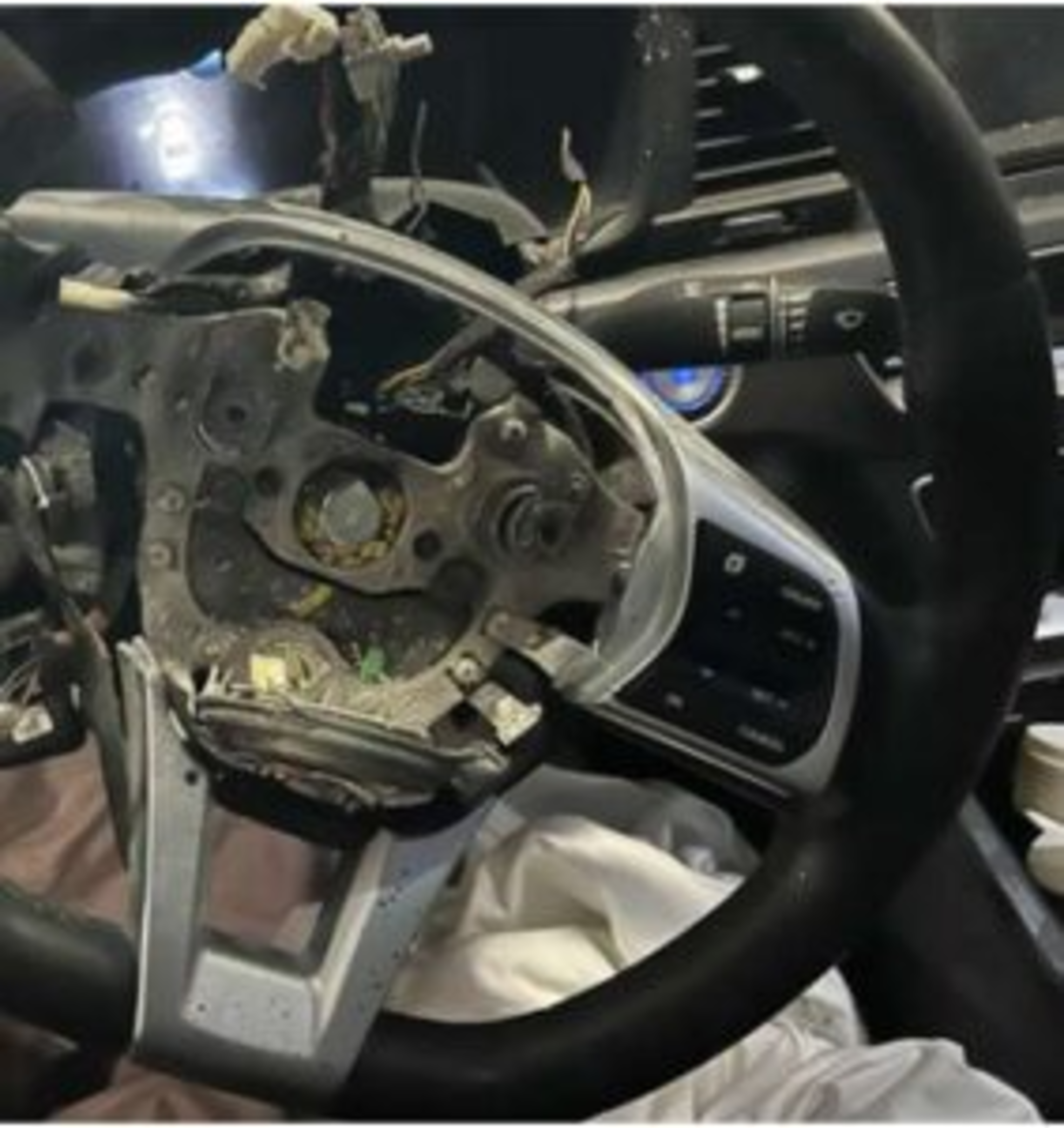
Family files suit over teen killed by improper repair involving counterfeit airbag

The family of a Utah teen killed by a counterfeit airbag has filed a wrongful death lawsuit against a national used car dealership that had the salvaged vehicle repaired, according to a press release from Morgan & Morgan law firm.
A complaint, filed with the Third Judicial District Court in Salt Lake County, Utah, alleges the teen’s driver-side airbag exploded when the car was involved in a minor crash on July 30, 2025.
It alleges that AutoSavvy sold a 2019 Hyundai Sonata to the teen’s family with a counterfeit airbag manufactured in China. It is the third suit filed by Morgan & Morgan where patients were allegedly killed when counterfeit airbags exploded in otherwise survivable collisions, a news release says.
The National Highway Traffic Safety Administration (NHTSA) issued an urgent alert last month that specifically asks the auto repair industry to look for dangerous airbag inflators that continue to kill consumers.
The alert follows another one issued by NHTSA on Jan. 15.
NHTSA is currently investigating DTN inflators, which it says have malfunctioned in crashes, sending large metal fragments into drivers’ chests, necks, eyes, and faces, killing or severely injuring people.
As of the most recent February alert, NHTSA has determined nine deaths from 11 crashes involving counterfeit airbags.
The Utah suit alleges the teen, described by the initials A.D.L.R was driving her Hyundai Sonata when it was involved in a frontal collision. It notes that A.D.L.R. was properly restrained.
The front driver-side airbag was signaled to deploy due to the forces of the collision, the suit claims.
“However, because the subject Hyundai Sonata’s front driver-side airbag system included counterfeit, non-compliant, and defective components, the airbag detonated like a grenade and shot metal and plastic shrapnel throughout the vehicle cabin,” the suit says. “A large, jagged chunk of metal shrapnel from the blast struck A.D.L.R. in her chest. Struggling to find help and choking on her own blood, A.D.L.R. died minutes later in the middle of the roadway.”
According to the suit, AutoSavy is a business that derives revenue from owning and operating a chain of car dealerships that purchase, sell, and lease a wide range of vehicles. As a part of its business, the company services and repairs the vehicles it sells, either directly or through hired third parties, the suit says.
AutoSavvy purchased the Sonata after it was involved in a 2023 collision, the suit alleges. It says the collision caused the front driver-side airbag to deploy, and the damage was so significant that the vehicle was classified as a total loss and issued a salvage title.
The dealership purchased the vehicle and repaired it to resell, the suit claims.
“In AutoSavvy’s effort to repair and replace the subject Hyundai Sonata’s deployed front driver-side airbag, counterfeit, non-compliant, and defective airbag components were procured and installed into the subject Hyundai Sonata,” the suit says.
According to the suit, the vehicle was originally equipped by the manufacturer with a functioning supplemental restraint system intended to mitigate injury to vehicle occupants during collisions of sufficient magnitude.
Hyundai designed the original front driver-side airbag to function through various components, including collision sensors, an airbag control unit, and an airbag module. The module contains the airbag inflator and cushion.
The suit explains that the Sonata’s OEM front driver-side airbag is designed as a single-use vehicle component.
“After being involved in a crash that causes the subject Hyundai Sonata’s front driver-side airbag to deploy, the front driver-side airbag module must be removed and replaced with a new module that complies with federal standards and Hyundai Motor Company’s designed specifications for the vehicle,” the suit says.
AutoSavvy sold the teen and her family a vehicle knowing it had been improperly and illegally repaired, and that it contained counterfeit, non-compliant, and defective airbag components, the suit alleges.
The suit continues by alleging that AutoSavvy placed the vehicle into the stream of commerce and warranted that the vehicle was safe, fit, and merchantable quality.
“When AutoSavvy sold the subject Hyundai Sonata, the subject Hyundai Sonata was not of safe, fit, or merchantable quality, but was instead defective, unreasonably dangerous, unfit, and unmerchantable for its designed and intended uses,” the suit says.
Federal Motor Vehicle Safety Standard (FMVSS) 208 requires that airbag components distributed, installed, and manufactured for installation in U.S. vehicles satisfy specified performance requirements, standards, and testing, the suit says.
It was designed to reduce the number of deaths and severity of injuries by specifying vehicle crashworthiness requirements, the suit says.
“FMVSS 208 is intended to protect vehicle drivers and occupants like A.D.L.R. from being exposed to unsafe vehicle airbag systems that can cause serious injury or death during collisions, like what happened to A.D.L.R. in this case,” the suit says. “AutoSavvy violated FMVSS 208 by having a nonfunctional airbag and counterfeit automobile supplemental restraint system components installed into the subject Hyundai Sonata that fail to comply [with] FMVSS 208 and then selling the subject Hyundai Sonata knowing these components were installed.”
During the 2025 Society of Collision Repair Specialists (SCRS) OEM Collision Repair Technology Summit, Collision Advice owner Mike Anderson said many OEM manufacturer procedures state airbags should be removed and inspected post-collision.
He said that in a recent “Who Pays for What?” survey, about 49% of shops say they are getting reimbursed for airbag inspections most of the time. However, he said there is a 10% decline in insurance companies refusing to pay for the operation.
The NHTSA alert also asks dealers to know the history of vehicles in their inventory.
“If a vehicle has been in a previous crash where the airbag deployed, it should be inspected immediately for one of these inflators, especially if it has a salvage or rebuilt title,” the alert says. “If you find a DTN inflator, the vehicle should not be driven until the inflator is replaced with genuine parts.”
Recently, an Automotive News opinion piece said the post-repair safety and roadworthy state-level inspection process should be standardized and codified as more franchised dealerships retail branded or salvaged titles.
The piece follows an Automotive News article that explores the shift in the market.
About 2.5 million vehicles were declared totaled by insurers last year and returned to U.S. roadways, the article says.
Anyone who knows about the sale or distribution of DTN inflators, or encounters a vehicle with one of the suspected inflators, should contact their local Homeland Security Investigations office or FBI field office to report it, or submit an online complaint to the National Intellectual Property Rights Coordination Center.
Also, report it to NHTSA online or by calling the agency’s Vehicle Safety Hotline at 888-327-4236, Monday through Friday, 8 a.m. to 8 p.m. Eastern time.
Image
Photo of the Hyundai Sonata involved in the death of a Utah teen taken from court records.