
Ford, I-CAR, and 2 collision repair organizations partner to provide new vehicles to schools

A new vehicle donation program aims to provide collision repair programs with newer model vehicles for students to work on, as schools and instructors often face budgetary limitations.
The program was created in partnership between the Collision Repair Education Foundation (CREF), Ford Motor Co., the Collision Engineering Career Alliance (Collision Engineering), and I-CAR to facilitate vehicle donations nationwide, providing students with a clearer understanding of the complexity of modern vehicle technology.
The vehicles will serve as valuable training tools by allowing students to gain hands-on experience with modern automotive systems and prepare for real-world repair scenarios, according to a press release.

“Collision instructors across the country have shared that their No. 1 need is having current model vehicles for their students to practice on, and this vehicle donation program is a significant step forward in our efforts to enhance collision repair education,” said CREF Executive Director Brandon Eckenrode in the release.
“This is a perfect example of a donation that truly allows students to learn, practice and hone the important skills that lead to rewarding careers in the collision repair industry. Real-world, hands-on experience is a vital component of the learning process, and Ford’s donation is helping to make that possible for thousands of future industry professionals.”
I-CAR says the new vehicle donation program complements the recent launch of I-CAR Academy, which provides collision repair education with access to the latest technologies and repair techniques.
The vehicle donation program has so far provided 31 late-model Ford vehicles to 16 educational institutions to aid over 1,000 students.
“Every student deserves the opportunity to learn with modern technology,” said Andrew McInnes, Ford Motor Co., in the release. “These schools are training the next wave of technicians for our industry’s pipeline. Investing in the industry’s future begins with investing in these future technicians and ensuring they have the resources to grow their skills and fill the roles needed in shops across the country.
“We need students to be prepared to enter the workforce, and given the advanced technology of modern vehicles, that means ensuring they are well-trained in the most current methods is critical. The vehicles donated by Ford are equipped with the newest technology, which will provide students with the opportunity to train on the cutting edge of the industry.”
The following six participants of the Collision Engineering program will each receive two vehicles:
-
- College of Lake County (Grayslake, Illinois)
- Contra Costa College (San Pablo, California)
- El Camino College (Torrance, California)
- Metropolitan Community College (Elkhorn, Nebraska)
- Parkland College (Champaign, Illinois)
- Sandhills Community College (Pinehurst, North Carolina)

Two schools not affiliated with the program or I-CAR Academy each received two vehicles to support their educational efforts. They are Delaware County Technical High School in Folcroft, Pennsylvania, and Norwalk High School in Norwalk, California.
“We are extremely grateful to our industry partners who are committed to increasing access to the latest vehicle technology and repair procedures to build a stable, skilled, and supported workforce by aligning education with the needs of industry,” said Mary Mahoney, chair of the Collision Engineering Career Alliance board, in the release. “Our strategic partners help scale our national impact and drive our mission to provide a strong pipeline of skilled technicians who are confident in the shop and connected to their future in collision repair.”
Bronco collision repair
Among details on several Ford-specific OEM procedures in the OEM’s latest OnTarget Vol. 4 are specifics related to the Bronco’s supplemental restraint system (SRS).
OnTarget provides the locations of the airbag and seatbelt pretensioner components, seat position sensors, and impact sensors. The detailed schematics are part of an ongoing series in OnTarget on the Bronco.
The latest issue also includes details about the removal and installation of the Bronco Raptor’s front fender moulding. It notes that the Bronco and Bronco Raptor share many similarities, including exterior body components, which were previously covered in all four volumes of On Target in 2021 and Volume 2 in 2022. All volumes can be found at FordCrashParts.com.
Ford+ plan reinvests in trucks, hybrids, EVs, and battery storage
Ford also recently shared changes to its Ford+ plan moving forward, including offering a broad range of hybrids to complement efficient gas engines, according to a press release from the OEM.
A universal EV platform will equip multiple models, and by 2030, nearly 50% of Ford’s global volume is planned to be hybrids, extended-range EVs, and EVs, versus the current 17%.
The next-generation EV platform architecture is engineered to underpin a high-volume family of smaller, highly efficient, and affordable EVs designed to be accessible to millions of customers. The first vehicle from the Universal EV Platform will be a fully connected mid-size pickup truck assembled at the Louisville Assembly Plant beginning in 2027.
Ford’s next-generation F-150 Lightning will shift to an extended-range electric vehicle (EREV) architecture and be assembled at the Rouge Electric Vehicle Center in Dearborn, Michigan.
The plan also includes assembling new Ford pickup trucks at BlueOval City in Tennessee and producing new gas and hybrid vans at the Ohio Assembly Plant, along with hiring thousands of new employees in the U.S. over the next few years.
Ford plans to launch a battery energy storage system (BESS) business under the plan, housed in its plants in Kentucky and Michigan. Leading lithium iron phosphate (LFP) battery cell production technology will provide solutions for energy infrastructure and the higher data center demand, the release states. Ford plans to begin shipping BESS systems in 2027 with 20 GWh of annual capacity.
“The company is shifting to higher-return opportunities, including leveraging its U.S. manufacturing footprint to add trucks and vans to its lineup and launch a new, high-growth battery energy storage business,” the release states. “As part of these actions, Ford no longer plans to produce select larger electric vehicles where the business case has eroded due to lower-than-expected demand, high costs, and regulatory changes.
“This approach prioritizes affordability, choice, and profits. Ford will expand powertrain choice — including a range of hybrids and extended-range electric propulsion — while focusing its pure electric vehicle development on its flexible Universal EV Platform for smaller, affordable models.”
Images
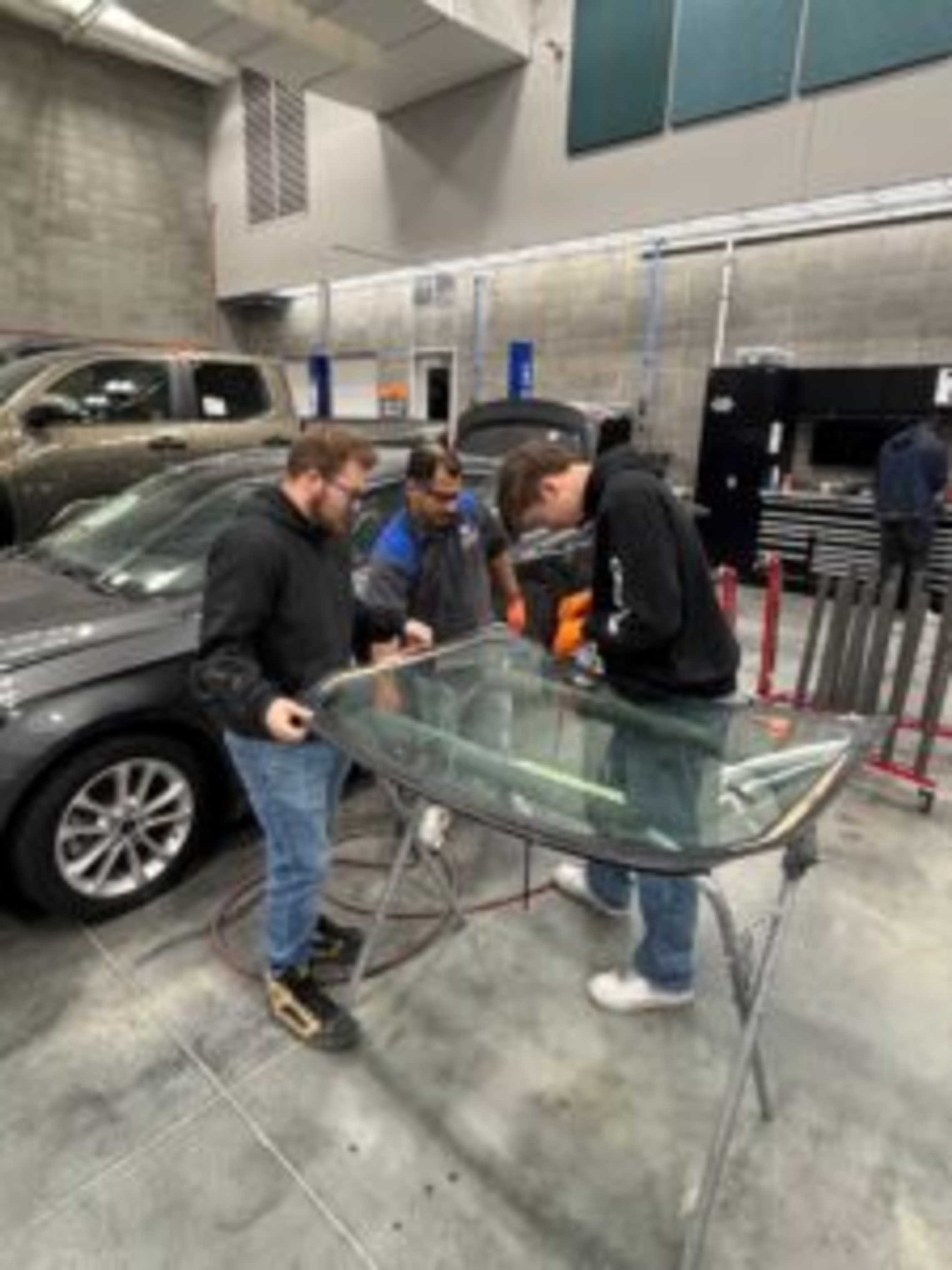
Featured image: Students at Metropolitan Community College check out the back windshield of a Ford Fusion that was donated to the school through the partnership between Collision Repair Education Foundation (CREF), Ford Motor Co., the Collision Engineering Career Alliance (Collision Engineering), and I-CAR.
Metropolitan Community College students pose with the Ford Fusion donated to their school.
Contra Costa College students pose with a Ford Fusion donated to the school through the new vehicle donation program.
All photos provide by CREF/I-CAR