
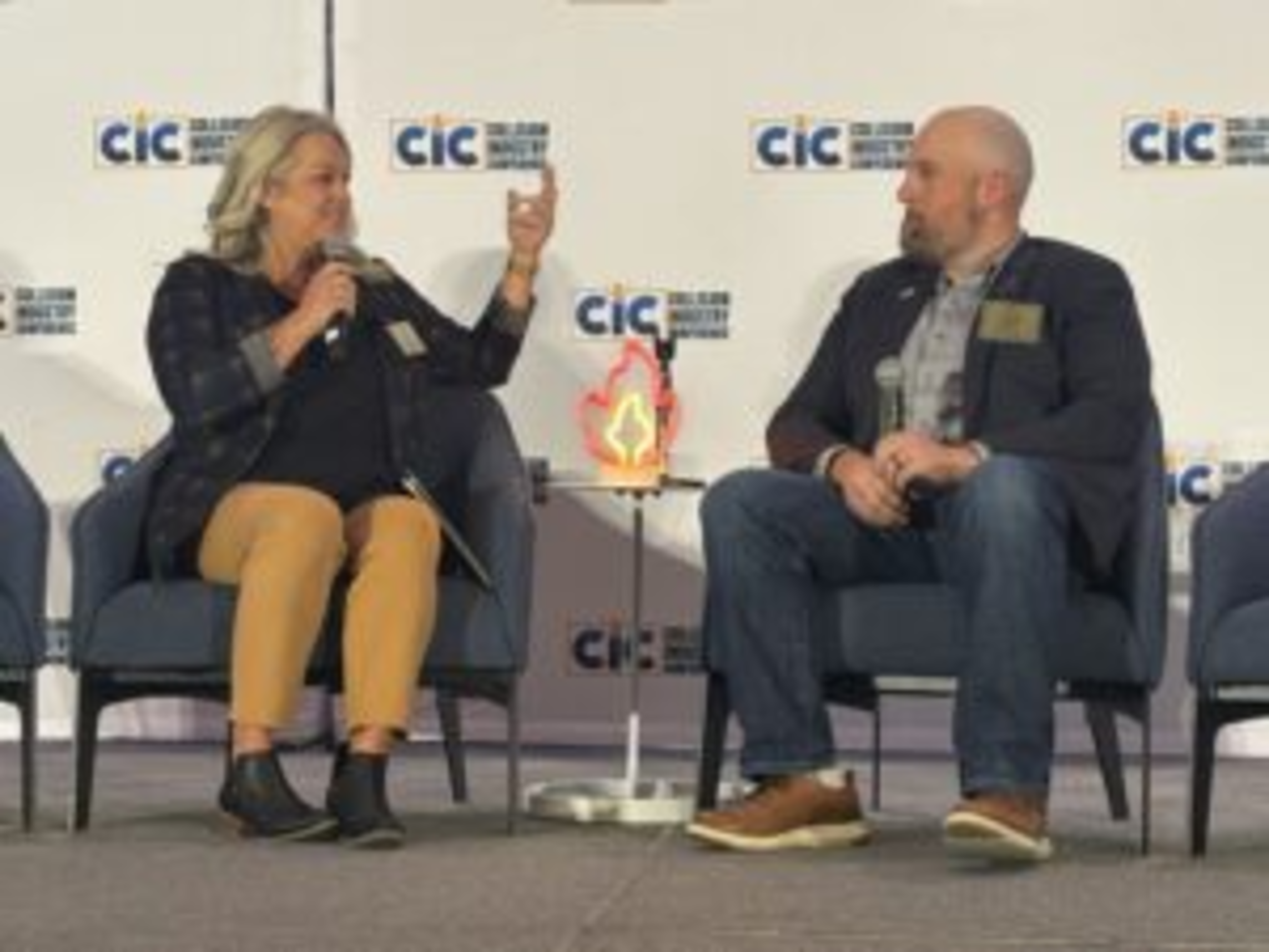
Texas, Washington collision leaders share legislative appraisal journey at CIC

Jill Tuggle, Auto Body Association of Texas (ABAT) executive director, and Justin Lewis, Washington Independent Collision Repair Association (WICRA) president, discussed the six-year lobbying journey each took to pass right-to-appraisal legislation in their states this year during a Collision Industry Conference (CIC) meeting last week at the SEMA Show in Las Vegas.
Both said the collision markets in their states first focused on appraisal clause education.
“We’ve seen in our industry over the last several years a lot of pressure building with customers having to pay out of pocket quite a bit of money for a safe and proper repair,” Tuggle said. “This [appraisal] was an avenue for the customer to receive a safe and proper repair and maybe lighten their out-of-pocket expense.”
As more body shops began using the appraisal clause, Tuggle and Lewis said, insurance companies began removing the clause from their policies in Texas and Washington.
“The appraisal clause has been a policy provision since the 1800s,” Tuggle said. “It has widely been recognized as something that is a part of a policy.”
The policy changes provoked the Texas Department of Insurance (TDI) to collect data, Tuggle said.
TDI found that appraisals were used in less than two out of every 10,000 payable personal auto claims, according to data Tuggle provided. It also found that about 94% of personal auto appraisals were initiated by the claimant. Most appraisals were for vehicles declared a total loss.
Average personal auto awards were $29,541, the data found. Personal auto awards averaged about $5,300 more than the initial offer, and about half of the awards were $2,100 to $5,900 more than the initial offer. About 98% of the personal auto awards were more than the insurer’s initial offer.
Half the appraisals were completed within a month of the demand, and 90% within four months. Appraisals with an umpire usually took much longer.
Tuggle said RTA legislation is a hot topic currently, with not only Washington and Texas passing laws but also Rhode Island.
Illinois and New Jersey have also filed appraisal bills.
Tuggle said legislation focuses on key topics within the clause, such as time triggers, who pays, and the qualifications of appraisers and umpires.
Lewis and Tuggle said the process wasn’t easy, and it took a lot of learning and determination to get it passed in both states.
The first bill filed in Washington addressed multiple issues, Lewis said.
“We quickly learned, first time around, that was impossible,” he said.
Fast forward to this year, Washington involved a lobbyist for the first time, Lewis said. It still took a lot of time invested and conversations with legislators, he said.
Some language was added and some removed, and the insurance industry tried to add language to the bill, he said.
Tuggle said it is important that those in the industry take the time to meet with legislators once a year, even when a bill isn’t being introduced.
“There doesn’t have to be a current problem or a right to appraisal; all of the words don’t have to be silversmithed into something perfect for them,” Tuggle said. “Once a year, reach out to your local legislator, say, ‘I’d love to come in and talk to you as a local business owner and here are the issues in our industry.’”
That conversation can lay the groundwork for when bills start to come across their table, she said.
As for right-to-appraisal, Tuggle said ABAT provided legislators with a one-page document that simply defined the issue.
Lewis said WICRA used a QR code that sent legislators to a webpage that described who they were and the issue.
Both said it is important to get shops and consumers to contact legislators on the issue.
Legislators have hundreds, if not thousands, of requests for bills come across their table, Lewis said. The more noise the industry and consumers make, the more likely a legislator will stop and read an issue, he said.
“If they don’t have a reason to look into it, they will move on to the next thing,” Lewis said. “It has to be something they have heard before.”
Tuggle said it was initially intimidating going up against large lobby groups with significantly more money.
“One of the things that we knew that we had was local constituent voices,” Tuggle said.
ABAT made it easy for people to send letters by connecting them with their legislators through a website and then pre-formulating a letter that could be tweaked to make their own.
Lewis also said that WICRA didn’t have many financial resources.
“With enough effort and not being quiet, things can be done,” he said.
Once you find someone to file the bill, it becomes a race, Tuggle said. She said the earlier the bill is filed, the lower its number and the more likely it is to be heard.
Lewis said you are watching the clock for each stage of the process, alluding to the deadlines bills must meet to pass through committees and onto the House and Senate floors.
Both said the bills succeeded because of support from members and consumers who attended legislative hearings to show the issue was important to them.
They said lobbyists who know legislative strategy and are familiar with the industry are important.
Tuggle said ABAT found their lobbyist with assistance from contacts she made at the capital after running her first bill.
“Ask around, ask people who are involved at the capital,” Tuggle said. “They know who is going to be on your side.”
Lewis said WICRA found its lobbyist by pure luck. A customer saw a flyer Lewis had taped to the back of his computer about the appraisal issue. The customer explained he was a lobbyist and could help with a bill.
The bill was also advanced when a legislator, whom Lewis had previously lobbied, ended up in a claim dispute.
“You have to be in front of them [legislators],” Lewis said. “It is not always easy to get to that point.”
Lewis warned that being cautious is important when working on legislation.
“People just want to pass a bill,” Lewis said. “It is important to understand that no bill is better than a bad bill. Don’t just get a bill done to get a bill, be very proactive on the language.”
IMAGE
Jill Tuggle, Auto Body Association of Texas (ABAT) executive director, and Justin Lewis, Washington Independent Collision Repair Association (WICRA) president, during CIC’s Nov. 4, 2025, meeting in Las Vegas (Teresa Moss/RDN).