
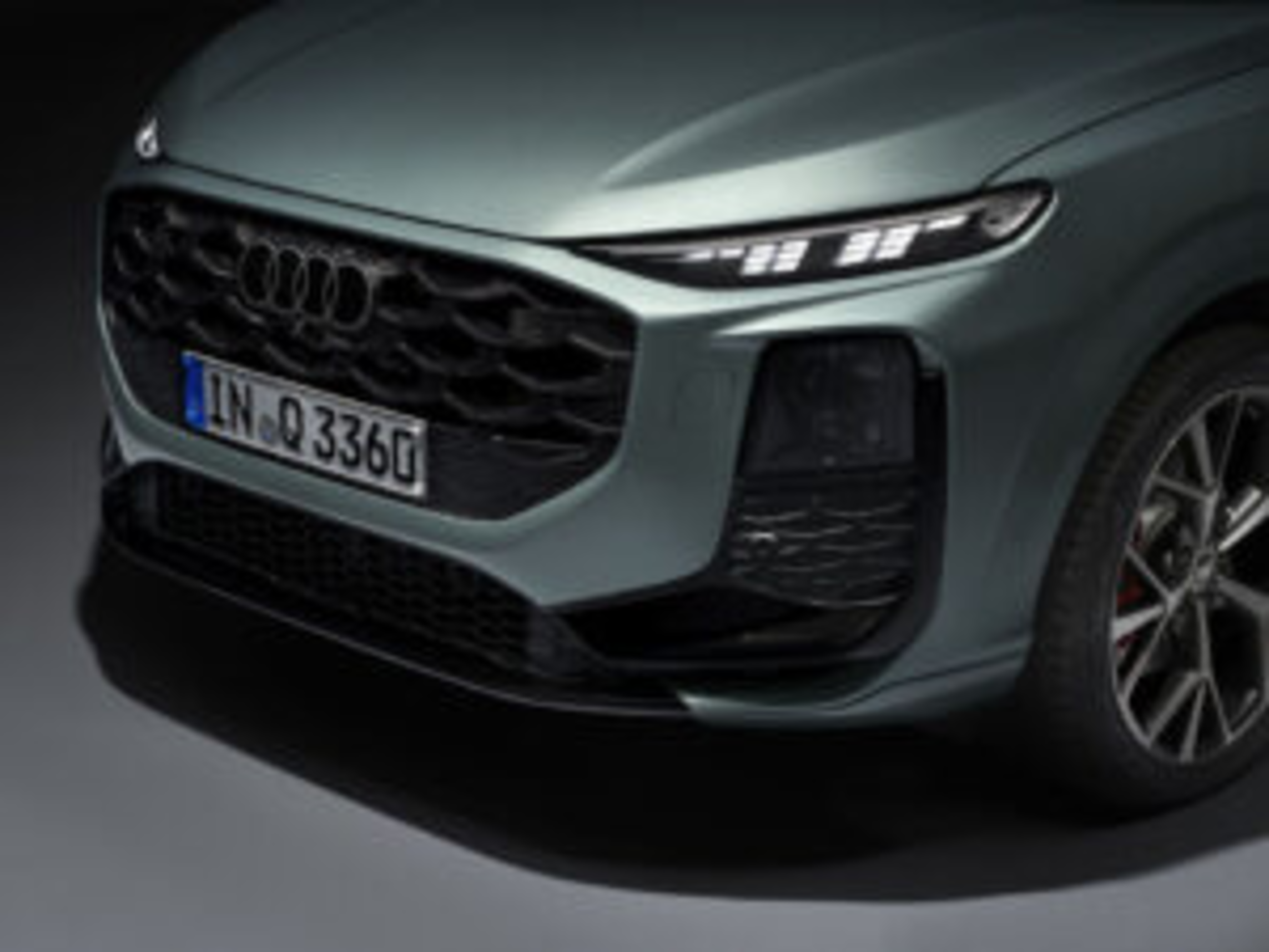
Audi talks safety pros of digital vehicle lighting

A recent Audi press release shares a Q&A with Michael Kruppa, the OEM’s head of front lighting development, on how digital vehicle lighting improves safety at night.
In the interview, he explains what makes good headlights and what sets the new Audi Q3 apart from the competition regarding lighting.
The following is a summary of the interview.
Q: Why are good headlights so important?
Kruppa: “The rapid onset of darkness and poorer weather conditions, especially now in the fall and winter, pose a greater risk in traffic. On the one hand, as a driver, I want to illuminate the area I’m driving into as well as possible so that I feel safe. On the other hand, it is very important that other road users see me in time. Often, just a few seconds make a crucial difference in avoiding a dangerous situation. Seeing and being seen is the be-all and end-all in road traffic. Good lighting is not just about comfort — it provides a significant boost in safety.”
He added that Audi customers have numerous options to personalize their vehicle lighting, such as digital light signatures and matching lighting for coming home or leaving home.
Q: What characterizes intelligent lighting at Audi?
Kruppa: “Intelligent lighting actively adapts to the driving situation and provides added safety for all road users. The lighting we develop at Audi is designed to prevent glare. Our matrix LED headlights detect vehicles ahead and oncoming traffic and automatically block out light that would blind them. The driver, therefore, no longer has to operate the high beams manually. This ensures that you always have enough light in front of you, can stay focused for longer, and drive more safely as a result.”
The digital matrix LED headlights have numerous adaptive lighting functions and can project light images directly onto the road, he added.
“Our digital matrix LED headlights with micro-LED technology are particularly impressive due to their smaller installation space, lower weight, and higher efficiency,” Kruppa said. “They also have greater luminosity with better contrast, which means they perform better in difficult visibility conditions.”

Q: What are the technical foundations for good lighting?
Kruppa: “The basic requirement is that the light works reliably. When I switch it on, it must be there immediately. Beyond that, we can now influence many parameters, such as brightness and color. There have recently been major advances in LED technology. Our development activities over the past four or five years have led us to start digitalizing lighting technologies, such as LED technology. At the same time, we are continually optimizing other aspects.
Q: The micro-LED technology you mentioned is being used for the first time in the new Audi Q3. How does it work?
Kruppa: “We have developed a light source in such a way that we can almost use it like a video projector. The micro-LED module, which is approximately 13 millimeters wide, has a chip with 25,600 tiny micro-LEDs — each measuring approximately 40 micrometers — that can be controlled individually. This allows the system to adjust the light image on the road depending on the situation. For instance, the light guidance functions, known as lane guidance and orientation lights, are now much more closely linked to the driver assistance functions.”
Q: What specific advantages does this technology mean for drivers?
Kruppa: “Picture it like this: the car projects two lines onto the road while driving. These lines help me stay in the center of my lane and give me an indication of my vehicle’s position in the lane I am driving in. That’s the orientation light. When I drive onto the highway, the projected light image changes. The car knows I’m on the highway and can illuminate my lane dynamically. This is the lane light with the orientation light.”

Digital Matrix LED headlights on the Audi Q3 with activated lane and orientation light
“If I want to change lanes, the lane light with direction indicator assists me. It shows the active turn signal at the edge of the lane light, depending on whether I am signaling left or right,” Kruppa said. “The benefit for other road users is that they can see early on that I want to change lanes. All this is made possible by the digital matrix LED headlights with our new micro-LED technology in the Audi Q3. It provides our customers with orientation and safety, and ultimately a positive feeling behind the wheel. And depending on your preferences, you can also deactivate these functions in the MMI [Multi Media Interface].”
Q: Which road users benefit most from the digital lighting technology in the new Q3?
Kruppa: “In addition to the safety of the vehicle occupants, it’s also about other road users. Take pedestrians, cyclists, or the occupants of other vehicles, for example. But the focus is also on those who are unaware that they are putting themselves in a dangerous situation, such as wild animals crossing roads at dusk. You want to spot them in time so you can react, brake, or even take evasive action.”
Q: And warning symbols can be projected too?
Kruppa: “Yes, that’s another example of the benefits of digitalization. When the outside temperature drops below 4 degrees, the system projects a snowflake onto the road — exactly the same symbol that you would normally see on the instrument cluster. As a driver, I know instantly: ‘It could get really slippery now.'”

Q: Why is advanced lighting more important today than ever before?
Kruppa: “Because it combines safety and comfort while also improving driver concentration. Good lighting means that I can see more, I am more visible, and I can react faster to any situation. Modern digital lighting systems, such as those in the new Audi Q3, take road safety to a new level.”
Headlight safety trends
Along with improving the visibility provided by headlights, automakers have made progress in reducing the amount of glare their headlights produce, according to the Insurance Institute for Highway Safety (IIHS).
In IIHS testing, 21% of headlights available on 2017 models produced excessive glare. For 2025 models, that dropped to 3%. In the institute’s scoring system, excessive glare makes it impossible to earn a good or acceptable rating.
However, headlight glare can still be improved, IIHS added.
“One way to address that problem is to focus on preventing the crash types associated with glare,” the release says. “Reducing lane departures — with improved lane markings and in-vehicle lane departure warning and prevention features, for example — could cut the already small number of glare-related crashes by more than half.”
High-beam assist, which automatically switches headlights from high beams to low beams when it detects vehicles ahead, could mitigate the problem of drivers neglecting to do so manually, IIHS said. The IIHS rating program awards bonus points for this feature.
Adaptive driving beam headlights are another promising development, according to IIHS. These systems adjust the headlight beam pattern to dim only the portions directed at other vehicles while maintaining full high-beam illumination otherwise. However, regulatory hurdles have delayed their adoption in the U.S., and no vehicles in the country were equipped with adaptive driving beam headlights by the end of 2024.
Images
All images of Q3 and Audi lighting provided by Audi