
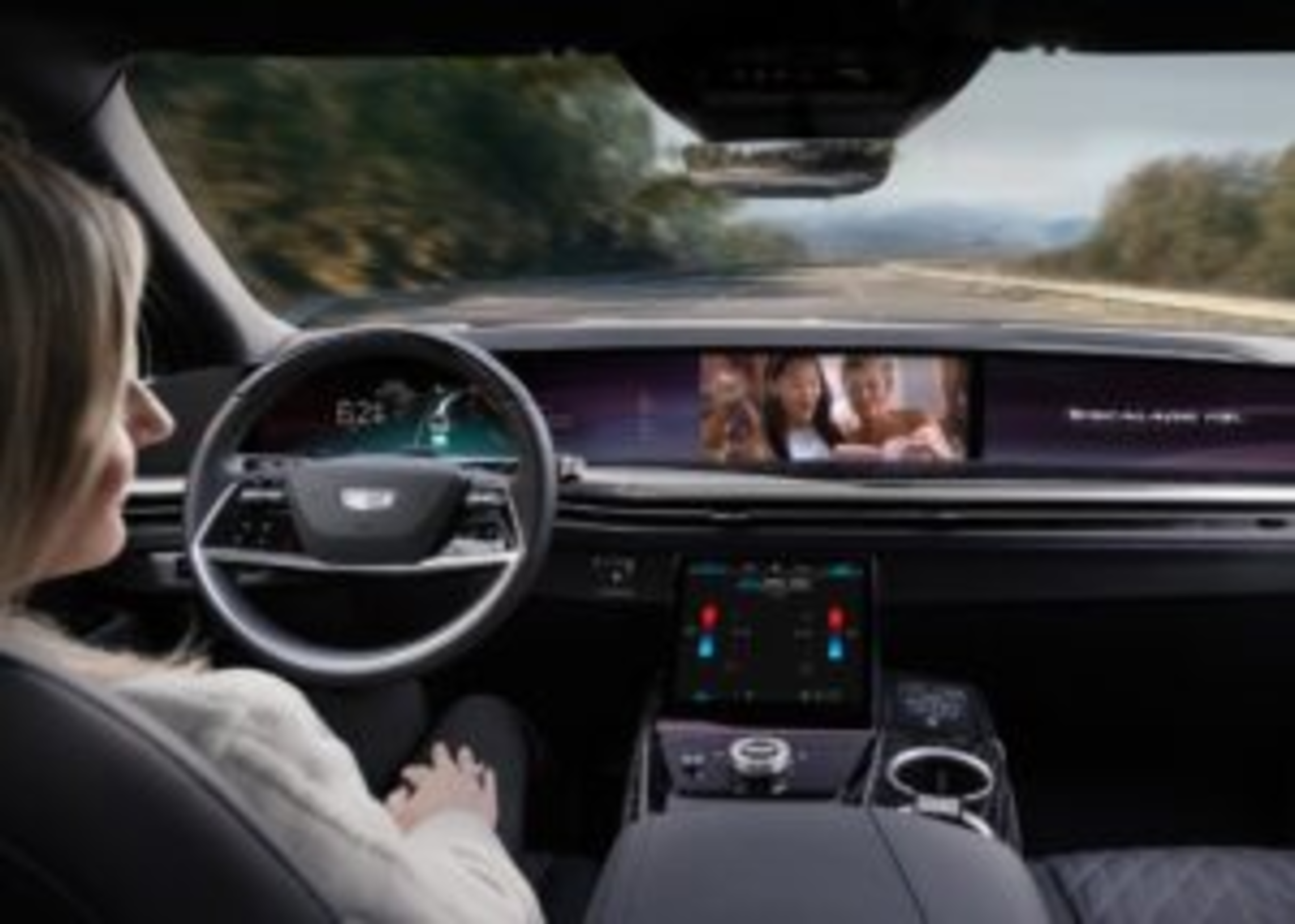
GM to offer new centralized platform, AI and autonomous features

General Motors will launch a centralized computing platform and next-generation electrical architecture across electric and gas-powered vehicles, starting with the Cadillac ESCALADE IQ in 2028.
The new design represents a fundamental reimagining of how GM vehicles are built and how they can be updated over time, according to a press release.
GM says it’s moving toward a centralized computing design to unlock new levels of performance, scalability, and software efficiency while also simplifying design. Doing so will enable faster software updates and improve reliability, the release states.
“With this approach, GM will share software across its portfolio, both electric and gas-powered vehicles, large and small,” the release says. “GM vehicles will always be connected, awake, and available, with near-instant responsiveness to remote commands.”

The updated architecture builds on GM’s Vehicle Intelligence Platform, which launched in 2020 to allow secure over-the-air (OTA) updates.
GM notes that in 2022, it unified dozens of infotainment modules into a single computing platform and consolidated multiple ADAS into one. The new platform consolidates dozens of electronic control units into a unified computing core that coordinates every subsystem in the vehicle in real time, the release says.
“Much like a smartphone’s single, powerful microprocessor that orchestrates everything from your camera to your messages, this centralized approach connects every system — propulsion, steering, braking, infotainment, and safety — through a high-speed Ethernet backbone,” GM said.
GM promises the platform will provide real-time safety updates in a self-driving system that reacts in milliseconds and evolves with each autonomous update.
GM says the new design allows for:
-
- “Hardware freedom: Vehicle-specific components stay isolated from the software layer, so GM can swap suppliers or upgrade parts like brake actuators, cameras, displays, and other components without rewriting core code.
- “Simplification: The new architecture simplifies the network topology.
- “Engineering to support both electric and internal-combustion vehicles.
- “Cars that learn and improve throughout their lifetime.
- “Architectures that deliver real-time intelligence and faster autonomy.
- “Platforms that bring the efficiency of the digital world into the physical one.”
Autonomous and AI
Also in 2028, GM says it will introduce “eyes-off driving” on the Cadillac Escalade IQ, beginning with highways. Availability and permissible use will vary by state.
Turquoise lighting across the dashboard and exterior mirrors will signal when the system is active.

“Unlike vision-only systems, GM’s approach is built on redundancy with lidar, radar, and cameras integrated into the vehicle’s design,” the release says. “At the core is sensor fusion: the lidar, radar, and cameras build the perception layer; real-world driving data trains the decision-making model; and high-fidelity simulation validates performance across rare or hazardous scenarios. This provides a safe, reliable, and highly capable eyes-off autonomous system.”
GM will combine the proven experience of self-driving Super Cruise with the autonomous expertise of Cruise, according to the release.
“Cruise’s technology stack — including multimodal perception systems, AI models trained on 5 million driverless miles, and a simulation framework running virtual test scenarios — feeds directly into GM’s next-generation driver-assistance and autonomy programs,” the release says. “The result: a vehicle designed to handle the drive when you want it to, with the safety and precision you expect from GM. Our goal is to bring to market the most trusted and scalable eyes-off driving technology on the path to personal autonomy.”
Beginning in 2026, GM vehicles will feature conversational AI with Google Gemini.
In the future, GM will introduce its own custom-built AI connected by OnStar that can be fine-tuned individually according to personal preferences.
“[T]his AI will draw directly from your vehicle’s onboard intelligence to surface relevant, vehicle-specific information like upcoming maintenance needs or optimal route timing, with controls that let you decide what you share and how personalized you want the experience to be,” the release says. “With your permission, it will be able to help with what you need in the moment, whether it’s explaining features like one-pedal driving, detecting a maintenance issue early, preconditioning your vehicle before your morning commute, or recommending a dinner spot based on your past preferences and routes.”
The eyes-off system and conversational AI will run on GM’s next-generation centralized computing platform.
GM will stop offering Apple CarPlay and Android Auto on all of its gas-powered cars — a decision that CEO Mary Barra confirmed on The Verge’s Decoder podcast. Both have already been eliminated on GM’s EVs.
“The timing is unclear, but Barra pointed to a major rollout of what the company is calling a new centralized computing platform, set to launch in 2028,” an article with the podcast states. “In place of phone projection, GM is working to update its current Android-powered infotainment implementation with a Google Gemini-powered assistant and an assortment of other custom apps, built both in-house and with partners.”
Images
Featured image: The 2028 Cadillac Escalade IQ will feature next-generation electrical architecture. (Simulated image provided by GM)
This diagram depicts the revised architecture of GM’s vehicle computing platform. (Provided by GM)
The turquoise light on future Cadillac Escalade IQ vehicles will indicate when it’s operating on a hands-off basis. (Simulated image provided by GM)