
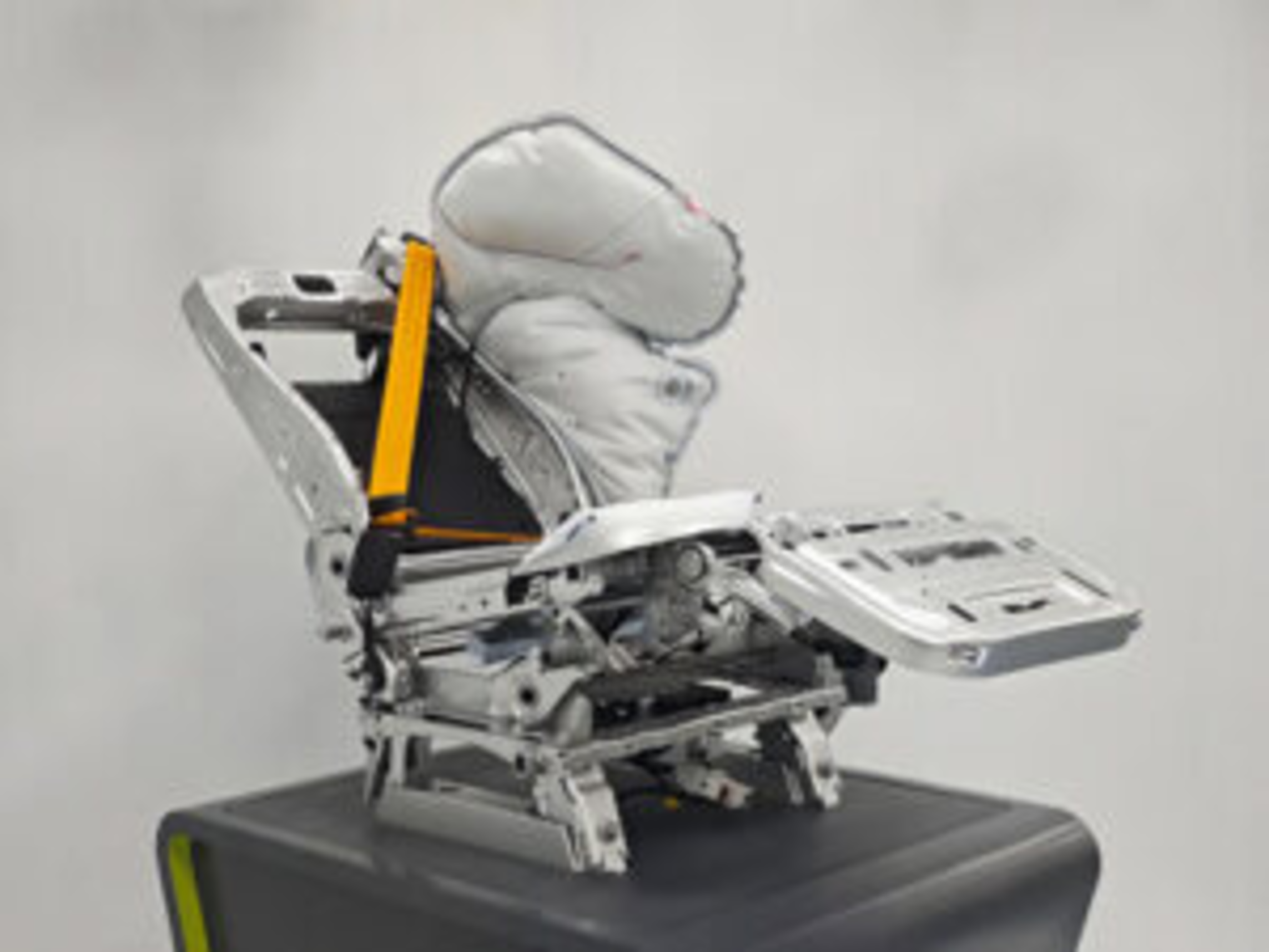
New safety system designed to protect vehicle passengers in deeply reclined seats

A new safety system with advanced constraints and energy-absorbing technologies has been designed to protect occupants in deeply reclined seating positions, according to a press release from developers Adient and Autoliv.
Adient, an automotive seating company, and Autoliv, a supplier of automotive safety systems, co-developed the safety solution that they claim significantly enhances occupant protection in the position commonly referred to as “zero-gravity.”
The system, named Z Guard, is now available for mass production, the release says. It adds that the system is scheduled for production in a high-volume model by a major global OEM but does not name the company.
“As electrification and smart technologies continue to reshape the automotive industry, zero-gravity seating is gaining popularity in mid- to high-end vehicle models due to its ergonomic benefits,” the release says. “However, the deeply reclined posture can compromise the effectiveness of conventional safety systems, which are typically designed for standard upright seating, potentially leading to safety risks.”
Z-Guard uses a multi-dimensional collaborative protection principle, the release says.
This includes two key innovations:
-
- “Active cushion collapse mechanism: In a crash, this feature rapidly collapses the seat frame to absorb energy and adjust posture, thereby reducing spinal impact and providing protection to vital body regions.
- “Adjustable seatbelt outlet: This feature adapts to various passenger postures and body types, enhancing comfort while maximizing precise restraint and minimizing risks like shoulder slippage.”
The release claims the Z-Guard concept enables integration with vehicle driver assistance systems and can be tailored to OEM requirements and real-world scenarios. It says the system leverages predictive signals by utilizing high-speed, motor-driven seat repositioning to adjust the occupant’s posture before a collision.
“In cases where a vehicle cannot detect a crash in time or lacks active repositioning capabilities, Z-Guard still provides robust protection through dual pretensioners, cushion buffering, and a collapse mechanism,” the release says. “These systems work in concert to prevent forward movement and submarining, enhancing reliable safety even in zero-gravity seating positions.”
Other technologies from Autoliv can complement the safety system, the release says. This includes an integrated seatbelt system for improved stability, a dynamic lumbar retractor for controlled restraint force, a pelvic cushion air bag to reduce pelvic impact, and a head side air bag for side collision protection in reclined positions.
“Together, these systems help safeguard critical areas — head, neck, chest, and pelvis — delivering truly dynamic, full-process occupant protection,” the release says.
Autoliv also announced this week that it has partnered with the China Automotive Technology and Research Center Co. (CATARC), a research institution that is setting standards in China’s automotive sector. A strategic agreement was signed by both parties to advance automotive safety standards for vehicles produced in China.
Key areas of focus include:
-
- Collaborative research in safety technologies — Advancing next-generation safety systems through quality and innovation.
- Testing and certification support — Enhancing efficiency and reliability in safety validation processes.
- International business development — Supporting Chinese OEMs in expanding globally with world-class safety.
- Public welfare and sustainability initiatives — Promoting safer mobility and sustainable development through joint advocacy and innovation.
Fabien Dumont, Autoliv executive vice president and chief, says in the release that for the last three decades, the company has had a presence in China, and this agreement marks a new chapter in the company’s commitment.
“Automotive safety products never get a second chance and need to work without any flaws or variations,” he said. “Together with CATARC, we aim to define the next generation of safety standards and enhance the safety on our roads.”
The release says regional, industrial, and technological advantages will drive innovation and set higher standards for automotive safety.
IMAGE
Photo courtesy of Adient