
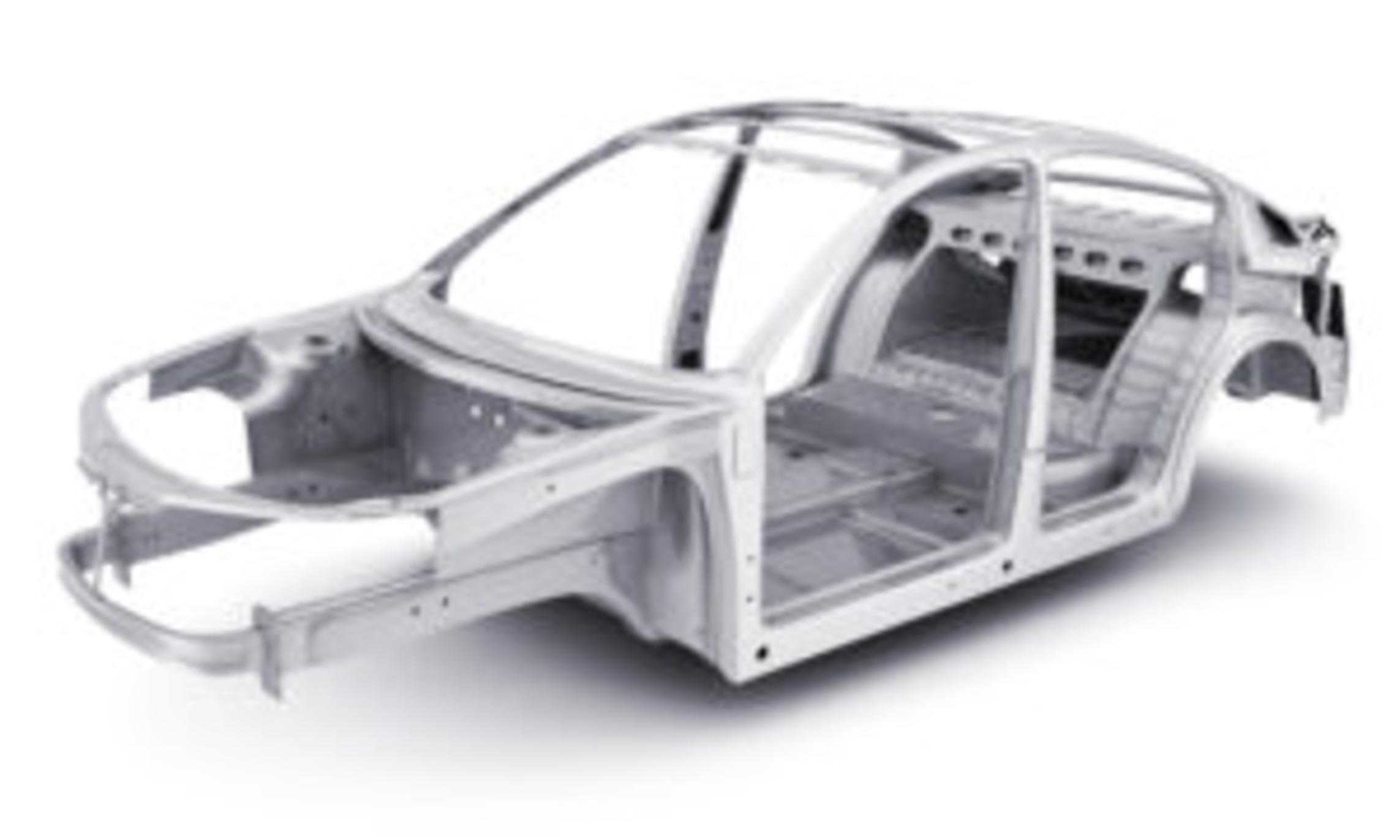
Body-in-white structures need rethinking for EVs, says opinion piece

The margin of safety for EV structures is narrower and demands innovation protection strategies, Prasad Kulkarni, Mahindra Group manager of body structures engineering, writes in an opinion piece to Automotive News.
The body-in-white’s role as a “safety shield” for occupants and electric vehicle’s battery is more crucial than ever with 69 million EVs on the roads and annual sales predicted at about 22 million, Kulkarni says.
“If the body-in-white lacks robustness, every aspect of vehicle safety and performance suffers,” he says.
He describes how the 880 to 1,300-pound batteries are at risk of thermal runaway if even a single cell is punctured. He adds that the puncture could turn a survivable crash into a catastrophic fire.
“In traditional internal-combustion cars, deformation of the fuel tank seldom leads to such immediate danger,” he says.
Kulkarni writes that the absence of a front engine allows for new design but this changes crash energy management pathways.
Safety regulations have become stricter as EV popularity grows, he says. It adds that the Insurance Institute for Highway Safety side test has updated its standards to use a 4,200 pound barrier and the European New Car Assessment Program and New Bharat New Car Assessment Program penalize any deformation around batteries.
“Meeting these global standards requires precise engineering, with particular focus on strengthening rockers and front rails to shield the all-important battery pack and occupants,” he writes.
Kulkarni gives strategies for safer EV body-in-white design:
-
- Seamless load path integration from front crush cans through side sills and rear members.
- Engineering front rails to deform probabilistically in three stages.
- Side sill (rocker) reinforcement is critical either of extruded aluminum or multicell ultrahigh-strength steel.
- Roof crush and rollover protection including hot-stamped boron steel in pillars and headers.
He notes the selection of material is important, adding that aluminum alloys may reinforce sills for weight savings, while dual-phase or ultrahigh-strength steel supports underbody crash members.
“Having worked across multiple continents and platforms, I have witnessed firsthand the shift from conventional combustion architectures to advanced EV structures,” Kulkarni writes. “No technology — be it advanced driver-assistance systems, airbags or software — can compensate for a weak body structure when a crash occurs.”
Last year at the SEMA Show, Rivian displayed its speciality-built R1S Body in White at the Society of Collision Repair Specialists’ booth. Officials with the EV manufacturer also shared the three-year process they undertook to research, develop, validate and publish new repair procedures during an OEM Collision Repair Technology Summit.