
3M engineers share effective mentorship tips for the industry

Mentoring a new generation of collision repair technicians isn’t as simple as teaching procedures and processes; it requires people skills and good communication.
That’s according to John Ascheman and Ryan Marrinan, senior application engineers for 3M’s Automotive Aftermarket Division, based on lessons they’ve learned as mentors over the past 15 years and from what younger technicians in the 3M Skills Development Center training program have said.
“There’s a massive [technician] shortage, and if we’re ever going to solve this problem, we need better mentors in our industry,” Marrinan said. “We need people to really take the time and first understand what it is that the job requires, but then being able to articulate that in a manner that makes sense.”
Ascheman added that at the 3M Skills Development Center, he’s seen individuals come in who are really skilled, have a good grasp on a lot of what they’re doing, and have been mentored well, while someone sitting next to them has also been mentored but is struggling with a lot of the tasks.
“A lot of that comes from this industry being just based on tribal knowledge,” he said. “They may be really good in their shop… but understanding what a proper repair looks like isn’t always being passed on to the mentee.”
Having noticed these trends, Ascheman and Marrinan put their heads together to identify what makes a good mentor. They shared several questions for shops to consider: What type of training and education should mentors have? What understanding of vehicle repair do they need to have? What else do they need to understand, such as goals and communication with their mentees? What is the right personality for a mentor?
They agreed, first and foremost, that management at every shop plans how they’ll identify the kind of mentors they need and lay out a mentorship program.
Oftentimes, Marrinan said, evaluating whether a technician would make a good mentor reveals skills, or the lack thereof, outside of repairing vehicles.
“They really start taking a very thorough look at their technicians and actually seeing for the first time like, ‘Wow, I consider them to be my best technician, but they don’t have good communication skills, so they’re maybe not somebody that can have a conversation.’ Or, ‘They don’t have the right temperament or personality to be sharing their experiences or training a younger person,’” he said. “Sometimes the shop owners start seeing the gaps within their own facilities, whether it’s the paint side, the body side, or the front office side, in identifying that the person making the most money may not always be the best person necessarily for this type of ask. When you identify that, you really start seeing where the efforts should be put, and in some cases, where the rewards need to go.”
Ascheman said figuring that out typically comes down to setting up a training path with the mentor and mentee and how it incentivizes either side, whether it’s monetarily, emotionally, or whatever the person wants out of their job. He said being a mentor shouldn’t be forced on employees who aren’t comfortable with the leadership role because doing so could cause both the mentor and the mentee to quit their jobs, or a mentee might not receive the right guidance they’re looking for.
Marrinan noted it’s understandable that shop owners have a lot on their plates. However, a vested interest in training needs to continue so that if a new technician comes in and doesn’t know how to do something, the seasoned techs can show them the ropes, he said.
Ascheman and Marrinan said the mentor and mentee should be passionate about their work.
“If you don’t have a passion, or you don’t have a person who’s willing to share that passion or help build that passion for what it is that you’re doing, you’re just setting yourself up for failure,” Marrinan said.
“Part of it is coming into it with a decent attitude, knowing that every day is not going to be a great day, but learn how to celebrate the good days and learn how to work as a team together through the tough days. If you’ve got reworks or you’ve got things that are taking a little bit longer, rather than getting upset, just be like, ‘OK, let’s break it down and figure this out.’”
Ascheman has noticed that the most successful mentorship relationships are those in which the mentor and mentee learn together.
“Everyone’s got things to learn,” he said. “We learn all day, every day… When you watch them both grow together, see it as a win-win because they’ve made the connections, they found a relationship, they’re both working together to better both of their lives and careers.
“For the mentor, this could be something that steps them into a leadership role within their organization, or it might just be what helps them really enjoy their job.”
Building those relationships also builds morale in the shop, Marrinan said.
“A good mentor should be excited when their mentee succeeds, when they’re improving in the right direction,” he said. “They should be able to acknowledge it, reward it, even if it’s just a simple, ‘That was awesome. Tell you what, let’s go have a beer after work.’ You build a relationship that’s long-lasting.
“As a shop owner, you should be encouraging that because then you’re building very good morale and a very good culture within your facility that other people are going to want to come and learn or be a part of it.”
They agreed that incentives for mentors are also a must, as long as the mentee-to-mentor ratio is manageable.
“The good mentors I’ve had in my life, I still talk to today,” Ascheman said. “They didn’t just make me better at collision repair, they made me better as a human and made me better at life. That’s really where those connections came in.”
Another tip they provided was for mentors to set boundaries up front for appropriate and inappropriate cell phone use, as it can often be a distraction.
As more technicians retire and younger techs begin in the industry, Marrinan said repairers should have a good sense of humor about the generational gaps.
“You’ve got to have an open mind and a good sense of humor,” he said. “Culture has changed from where it was 20, 30 years ago for sure. It’s a little less brash than it used to be. There’s probably still some improvement that can happen there… embrace the differences in learning.
“Sometimes it’s just going to be taking a step back and identifying the speed at which the person’s capable of learning. Some people move at a much faster pace than others.”
Ascheman added, “When I mentor people younger than me, they teach me a lot about what’s actually going on in their world, how they want to learn, what’s important to them.”
Marrinan said mentors should always encourage their mentees to ask questions and provide them with answers, whether it’s right away or when there’s more time to come back and discuss it.
“What people think is the gray area is how you achieve right and wrong,” he said. “When I’m showing somebody the proper way to make a plug weld, your technique might be different than mine… As long as you get to the end goal, which is what is right, everybody’s going to go at it slightly different. You might learn something by accepting it.”
Images
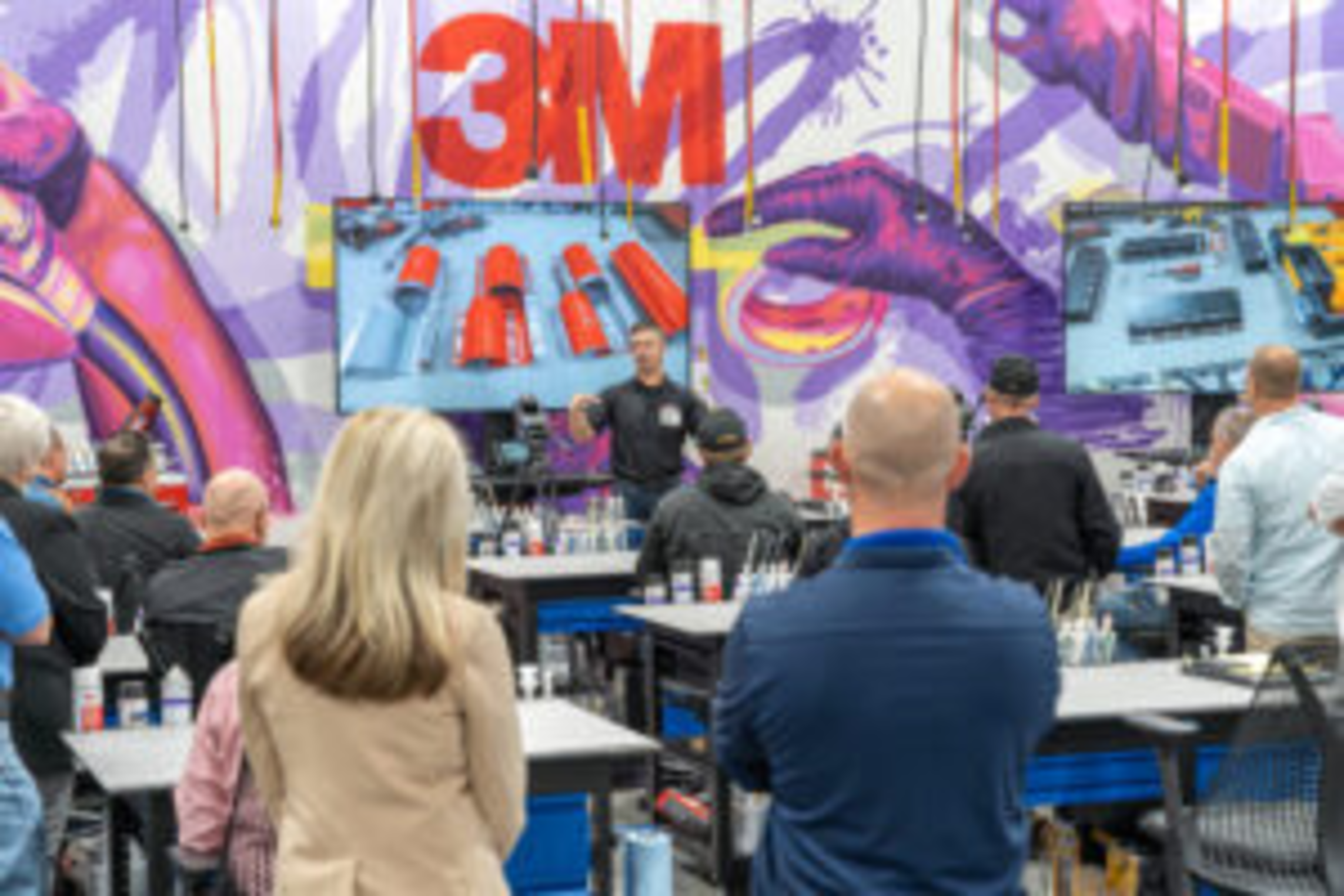
Featured image: Ryan Marrinan speaks during the 3M Skills Development Center open house on Oct. 11, 2023. (Credit: 3M)