
Washington OIC talks restitution bill and legislative process in podcast

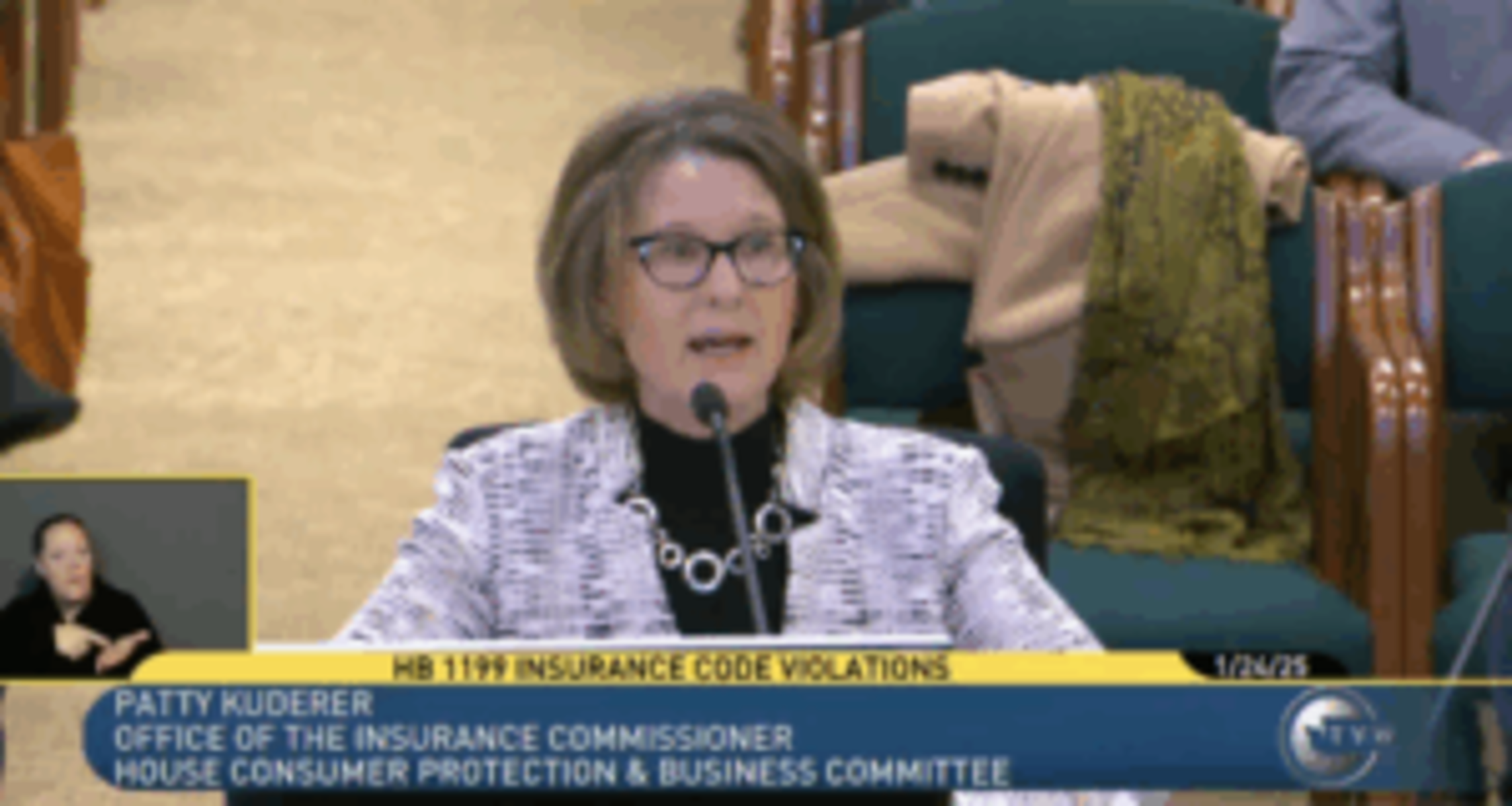
Washington Insurance Commissioner Patty Kuderer talks during a podcast about plans to introduce another restitution bill next year.
The Office of the Insurance Commissioner (OIC) supported a bill that would have given the office authority to order insurance companies to pay restitution to consumers for bad acts during the last legislative cycle but it was voted down in the House Consumer Protection and Business Committee.
The bill SB5331 would have also given the insurance commissioner the authority to fine home and auto insurance companies up to $10,000 for each violation.
A committee-approved substitute to the bill would have created a cap on total fines for the OIC at $100,000, a move not supported by the OIC and other bill advocates.
During a podcast created by the OIC Kuderer talks with Rep. David Hackney (D-11), co-chairman of the House Consumer Protection and Business committee about the bill.
Hackney notes that he was out on medical leave while the bill was making its way through the committee last session.
Kuderer told Hackney that the restitution bill was formed after hearing concerns from the industry and consumers. She said insurers told her how they voluntarily pay consumers when there’s an issue found by the OIC.
“I know that the good companies do that,” Kuderer said.
However, not all companies do and any fine ordered by the OIC goes to the state’s general fund, not the consumer, she explained.
“There has been a decrease in trust between the insurance industry and the insurers and I’ve heard that loud and clear,” Kuderer said.
She said health insurance is the top complaint she receives but it is quickly followed by property and causality concerns.
“It does sound like an important piece of legislation,” Hackney said in response. “This agency has a dual role; protection of consumes and making sure that there is a fair playing field for the industry. If we over regulate, we drive the insurance industry out of the state. I think it takes a balance but it does seem to me to make sense that those that are harmed are the ones who are compensated and not the state.”
Kuderer said that 12 other states have already passed restitution legislation.
“We are not reinventing the wheel,” Kuderer said.
However, Kuderer said she wasn’t upset that the bill failed upon it being amended for a $100,000 aggregated cap for fines.
“It just excuses the most egregious behavior and is anti-consumer,” Kuderer said.
Kuderer said she is hopeful that the bill will be filed again next year and be successful.
“I think so,” Hackney said in response. “This doesn’t seem like it falls in the normal partisan debate between moderates and progressives. This seems like a pro-consumer bill that benefits everyone.”
Hackney said he can’t speak for the committee and notes that it is really hard to predict how people will behave.
“The members of this committee are under siege by lobbyist from both sides,” Hackney said.
He added that the committee has the responsibility of also ensuring that businesses are not unnecessarily regulated.
“We don’t want to pass things that are difficult for business but this is not difficult,” Hackney said. “Follow the law. These are not gotchas, these are not loopholes, this is extreme negligence or intentional behavior.”
Insurance companies hire people to make sure they understand regulations and comply by them, Hackney said.
Kuderer said many in the insurance industry supported the bill because it was focused on the bad actors. She said good insurers don’t want the bad actors operating in their space.
Hackney noted that it often takes more than one time to bring a bill forward in order to get it passed.
“It takes time to educate,” Hackney said.
Legislators often are lobbied and they need time to decipher who they can trust and who they cant.
Hackney said he didn’t understand the role of lobbyist when he first entered office.
“I didn’t realize that most of the bills come from stakeholders and lobbyists who meet with constituents and consumer groups and business groups and because of their work and living experience they realize where the gaps are in the state,” Hackney said. “They come to us and say here is a problem that we have, can you help me solve this?”
Hackney added that he was “disappointed” that his committee didn’t support the bill.