
Patent aims to speed up EV and hybrid vehicle identification for first responders

QR codes and LED flash patterns are included in a patent aimed at helping first responders identify EV and hybrid vehicles quickly.
The patent states that the vehicle would provide an indication of the status of its energy source and would be located in an area most likely to remain intact after an accident.
“The indicator may provide a visual or acoustical indication or may provide a wireless message,” the patent states. “The indication may provide an indication of one or more of make/model of the vehicle, battery charge level, type, danger condition, danger condition reoccurrence, danger condition suppression technique, and a warning to not approach the vehicle.”
The patent states the indicator could be a QR code or barcode, and LED flash patterns could be used to provide information, such as the color blue, if the vehicle is a hydrogen vehicle.
William S. Lerner, inventor and owner of the patent, recently told Autoblog that the QR code could be placed on a rearview mirror where sun dots are typically located.
“A first responder then uses a scanner to scan the QR code and learn everything they need to know about the vehicle,” Lerner told the blog. “The second phase is that there could be an LED illumination backing the QR code to flash patterns signaling emergencies, like a car being in failure mode. Ultimately, the blinking lights and QR code serve different, complementary purposes.”
First responders could be trained on the technology through organizations, such as the International Association of Firefighters, he said.
“If you see three flashing greens, you’ll know that’s going to be an EV. If you see flashing green, then flashing pink, then flashing red, that’s going to be a hybrid. There will be three different colors starting out,” Lerner said
Lerner is a co-founder of Intermodal Renewables, a consulting firm that helps shipping, rail, and trucking companies optimize energy consumption, according to his LinkedIn profile.
He told Autoblog that the toxic mix of chemicals and carcinogens that burn during an EV fire is not completely understood.
“We don’t understand if cyanide is burning from the battery or how it mixes with the other chemicals to burn,” Lerner said. “We also have to understand that cars now have 400-500 pounds of plastic. Once you start to make a bonfire of lithium-ion and all these other chemicals, it becomes this toxic thing. We don’t have the tools to understand what the chemicals are; we don’t have the data to understand the long-term effects; we don’t have a diagnosis; we don’t have a treatment. So the most important thing you can do is to distance yourself from it until we have the data.”
Lerner told Autoblog he doesn’t take any money for his first responder training. He’s willing to license it royalty-free to certain fire departments and government agencies, and automakers won’t have to spend anything to perform a pilot program.
OEM1Stop.com, an industry site developed by automakers, provides access to vehicle repair and service information, including Emergency Service Guides for first responders, written by OEMs. The guides include proper battery removal and storage guidance as well as information about what should happen once the vehicle is brought inside the repair facility.
The Energy Security Agency (ESA) also staffs a 24/7 Guidance Center for first responders, towing and recovery, recyclers, salvage yards, and the repair industry to answer questions about properly handling EV and hybrid vehicles.
The center can walk repairers through risk assessments and help each party label the vehicles with color-coded stickers that warn others of potential risks.
The National Fire Protection Association offers numerous EV training courses online for first responders and the general public, including training sessions for vehicle dealerships. The U.S. Department of Energy website also lists EV fire training resources.
Images
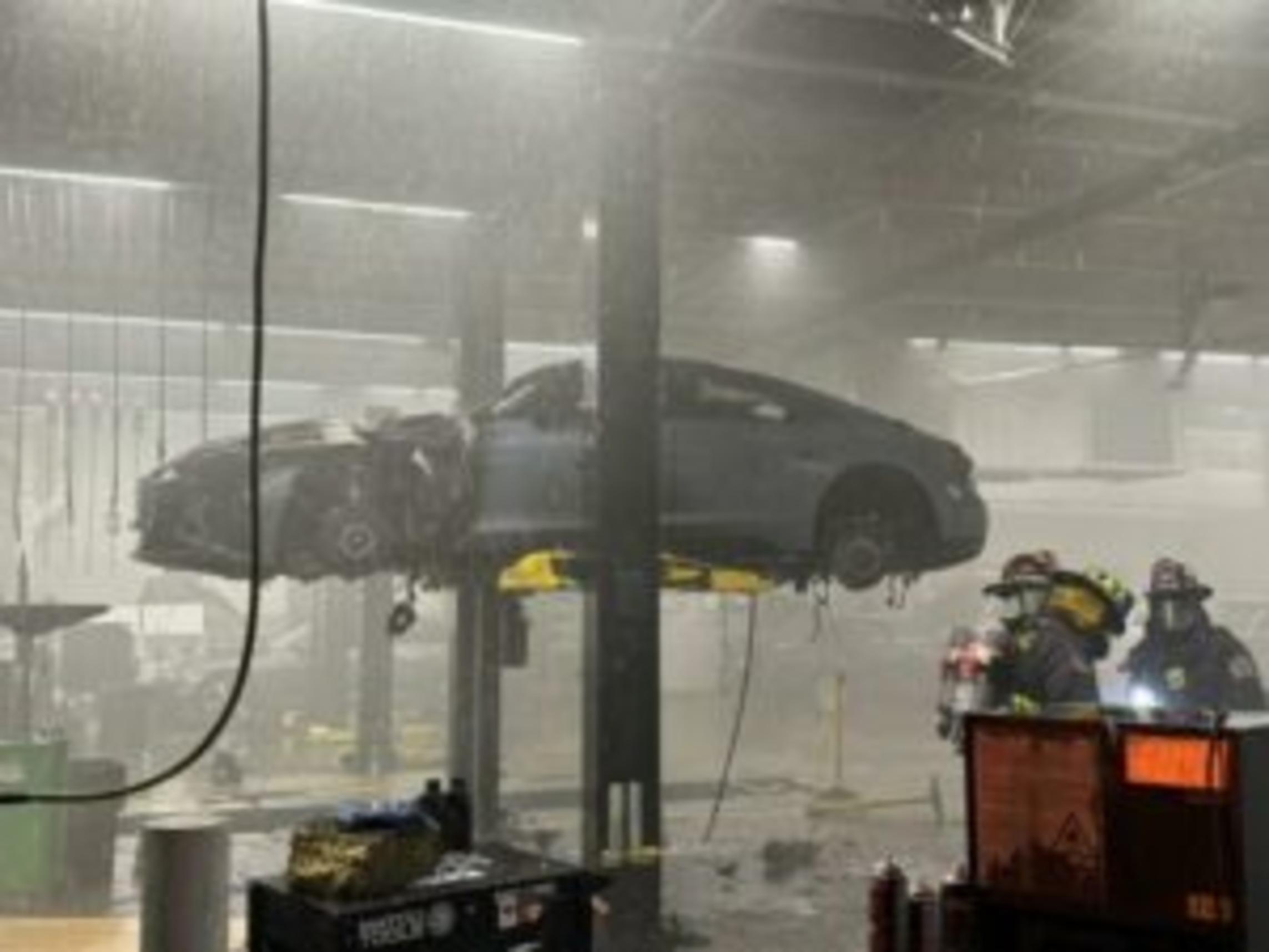
Photos are courtesy of the Carmel Fire Department.