
CIC interview discusses how calibrations could be the difference between life and death

Imagine a run-of-the-mill day. You’re making the usual drive through your neighborhood when tragedy almost strikes — a child rides their bike in front of your SUV.
That was the picture painted with real Ring camera video footage shared during the July 23 meeting of the Collision Industry Conference (CIC) in Philadelphia. Thankfully, the vehicle’s ADAS kicked in and brought it to a halt before even touching the child. But what if it hadn’t worked properly? How does that illustrate the importance of post-collision calibrations and regular ADAS maintenance?
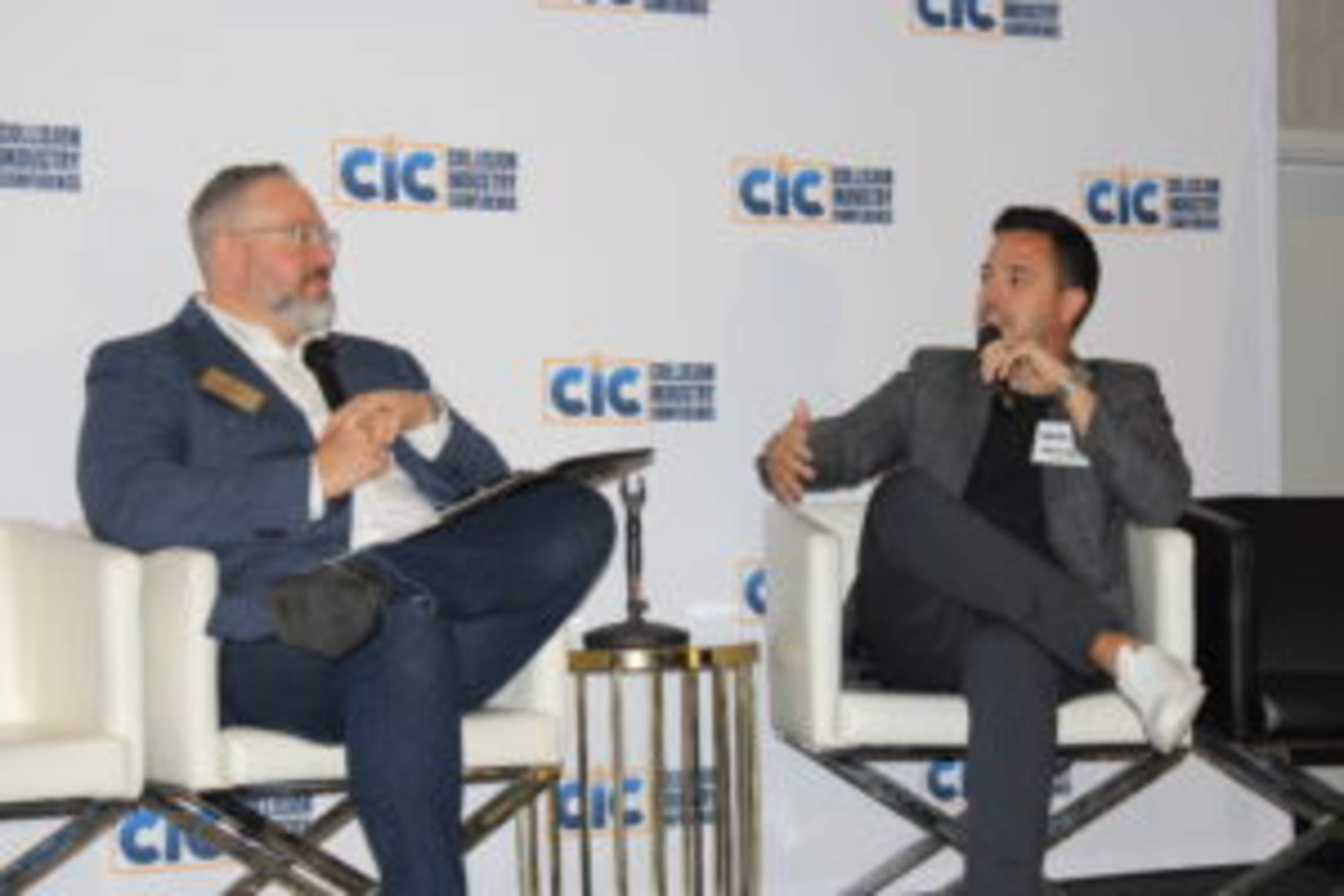
Those were questions asked and expanded on during “The Industry Experiment,” a new CIC podcast-like segment, moderated by Society of Collision Repair Specialists (SCRS) Executive Director Aaron Schulenburg. Brunno Moretti, Ascential Technologies ADAS solutions president, was brought on stage for the segment to talk about his company’s recently released research.
“This is why I’ve been in the industry for a long time and focus specifically on ADAS and autonomous vehicles and other technologies that enable safer driving,” Moretti said after the Ring camera video was shown. “I always tell my wife, ‘Drive safe,’ whenever she goes anywhere. I want the work that I do to actually help enable that to be a reality, even when maybe you have three screaming kids in the back of your car or your van, and something like this happens, to have systems in place that are going to help save lives. That child’s life was almost lost, and it wasn’t because the vehicle did what it was supposed to do.”
In January, a 2024 Nissan Altima test vehicle with about 13,000 miles — representative of the average number of miles put on a U.S. vehicle in a year — was evaluated by Ascential Technologies using National Highway Traffic Safety Administration (NHTSA) testing procedures for automatic emergency braking (AEB), pedestrian AEB (PAEB), lane departure warning/lane keep assist (LDW/LKA), and adaptive cruise control.
The Altima was equipped with forward-facing radar and camera-based ADAS features. Calibration scenarios ranged from replicating original equipment manufacturer (OEM) standards to deliberately poor conditions, including misaligned sensor mounting and suboptimal calibration environments.
The results were astounding. For example, in the PAEB good calibration tests, the baseline vehicle hit the pedestrian four out of the seven times.

Brunno Moretti
“The hypothesis on this one was the good calibration would be just as good as the baseline, the poor calibration would perform worse than the baseline, and worse than a good calibration, and the no calibration would probably hit the target a lot of the times,” Moretti said. “What we ended up finding out is that the no calibration [was like] the system was off — it did not engage alerts, it did not engage brakes… it didn’t do anything, so that was the scariest one by far. Even with a big target like a vehicle, it did not see it and didn’t do what it needed to do.”
He added that there were also a couple of surprises.
“The good calibration outperformed the baseline, and the poor calibration outperformed the baseline,” Moretti said. “To me, what that tells you is that there was already enough wear and tear of the brackets or [from] potholes or whatever has happened in those 13,000 miles that caused the vehicle’s ADAS system to drift in performance. That opens the door to talk about ADAS calibration as a maintenance item because, as these systems are on the road for quite some time, there are things that are happening that are not collisions that are knocking it out of whack.”
When asked what he thinks the average consumer would take from his research, Moretti answered, “Fear.”
“It’s just very revealing,” he said. “Coming here is shedding a light onto this and how important it is, and that we need to do more research and get more data to really quantify this problem… to know that there are consequences when you don’t do it the correct way and you don’t follow the proper way of doing things. I think it’s an educational thing that we need to make sure that gets brought up, people understand it, and then start paying attention to it.
“Every time I get a chance to go talk to a body shop and explain the technology and what it does, you see light bulbs pop up. We need to get more education out there about what it does, what it is, what happens when you don’t calibrate or when you don’t calibrate it properly.”
Moretti also said consumer education should exist, especially since OEMs naming their ADAS features differently “muddies the waters.”
While he thinks a federal mandate on ADAS calibrations would be too much, Moretti said it would be helpful for Congress to direct the National Highway Traffic Safety Administration (NHTSA) to write best practices.

Aaron Schulenburg
Moretti stressed that additional research is necessary, like what Ascential has conducted, but with more brands, vehicle types, and calibration variations to provide data to the industry on the boundaries and conditions of proper calibrations.
He noted that the tests aren’t cheap, which is what limited Ascential’s research. The research that was completed cost $100,000.
Shops can also think of ADAS calibrations as an additional revenue stream, he said.
“This is a very specific cross-section of you can make more revenue for your shop by doing the right thing,” Moretti said. “You start calibrating — you are generating more revenue for your shop, you’re doing the right thing to the customer, you’re doing the right thing to vulnerable road users… I know we’re talking about what matters to us, family, and that to me is paramount, but it’s a good business as well for the shops to do that, and it just happens to be the right thing.
“Knowing what I know through the research that we did, through the research AAA and others put out, is that you always have to be engaged, always. It is so easy to disengage because it [ADAS] is good — it works really well… but it’s not 100%.”
After the research, Moretti said he changed what he tells his wife to “Do not rely on this fully. Be fully focused. It’s nice to have, but do not let go, or yell at a kid, or check your phone, please.”
Images
Featured image: Aaron Schulenburg, SCRS executive director, and Brunno Moretti, Ascential Technologies ADAS solutions president, discuss new safety research on ADAS calibrations during the July 23, 2025, meeting of the Collision Industry Conference (CIC) in Philadelphia. (Lurah Lowery/Repairer Driven News)
Videos of ADAS calibration tests provided by Ascential Technologies