
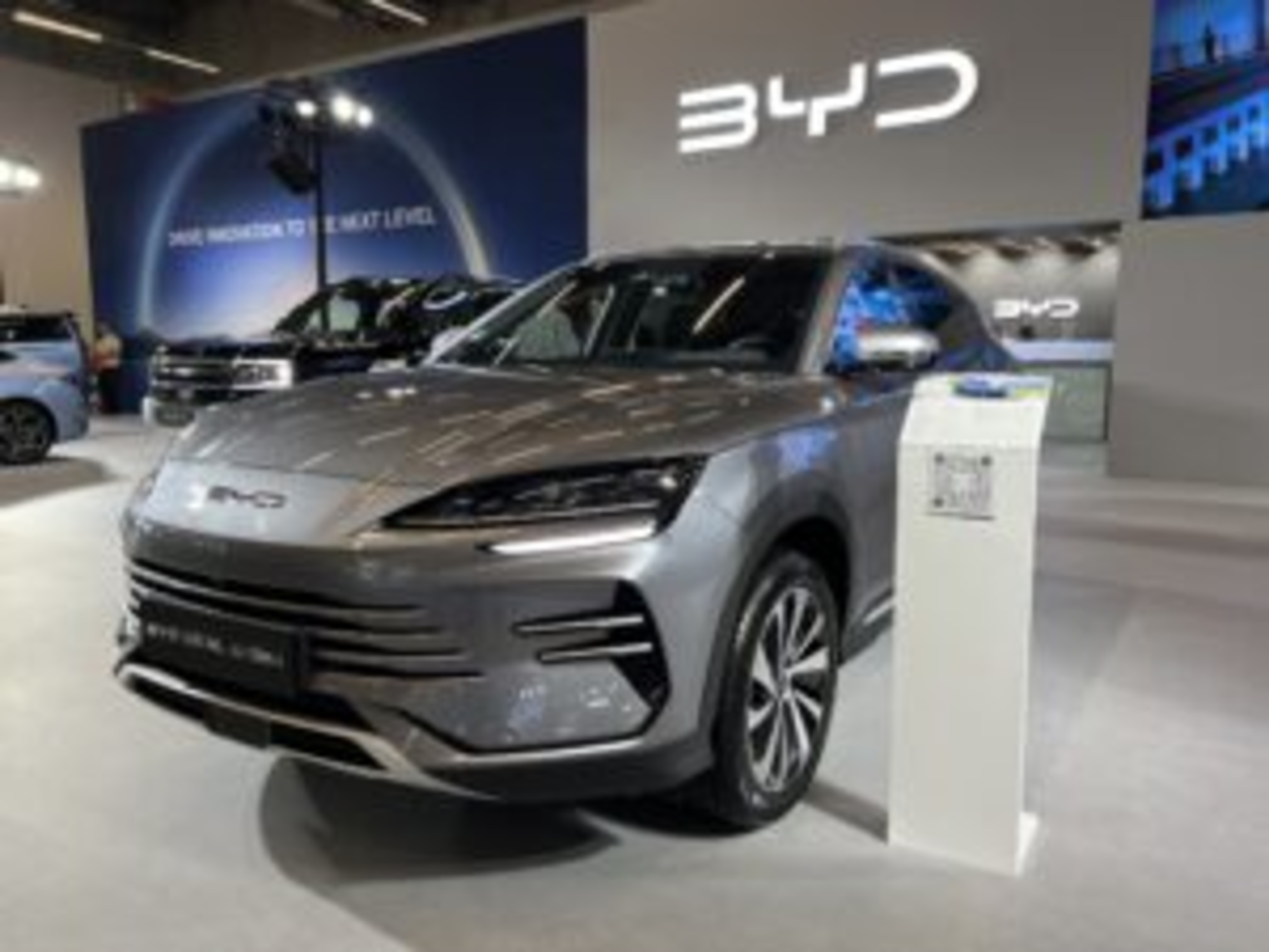
Former GM executive NYT opinion piece says changes must be made in auto industry to compete with China

A former General Motors executive writes that America “must take a page from China’s playbook” if it wants to remain competitive in the automotive sector in a recently published New York Times opinion piece.
Michael Dunne was previously GM’s Indonesia president and J.D. Power’s vice president and managing director for China. He currently runs his own consulting company, Dunne Insights.
“Like it or not, China is the new center of the global automotive industry,” Dunne said in an X post about his opinion piece. “Its scale, speed, supply chains, software, and subsidies are overwhelming Western automakers.”
Dunne writes that BYD surpassed Tesla with the world’s top-selling EV brand last year and is on track to be even with Toyota and Volkswagen as a carmaker by 2030.
Currently, a 100% tariff rate on electric vehicles keeps BYD, sold for about $10,000 in China, out of the U.S. market. The tariff rate began in September under former President Joe Biden.
“Erecting tariff walls may buy the domestic auto industry some time, but it ultimately won’t insulate American manufacturers from BYD or the bigger threat that it represents,” the NYT piece says. “The company embodies a Chinese industrial model that is leaving America in the dust.”
The model includes government financial support, methodical long-term planning, and aggressive innovation, the piece says. This has helped China achieve global dominance in high-tech industries, from batteries to robotics to drones, it adds.
“If the same happens in auto manufacturing, the impact would be far worse for America because of the industry’s size and its economic, political, and strategic importance,” the article says. “The success of BYD and several other upstart Chinese car brands should be a warning for U.S. auto manufacturing and our industrial sector as a whole. We need the courage to recognize how badly we are falling behind, shake off complacency, and adopt an urgent government-led effort — think of a Manhattan Project but for cars — to restore U.S. competitiveness.”
Dunne says that in the early 1990s, cars produced in China were known to be of poor design and made with cheap materials. BYD began making vehicles in 2003, and they were known as clunkers, he said.
He said this has changed, as BYD models are now as good as Tesla in design, features, and advanced technologies. The company’s Blade battery is among the safest and most cost-efficient, he said.
BYD is believed to have received billions of dollars in government funding for the development of its vehicles, Dunne says.
Dunne adds that BYD builds vehicles inexpensively by using vertical integration.
“While most major carmakers source many important parts from outside suppliers, BYD makes almost all of its key components in-house, including batteries, semiconductors, motors, and tablet screens, which saves costs and enhances quality control,” the piece says. “It developed its cars’ operating software, has stakes in mines and mining companies that produce the minerals for its batteries, and transports its vehicles around the world aboard its fleet of specially designed car-carrier ships.”
BYD also rapidly innovates, Dunne says. He notes that it released an autonomous driving system this year that competes with Tesla’s. The company also claims it has technology that can charge a vehicle in 5 minutes.
If let into the U.S. market, BYD could “end up destroying its U.S. competitors,” he said.
“We can coddle American companies with tariffs, but it won’t change the fact that we are losing badly,” Dunne writes. “China is, far and away, the world’s largest producer and exporter of all types of cars, including electrics. BYD and its Chinese peers may be shut out of the United States, but they are seizing control of the fast-growing global EV industry. Unable to compete abroad, U.S. automakers will have to retreat into the narrow space where they remain strong: the domestic market for gas-guzzling trucks and SUVs.”
Dunne states that the U.S. has never confronted an industrial competitor like China and added that the auto industry is important to the nation for multiple reasons, including national defense. Technologies developed by the industry, such as batteries, sensors, and motors, are often adapted for use in military equipment, he said.
“China’s control of supply chains for batteries and rare earth minerals used in electric vehicles is also a potential national security threat, one that we glimpsed recently when Beijing retaliated against U.S. trade tariffs by halting exports of rare earths and the magnets made from them,” Dunne says. “Led by its national champion BYD, China has overtaken Detroit as the center of the global auto industry. America can embark on an all-out push to rebuild world-class manufacturing and supply chains, or our carmakers can hide behind tariffs, continue making gas-powered trucks and SUVs, and fade into irrelevance.”
The Ministry of Industry and Information Technology of China released an international standard on test scenarios for autonomous driving systems Monday, according to China Daily, a media source owned by the Central Propaganda Department of the Chinese Communist Party.
The standard outlines evaluation procedures and methods for the test scenarios, the article says.
“The ministry will cooperate with Chinese institutions in the automotive industry, including [the] technology research center, to further contribute to the formulation and revision of international standards in the field,” China Daily reports.
Images
BYD display at Automechanika Frankfurt