
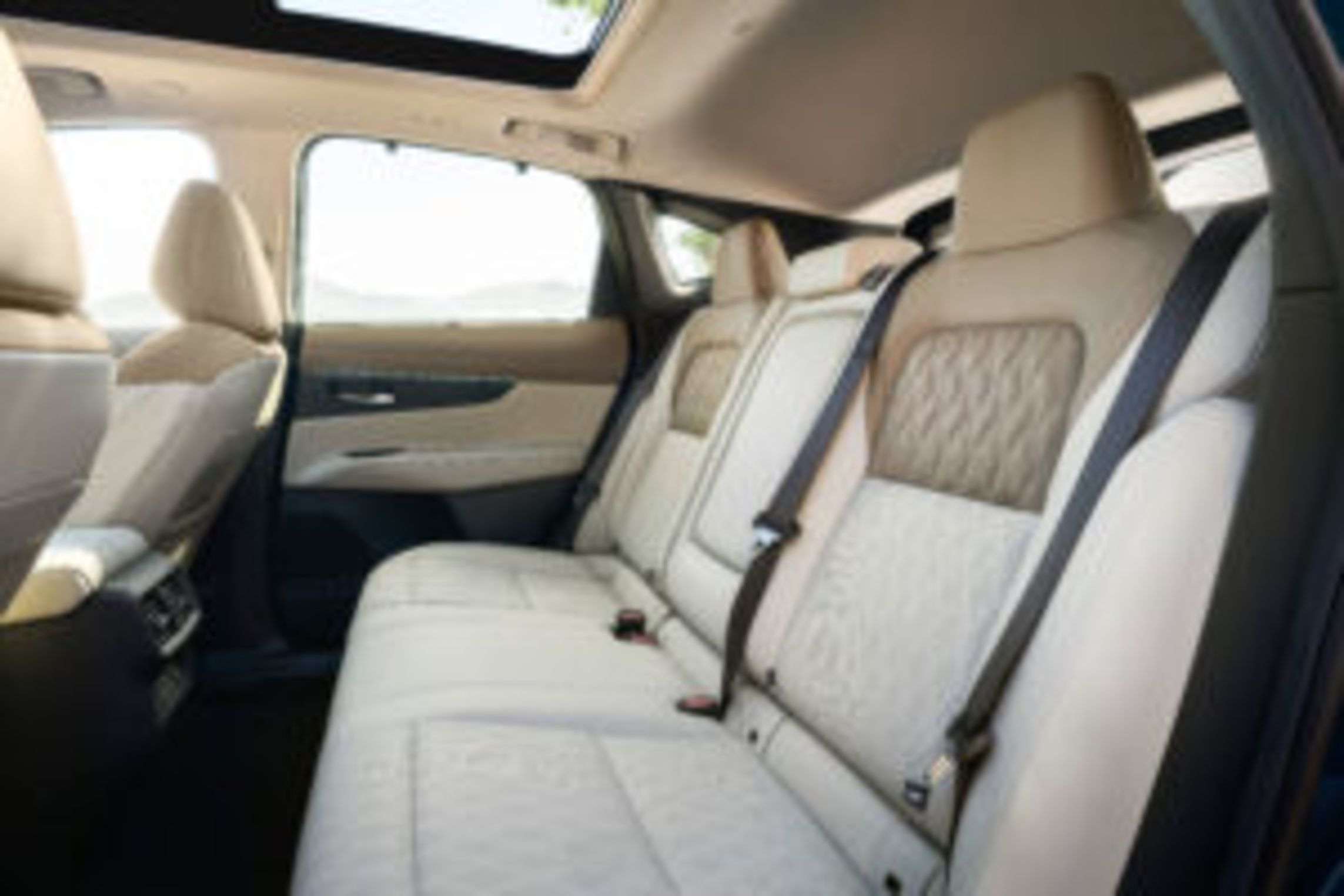
Nissan highlights engineering, improved rear seat safety behind new IIHS Top Safety Pick+ Murano

The all-new 2025 Nissan Murano includes upgraded safety features engineered based on OEM testing using advanced monitoring equipment on board and in crash dummies, according to a press release.
The equipment provided data on how the vehicle absorbed crash energy, and high-speed cameras captured passenger positions to evaluate how well seatbelts keep them in line with air bags as they’re deployed to reduce the risk of injury.
The safety improvements led to the Murano earning the Insurance Institute for Highway Safety (IIHS) Top Safety Pick+ award.
Nissan said that while developing the new Murano, there was an intensified focus on enhancing rear-seat passenger safety. Crucially, the seat belt system must help prevent “submarining” — when the passenger partially slips under the lap portion of the belt, increasing the risk for injury, the release says.
“Having a safe rear seat is important in any vehicle,” said Jeff Sitko, Nissan’s safety performance manager, in the release. “That’s where we’re going to put our younger family members, and so we engineered it to be as safe as possible.”

To qualify for either Top Safety Pick+ or the lower-tier Top Safety Pick award this year, vehicles needed good ratings in the small overlap front and updated side tests, an acceptable or good rating in pedestrian front crash prevention, and acceptable- or good-rated headlights across all trim levels.
To achieve the IIHS’s highest individual test rating of “good,” rear seat occupants must be well-protected in the updated moderate front overlap test.
“The Murano performed very well,” Sitko said. “Rear seat passengers’ interaction with the seatbelt and air bag was excellent.”
Part of earning the IIHS Top Safety Pick+ award requires a vehicle to protect its occupants well when it crashes into a deformable, offset barrier at 40 mph, according to the release.
To achieve this result, Nissan engineers replicated the crash test several times at the OEM’s $40 million Safety Advancement Lab near Detroit, Michigan, where roughly 400 crash tests are conducted each year, simulating real-world scenarios. Results were studied after each crash, and if adjustments were needed, engineers found a solution and implemented it in the next test, the release says.
The Murano is equipped with Nissan’s Safety Shield 360, which uses cameras, radar, and sonar to monitor in front, behind, and beside the vehicle as it drives and deploys a suite of advanced driver assistance systems (ADAS) as needed. The ADAS are automatic emergency braking with pedestrian detection, high beam assist, lane departure warning, blind spot warning, rear cross traffic alert, and rear automatic braking.
“Nissan safety and design engineers collaborate extensively to ensure the Murano’s body structure deforms as intended to absorb energy during a crash and protect passengers,” said Derrick Diver, Nissan senior safety performance engineer, in the release.
The release notes that, like all Nissan vehicles, the Murano was crash tested from the front, side, and rear as well as through pedestrian crash tests, among others.
“One of the most grueling tests is the side oblique pole test, which simulates the vehicle hitting a rigid, pole-like barrier on the side,” the release states. “The test is just one of those conducted by the federal government’s New Car Assessment Program (NCAP). Murano earned an overall five-star safety rating from NCAP.”
The crash is a true test of the vehicle’s side and curtain air bags, according to Nissan.
“It represents if a vehicle were to skid and strike a utility pole, for instance,” said Adam Gohl, a Nissan safety performance engineer, in the release. “Immediately after the test, we look to see if the air bags deployed properly. The dummies’ heads are painted, so we evaluate the paint transfer from the head to the curtain air bag. It helps us evaluate where the passenger contacted the air bag and whether it aligned with the intended zone.”
Engineers also examine the vehicle to ensure doors remain latched and there are no fuel leaks.
The oblique pole test is a key indicator of a vehicle’s structural strength, and as in the front-impact tests, the Murano performed exceptionally well, Nissan said.
“People share stories that they survived an accident — the restraint systems worked as designed, and the body structure kept them safe. Those are incredibly inspiring,” Gohl said.
Sitko added, “I trust the vehicles I design to help keep my family and friends safe. They don’t have to worry about safety because I do. That’s a very rewarding feeling.”
Five other vehicles also earned this year’s IIHS Top Safety+ award — the Hyundai Elantra, Kia K4, Toyota Prius, Hyundai Sonata, and Toyota bZ4X.
The Murano was the only midsize SUV to earn the award. The Elantra, K4, and Prius are categorized as small cars. The Sonata is a midsize car, and the bZ4X is a small electric SUV.
For several vehicles, the award applies only to models built after a certain date, when their manufacturers made modifications to improve rear occupant protection. The award applies to Elantras built after October 2024, Sonatas built after November 2024, and K4s built after January 2025.
Images
Featured image: Rear seat of the 2025 Nissan Murano. (Photo provided by Nissan)
2025 Nissan Murano (Photo provided by Nissan)