
CIC committee clarifies proper clearcoat procedures

The Collision Industry Conference (CIC) Repair Process & Procedures Committee discussed the clearcoat operations that ensure a seamless, durable, and warrantied finish during CIC’s most recent meeting in Richmond, Virginia.
“There’s always some confusion as to what pathology repairers choose to follow,” said Kye Yeung, owner of European Motor Car Works in Santa Ana, California. “This gives us an opportunity to educate and show the differences of what is out there.”
Yeung said clearcoat is applied to vehicles to protect the color once it has been applied.
Yeung asked, “If you have a quarter panel on a vehicle that’s either damaged or been replaced, where do you stop painting?”
Clearcoat examples on social media or YouTube will often show off how shiny a paint job is but don’t always use the proper procedures, he said.
He showed examples where repairers use foam tape or back tape the back door to the quarter panel. Similar examples on social media or YouTube will often show off how shiny a paint job is but don’t always use the proper procedures, he said.
Axalta released a recommendation document earlier this year that says applying clearcoat to a back taped or back masked body line can generate failures.
“It is also important to note that most vehicle manufacturers do not recognize clearcoat blending or back taping/back masking on body lines as an accepted method for the execution of OEM warranty repairs,” the document says.
The document also says that when repair centers receive requests to blend clearcoats within a panel versus applying the clearcoat to the entire panel, a finish can be produced that appears acceptable to the customer. However, the blend edge can become apparent within the remaining service life of the vehicle.
Tim Ronak, AkzoNobel senior services consultant, said there is a specific process that technicians need to use for AkzoNobel to honor a refinish warranty.
“They must take it back to the nearest breakpoint or panel edge,” Ronak said. “We define the breakpoint pretty clearly as a 180-degree panel edge.”
He said this is a pretty uniform statement for paint manufacturers.
“I used to be a technician and a painter, and one of the things that we would find is that moisture would get to the edge of whatever paint surface coating, if you had an edge tape, and it would freeze,” Ronak said. “When it froze, it would slightly lift the very edge of the surface, and it would start to cause it to release. And then, over time, it shows up as peeling.”
AkzoNobel published documents in 2014 and again in 2018 outlining the process that needed to happen to receive the warranty, he said.
“There’s all kinds of things you can do, but that liability falls on the repairer and the impact on their customer,” Ronak said. “Have they really put that customer back to the contracted position that the insurance company provides as part of their insurance document?”
Mil thickness is another key component of a proper clearcoat, Ronak said.
“That mil thickness is defined by each manufacturer,” he said. “[For] some it’s 2 mils, some it’s 3 mils. It just depends on the individual manufacturer how much UV screening is in those products. If you go below what they require, it will allow enough UV penetration to get through that top coat and allow it to degrade the undercoat.”
Yeung explained that most manufacturers have a minimum of 2 mils. He added that the average piece of printing paper is 4 mils.
“That tells you how thin of a clearcoat has to be applied to a vehicle,” Yeung said.
There is equipment that can measure mil thickness, Yeung said. This includes measuring different layers of substrates.
Yeung said he’s had situations where vehicles have come back to the shop with paint peeling.
“We’re thinking, ‘We did everything right. It has to be the product,'” Yeung said. “But when the paint rep came out and measured the clearcoat, we were below the 2 mils because we polished it too far. It happens every day, even when your heart’s trying to do the right thing. Things do happen.”
Yeung asked the panelists how they educate customers on the steps needed to complete a proper repair that includes clearcoat.
Justin Lewis, president of Accurate Auto Body in Redmond, Washington, said it starts with the estimating process.
“When we have our consultation with our customer, we’ll walk out, go over the vehicle, and explain the repair process,” Lewis said. “We’ll explain a lot of the OEMs, and I think all the paint manufacturers, have position statements on what’s warrantied and what’s not. We’ll go through, we’ll explain to our customer why we do what we’re doing. A lot of times, they just can’t comprehend. They’re not in the shop every day. A lot of times, we’ll offer to bring them back into our paint department, show them what that looks like, explain in depth why we’re doing it that way.”
A January 2019 “Who Pays for What?” survey found 82% of respondents said leading insurers “always” or “most of the time” reimbursed work to extend clearcoat to its natural break.
CRASH Network’s 2024 survey found 79% of insurers always or most of the time reimbursed for labor to apply clearcoat over an entire panel or as far as a molding or other breaking point to ensure the refinish work qualifies for lifetime warranty from the paint manufacturer.
In 2020, the Database Enhancement Gateway worked to help clarify the topic.
“In the P-pages, it states that the clearcoat must be carried to the nearest break point,” a user wrote in an inquiry regarding a 2018 Cadillac CT6 and the CCC P-pages. “On this particular case, the damage is to one quarter panel and the clear coat needs to be taken UP on the roof and OVER to the adjacent pillar/quarter panel. According to the insurance adjuster’s interpretation, a gap between two panels is not necessary, and the valley delineating the pillar from the roof is a proper location to break the clear coat.”
CCC responded to the user by stating that when refinishing a “Welded-On Panel,” the requirement is to refinish to the nearest “Break-Point” because creating a “Blend-Line” at a “Non-Break Point” may result in “Refinish Deterioration.”
“Repairing the quarter panel and the outer surface of those parts will require some type of refinishing. The time necessary to perform this type of operation should be estimated after an on-the-spot evaluation of required procedure. MOTOR recommends these factors be considered before finalizing any repair cost estimate.”
CCC also quoted the Refinish Clear Coat Application entry referenced above. That P-pages item states: “Most major paint manufacturers recommend that when performing refinish repairs on an OEM base coat/clear coat or multistage finishes, the application of clear coat must be extended to the nearest panel edge or breakpoint to qualify for their lifetime refinish warranties.”
Images
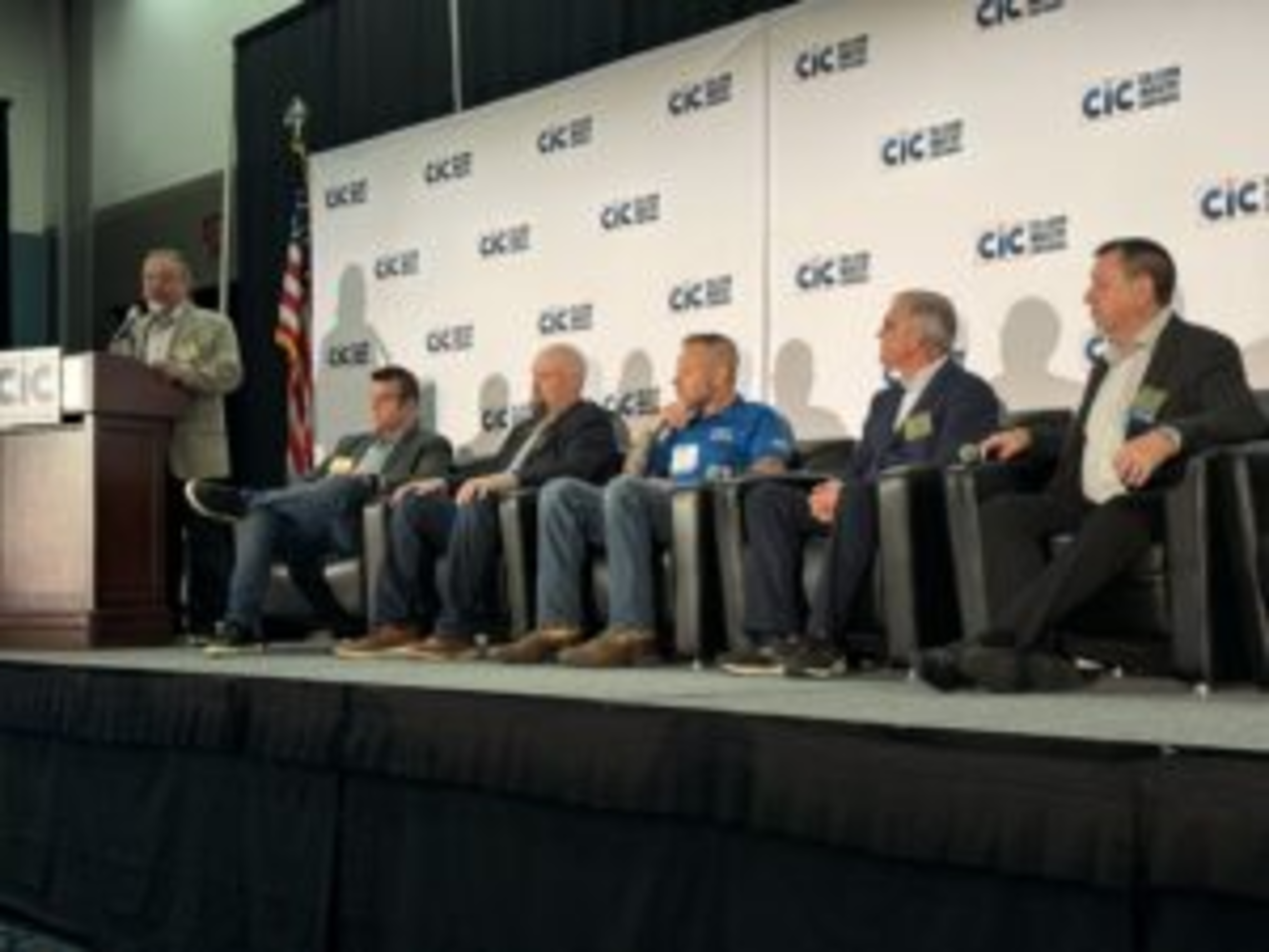
Repair Process & Procedures Committee presents at CIC May 1 in Richmond, Virginia/Teresa Moss