
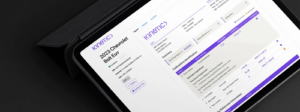
Intrepid and Kinetic program will give premium discounts for ADAS procedures preformed

A new program launched by Intrepid Direct and Kinetic ID could reduce business insurance costs for collision repair shops that recognize and complete ADAS procedures.
Nikhil Naikal, CEO and co-founder of Kinetic, told Repairer Driven News that the software is used by shops and insurance carriers to identify ADAS requirements when vehicles have been in a collision or if they had a mechanical repair done.
“Sensors on the vehicles can be disrupted or dislodged during the process of a repair and the requirements of calibrations are not very easy to know or understand,” Naikal said. “It is a hidden digital damage. Kinetic ID is a software that helps identify when reprogramming and calibrations are required.”
Intrepid Direct, which provides business insurance to collision repair facilities, have identified that the completion of proper ADAS procedures serves as a liability risk control, Naikal said.
“Collision repair keeps getting more complex, and shops are being asked to take responsibility for increasingly sophisticated vehicle systems,” Bill Strout, president of Intrepid Direct, says in a press release. “This program gives our customers an easy way to build systematic ADAS review into their estimating and repair workflows through Kinetic ID Premium. Just as important, it creates a way to recognize shops that consistently identify and complete the right ADAS procedures, because those practices help reduce repair risk.”
Through the use of Kinetic ID software, collision shops can qualify for additional liability and umbrella premium discounts, Naikal said. He adds that Intrepid Direct sees more use of the software and performance of ADAS calibrations as risk reducing behavior by the collision repair business.
“Their completed operations exposure goes down, and umbrella claims can go down,” Naikal adds. “Intrepid is recognizing that positive behavior and willing to reward that behavior with additional discounts.”
Identifying calibrations is important for vehicle repair, Naikal added.
“These sensors on the cars are no longer just convenience features,” he says. “They’re safety features. A vehicle that’s driving down the freeway at 60 miles per hour with a miscalibrated lane-keeping or lane-assist sensor behind the windshield or a blind spot monitoring system that doesn’t alert oncoming traffic in an adjacent lane can cause an accident and can be life-threatening for both the driver and passengers as well as the other vehicle.”
Failing to calibrate sensors can leave a vehicle not returned to its original state of safety, Naikal adds.
Naikal notes that Kinetic is a starting point that repair shops should use.
“The repairer is the one who has to make these decisions, and it could be nuanced,” Naikal said. “It could be circumstances and instances that they would choose to go one way or the other. Our idea with the software is to give them a starting point on the research and on where to go look.”
The partnership is a sign that the broader industry is recognizing good repair behavior, he adds. Shops that bring vehicles back to the factory state of safety will be rewarded for that behavior, he says.
“This is a good thing that the broader industry is starting to recognize shops that go the extra mile and make sure that the cars are repaired correctly,” Naikal says.
During a Collision Industry Conference meeting earlier this year, Rebekah Cooper, The Cooper Firm partner, explained how improper repairs, including those that involve ADAS systems, can be deadly or cause serious injuries.
Improper repair cases are changing as more emerging technology, such as ADAS features, become prominent on vehicles, she said. She said the legal system currently sees dozens of ADAS cases annually and that number is expected to increase.
She told the story of a case where a repair involving a bumper necessitated a calibration that wasn’t completed by the repair shop.
The firm discovered this by looking at what technology was on the vehicle and the repair procedures to see how it’s supposed to be repaired. They tracked the vehicle back to the last place it was repaired. It was discovered the business didn’t do the needed repair, she said.
The failed repair caused the collision warning not to work, she said. The consumer was quadriplegic following the crash. She lived in a mobile home for three years waiting for accountability, Cooper added.
“There are times we ask a shop for those, and the OEM has it, but the shop does not,” Cooper said. “Have you seen this before? When is the first time? Are you seeing it for the first time right now? If the answer is yes, that’s a problem.”
Intrepid and Kinetic’s new program will also give Intrepid Direct collision repair customers a limited-time free trial of Kinetic ID Premium and provide Kinetic network shops with access to Intrepid Direct insurance.
The program will kick off with Kinetic and Intrepid Direct co-hosting an event at Wynn Las Vegas Tuesday, Nov. 3 at 6 p.m. during the SEMA Show.
The Society of Collision Repair Specialists’ (SCRS) 2026 OEM Collision Repair Technology Summit will dive into a conversation about ADAS and calibrations during the SEMA Show next week.
The afternoon begins with “The National Safety Objective: Safer Vehicles, Safer Roads,” featuring National Highway Traffic Safety Administration (NHTSA) Deputy Administrator Lee White, who will examine federal vehicle and roadway safety priorities.
The session, held Thursday, Nov. 5 from 12:30-1:30 p.m., will include a conversation about emerging transportation technologies, data-driven research, and the federal government’s work with the industry to reduce fatalities and serious injuries, an SCRS release states.
During the “Engineering the Safety Benefit: From Requirements to Real-World Performance” session, active safety engineers from General Motors and Rivian will provide a look behind the engineering decisions that influence vehicle safety before, during, and after a collision.
The session, held Thursday, Nov. 5, from 2–3 p.m., will explore ADAS feature development, real-world effectiveness, crash avoidance and mitigation, implications of inoperable systems, verification of safety performance, and the potential for system degradation.
A session that follows, “Preserving the Driver Assistance System: Sensors, Calibration and Repairability,” will include service engineering experts from General Motors, Ford Motor Co., and Rivian. The conversation will answer for repairers what it takes to preserve and restore ADAS capabilities engineered into the vehicle after collisions.
The session, held Thursday, Nov. 5, from 3:30–4:30 p.m., will also take attendees behind the development of collision repair information.
The 2026 OEM Collision Repair Technology Summit is part of SCRS’ Repairer Driven Education (RDE) program at the SEMA Show, which includes several classes, the IDEAS Collide Showcase, and more.
An SCRS RDE Full Series Pass provides access to Tuesday and Wednesday RDE sessions, IDEAS Collide, the OEM Collision Repair Technology Summit, and the SCRS Afterparty. To register for the full series pass, click here.
For additional information about SCRS and Repairer Driven Education, visit scrs.com/rde.
Image
Photo courtesy of Kinetic.