
Toyota plans hydrogen-powered commercial trucks launch for 2027

Toyota Motor North America says its commercial hydrogen-powered trucks will hit the road next year.
Its Hydrogen Headquarters (H2HQ) division is steadily improving fueling for heavy-duty fuel cell trucks as it works to bring advancements to the OEM’s commercial U.S. fleets, according to a company press release.
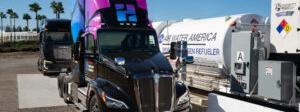
Toyota recently installed two mobile hydrogen fueling devices at North American Parts Center California (NAPCC), its largest U.S. parts distribution facility.
With the tanks and fuel in place, Toyota’s commercial logistics fleets plan to use the mobile fuelers to support operations by fueling heavy-duty fuel cell trucks hauling freight from the Port of Los Angeles to Ontario and throughout the region. Toyota plans to build a permanent station on site.
The station will initially fuel heavy-duty trucks commissioned through Hyroad Energy and will later integrate heavy-duty trucks with Toyota’s own certified fuel cell powertrain.
In a public-private partnership, Toyota is collaborating with the U.S. Department of Energy’s National Laboratory of the Rockies (NLR) in Golden, Colorado, to research several initiatives, including 70 MPa high-flow hydrogen fueling for heavy-duty trucks.
High-flow fueling means trucks can accept hydrogen fuel at speeds about five times faster than conventional light-duty fueling technology, up to 300 grams per second, and allows energy to be brought into heavy-duty trucks equivalent to the speed of a 20 MW fast charger.
Refueling times are comparable to modern diesel-powered, heavy-duty trucks. Unlike a diesel powertrain, however, fuel cells emit only water.
Toyota and NLR engineers and researchers have conducted multiple rounds of testing under SAE J2601-5 standards, demonstrating that the OEM’s heavy-duty trucks can be refueled in about 8 minutes for a range of up to 450 miles, the release states.
Over the next several months, Toyota says it aims to upgrade its private fueling infrastructure at its H2HQ to the same high-flow standard for testing heavy-duty vehicles. It also plans to install new equipment for light passenger fuel cell electric vehicles in order to evaluate station hardware and share insights intended to improve operations and reliability.
When the publicly available permanent station at NAPCC goes online, Toyota plans to provide conventional and high-flow hydrogen fueling for heavy-duty trucks, along with a separate area for fueling light-duty vehicles.
Toyota continues to develop and refine fuel cell technologies for heavy-duty vehicles, commercial applications, stationary power generation, and light-duty passenger vehicles, including supporting past, current, and future vehicle development.
General Motors and Stellantis discontinued hydrogen fuel development last year.
In July, Stellantis announced it will discontinue its hydrogen fuel cell technology development program “due to limited availability of hydrogen refueling infrastructure, high capital requirements, and the need for stronger consumer purchasing incentives.” The company said it didn’t anticipate hydrogen-powered light commercial vehicle adoption before the end of the decade.
In October, GM announced it would cease next-generation hydrogen fuel cell development through its Hydrotec brand to focus its research and development and capital resources on batteries, charging technology, and electric vehicles.
In September, Toyota filed a patent application for a hybrid electric vehicle with a hydrogen engine.

The diagram above shows Toyota’s proposed patented arrangement of hydrogen tanks and battery as viewed from below the vehicle.
According to the patent application, the vehicle would include a center tunnel, hydrogen engine, generator, battery, and hydrogen tank. The generator would provide electric power after receiving it from the hydrogen engine.
Images
Featured image provided by Toyota
Diagram provided in U.S. Patent and Trademark Office patent application 20260274062