
Rivian and Redwood expand partnership to repurpose EV batteries

Rivian has expanded its partnership with energy technology company Redwood Materials to recycle production scrap and end-of-life EV batteries, according to a Rivian press release. Redwood will also provide stationary battery storage at its manufacturing plant in Normal, Illinois.
Redwood collects Rivian EV battery packs through Rivian’s nationwide network of service centers when they are no longer suitable for in-vehicle use. Redwood then evaluates each battery pack for energy storage at Rivian’s manufacturing facilities or other locations, or for recycling. Redwood will now also recycle battery scrap generated at Rivian’s manufacturing operations.
Rivian says the partnership expansion builds on existing work, announced in April, that provides 10 megawatt-hours (MWh) of battery energy storage from repurposed Rivian battery packs at the automaker’s Illinois manufacturing plant.
“Giving Rivian battery packs a second life in stationary storage is a massive unlock for the energy transition,” said RJ Scaringe, Rivian founder and CEO, in the release. “By partnering with JB and the Redwood team, we’re turning retired EV batteries into a powerful tool to make the grid more reliable and lower energy costs for everyone.”
JB Straubel, Redwood Materials founder and CEO, added that every Rivian battery pack can potentially provide domestic grid energy storage and critical materials.
“Redwood’s unique ability to integrate and redeploy Rivian batteries with our technology is an opportunity to enable fast, flexible, and more cost-efficient energy storage,” he said. “As the demand and cost for energy keep rising, working with companies like Rivian is how we help meet these challenges.”
Energy storage applications with repurposed batteries can ease grid stress during periods of high electricity demand, improving grid reliability while reducing energy costs for users and the grid at large, the release states.
During periods of low demand or when low-cost renewable energy is most productive, the packs can store electricity for easy dispatch during periods of higher demand. When paired with EV battery packs from Rivian and others, the release states that Redwood’s proprietary technology architecture offers an integrated system that can respond intelligently to the needs of the facility it is serving.
Then, when batteries are no longer useful in energy storage applications, or when manufacturing generates scrap, they can be recycled.
Redwood’s process can recycle and recover critical minerals, such as lithium, nickel, cobalt, and copper, at rates exceeding 95%, encouraging circular, domestic supply chain development for battery materials in the U.S., according to the release.
“This expanded partnership reflects a broader shift underway in how American manufacturers source power,” the release states. “As grid connections take years to secure and conventional infrastructure remains supply-constrained, companies increasingly need partners who can solve more than one piece of the problem — recovering materials, managing recycling, and deploying storage as a single system rather than separate vendors.”
BMW and General Motors have also previously announced partnerships with Redwood. BMW’s was to recycle lithium-ion batteries, similar to recycling partnerships Redwood signed with Toyota, Ford, Volvo, and Volkswagen.
GM launched a program to accelerate the deployment of energy storage systems using new and second-life battery packs from the automaker’s EVs.
Images
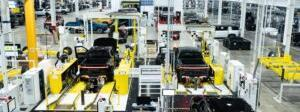
Featured image: Rivian’s manufacturing operations at its Normal, Illinois plant.