
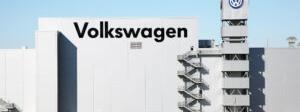
Volkswagen starts restructuring as it faces pressure from Asian vehicles

Volkswagen moves forward with a restructuring program that includes 50,000 jobs after being excluded from the benchmark Euro Stoxx 50 index Monday, according to multiple media reports.
German automakers and suppliers have faced profit cuts as they compete with cheaper Asian vehicles entering the European market and with U.S. tariffs.
Tens of thousands of auto workers protested across Germany Monday, calling on Volkswagen and Mercedes-Benz to secure jobs, according to Yahoo News.
Mercedes, BMW, and Bosch have all released plans to reduce tens of thousands of jobs, the article states.
U.S. News reports that the protests also focused on possible production relocations and plant closures in the country.
“I had hoped that the measures agreed in 2024 would already be sufficient. Unfortunately, that has not been the case,” U.S. News reports that Volkswagen Brand Head Thomas Schaefer told staff during a meeting at the company’s Wolfsburg headquarters.
Volkswagen stakeholders approved the plan earlier this month, the article states. It adds that the company also cut its 2026 profit margin outlook to 1% last week.
U.S. News says the automaker is also struggling in part because of accelerated demand for less profitable electric vehicles.
“Most managers have failed to keep pace with developments in e-mobility, digitalisation and battery technology, thereby causing the German automotive and supplier industries to fall behind,” said Horst Ott, of trade union IG Metall, according to U.S. News.
Volkswagen shares fell 1.1% after being excluded from the Euro Stoxx 50 index Monday, and Porsche shares dropped 1.6%.
In recent months, the U.S. has taken multiple steps to keep Chinese automakers out of the country.
The Alliance for Automotive Innovation (Auto Innovators) asked the U.S. House and Senate to permanently ban the sale, import, and manufacturing of Chinese connected vehicles, hardware, and software before the 119th Congress concluded earlier this month.
The letter points to multiple pieces of bipartisan legislation already before Congress.
This includes the Connected Vehicle Security Act of 2026, a bipartisan bill introduced by Sen. Bernie Moreno (R-Ohio) and Elissa Slotkin (D-Michigan) in May, and advanced by the U.S. Senate Commerce Committee in July.
The bill would ban any vehicle equipped with connected hardware or software from China.
The companion bill, H.R. 8730, was filed by U.S. Reps. John Moolenaar (R-Michigan) and Debbie Dingell (D-Michigan).
While it wasn’t mentioned in Auto Innovators’ release, Dingell also recently filed the Automotive National and Economic Security Act of 2026 with Congresswoman Diana Harshbarger (R-TN).
The bill would direct the U.S. Secretary of Commerce to conduct a study on the national and economic security risks foreign adversaries, such as China, pose to the U.S. automotive industry.
Image
Photo courtesy of TennesseePhotographer/iStock