
Counterfeit airbag death total continues to uptick

The National Highway Traffic Safety Administration (NHTSA) has identified an 11th death caused by a counterfeit airbag part that the agency banned earlier this year.
The death happened Aug. 27 in Dallas, Texas, and is described as an otherwise survivable crash by NHTSA.
It is the first death involving one of the replacement airbag inflators installed in a Chevrolet Equinox, according to a NHTSA release. The previous 10 deaths and three serious injuries happened in Chevrolet Malibu and Hyundai Sonata vehicles.
Each deadly crash involved vehicles that had the original frontal driver airbag inflators replaced with a defective and likely illegally imported inflator marked with the identifier DTN60DB, the release states.
Seventeen-year-old Alexa De La Rosa, of Utah, is one of the previous 10 deaths identified by NHTSA.
A minor collision deployed the counterfeit airbag, shooting a large, jagged chunk of metal shrapnel into De La Rosa’s chest, a lawsuit filed by Morgan & Morgan claims.
Morgan & Morgan filed suit against AutoSavvy in March, alleging the dealership purchased the Sonata after it was declared a total loss due to a 2023 crash in which the driver’s airbag deployed. AutoSavvy repaired the vehicle using a counterfeit, noncompliant airbag before reselling it, according to the lawsuit.
Teena Bohi, an Automotive Anti-Counterfeiting Council (A2C2) board member, said during a Collision Industry Conference (CIC) in July that NHTSA’s investigation has uncovered how dangerous counterfeit parts find their way into vehicles.
“Up until the point that a counterfeit product gets installed in the vehicle, everything about it is legal,” she added.
The vehicles are typically fleet vehicles or self-insured vehicles that were at some point totaled, Bohi said.
“The totaling of a vehicle isn’t a cut-and-dried process,” Bohi says. “The value is driven depending on whether it is self-insured, the state the vehicle was in, the insurer’s own practices, processes, and thresholds. There is a lot that goes into just determining if the vehicle is totaled.”
Next, the vehicle often goes to an auction. If it is a public auction, an airbag deployment will possibly be reported to the National Motor Vehicle Title Information System (NMVTIS). The system is a database meant to prevent the resale of stolen vehicles and track unsafe salvage cars. If the vehicle goes to a wholesale or private auction, the previous crash information is not always captured, she said.
While automakers sell certified replacement parts for deployed airbags, counterfeit airbags sell for as little as $100 on websites such as eBay and Facebook Marketplace — one-tenth of the typical OEM cost, The Wall Street Journal (WSJ) reports. Often the parts are labeled as OEM.
“I have seen counterfeit airbags for sale online by recyclers who just took it out of the car, and they didn’t know what they were selling, but I could look at it and know it was a counterfeit airbag,” Bohi said.
It is important for collision repair shops to always know their source, she added.
After the repair, vehicles are retitled, and the process can vary state to state, including the inspection process, Bohi says. Many don’t require airbag inspections.
“There are a lot of gaps where attention could be focused that could help address these types of issues,” Bohi said.
Reputable collision repair shops are unlikely to use counterfeit parts, but those parts can still arrive at shops in vehicles that need repairs, Bohi said. Safety inspections of vehicle components, such as airbags and seatbelts, can help repair shops identify counterfeit parts.
“There are usually a lot of other things wrong with these cars when a counterfeit airbag is installed,” Bohi said. “Usually the seatbelts are also deployed, and those are typically not properly repaired either. There are bypass resistors that can be installed, itty bitty things that can be bought for a dollar on various websites.”
NHTSA “urges” owners of used vehicles that have previously been in a crash since 2020 to have their vehicles inspected. It also “urges” used vehicle owners and buyers to learn their vehicle’s history and ensure it has genuine airbag inflators.
“If a vehicle has been in a previous crash where the air bag deployed, it should be inspected by a reputable mechanic immediately to ensure the air bag is a legitimate replacement equivalent to the original,” NHTSA says in the release. “Owners should not attempt to inspect their air bag themselves. If a vehicle is found to have a DTN60DB inflator, it should not be driven until the inflator is replaced with genuine parts.”
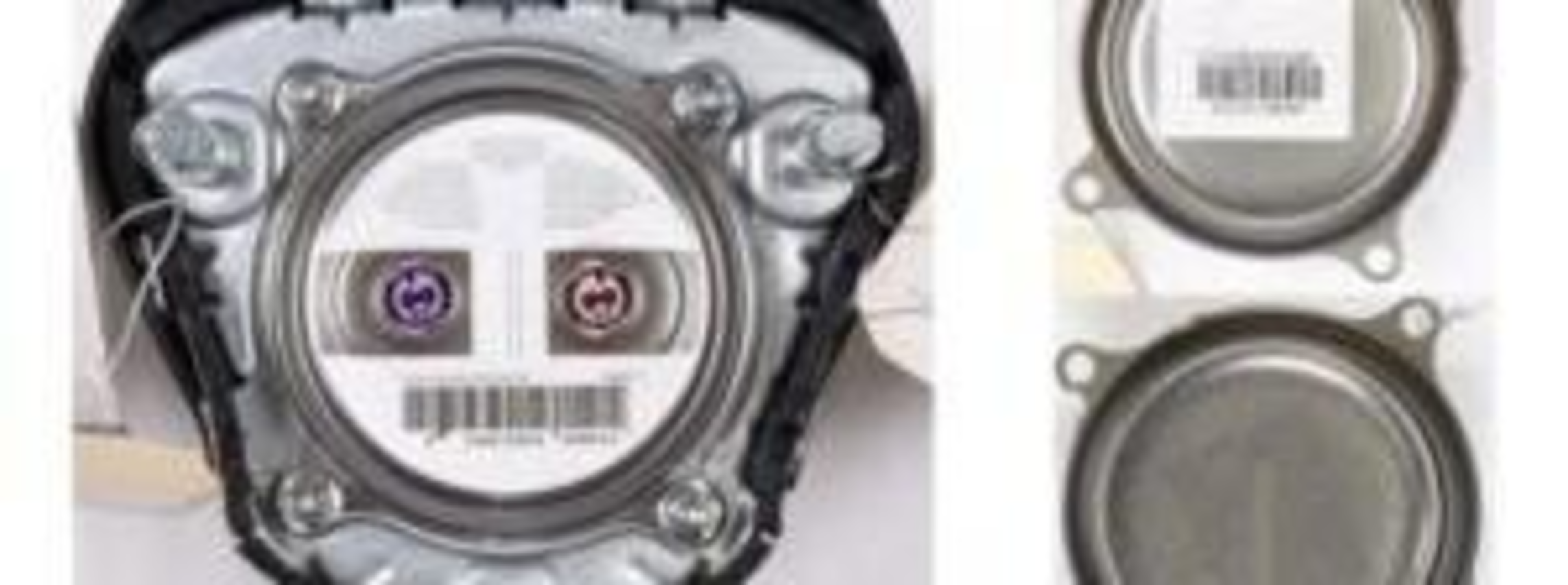
Technicians looking for guidance on identifying a DTN airbag can also refer to an NHTSA document. The document outlines the materials and design characteristics that can be used to indicate whether an airbag is a counterfeit. DTN airbags are also often marked with DTN60DB. Yet, it can be hard to identify DTN airbags when they’re still installed in a vehicle.
Bohi said the council has reached out to the Bureau of Alcohol, Tobacco, Firearms and Explosives (ATF) and the Department of Transportation (DOT) to get clarification on those processes.
“How do you safely handle these things, and what do you do if you get one? Because there are special permits to transport or get rid of these things if there is a counterfeit because we don’t know what’s in them. It’s an unknown explosive, potentially,” Bohi said.
NHTSA’s technician guidance does offer warnings that strongly advise technicians not to electronically probe or electrify airbag connecting terminals because they can detonate and cause serious injury or death.
Bud Center, I-CAR director of technical products and curriculum, previously told Repairer Driven News that electronic probes can be used to deploy a removed airbag. However, if a repairer believes an airbag is counterfeit, they should contact the vehicle’s OEM and ask for instructions.
“You want to make sure you are not going to deploy something that is unsafe,” Center said.
Center dives into the issue of counterfeit parts from the collision shop level in I-CAR’s most recent Repairers Realm.
Nearly all OEMs and many major aftermarket parts companies have people within their organizations who can answer questions concerning products, Bohi said.
If an owner has a vehicle with one of these suspect inflators, they should contact their local Homeland Security Investigations office or FBI field office to report it or submit an online complaint to the National Intellectual Property Rights Coordination Center.
Owners should also contact NHTSA online or by calling the agency’s Vehicle Safety Hotline at 888-327-4236, Monday through Friday, 8 a.m. to 8 p.m. Eastern time.
Image
Photo of DTN counterfeit airbags courtesy of NHTSA