
Honda newsletter gives tips on where to find ultra-high-strength steel repair information

A recent Honda “Joy of Repair” newsletter provides insight on where to find repair information when working with ultra-high-strength steel (UHSS).
Honda began integrating UHSS into vehicles in 2009 and today every Honda and Acura vehicle platform includes 1500 MPa UHSS in the body structure, the Joy of Repair summer newsletter states.
UHSS is defined by Honda as any steel with a tensile strength of 980 MPa or higher.

“That threshold is critical because repair limitations and joining requirements become progressively stricter as tensile strength increases,” the newsletter states.
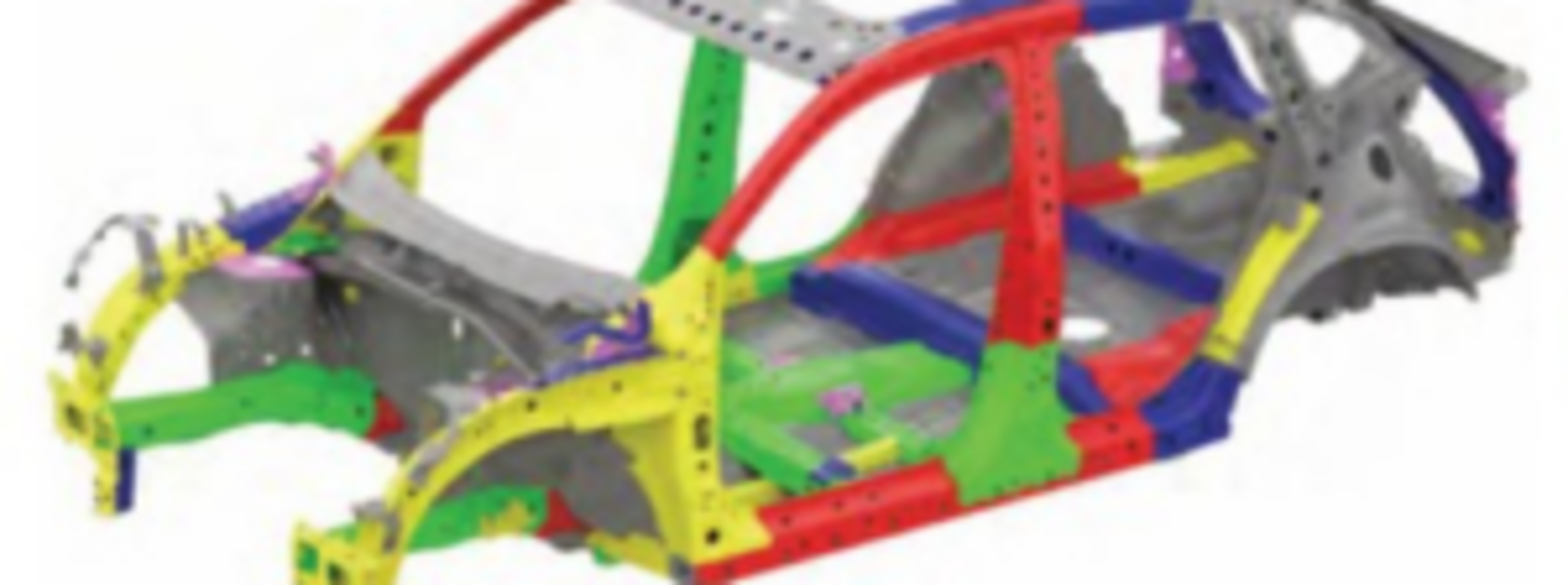
Honda first used 1500 MPa UHSS in a specific area of the center pillar to enhance rollover protection. That evolved into Honda’s engineered “Door Ring Assembly” introduced with the 2014 Acura MDX, the newsletter states. The design is a hot-stamped, single-piece 1500 MPa steel component that generally integrates the front pillar (A pillar/windshield pillar), sill reinforcement, roof side rail, and center pillar (B pillar).
Cold or heat must not be used when straightening UHSS, the newsletter states. Either approach can compromise the internal structure of high-strength steel parts.
“Any UHSS component that has had heat or cold straightening applied during repair must be replaced with a new part,” the newsletter states. “Ignoring these instructions can significantly reduce occupant protection in any subsequent collision.”
Tensile strength of the parts involved determine the steel repair and welding procedures, the newsletter states. It also states that before sectioning, straightening, or joining any structural component, confirm the material grade and follow the model-specific body repair guidance.

Tensile strength of the metals can be found when repair planning in the Body Repair News document within SIS. The documents are assigned to each model platform and provide a quick visual reference of the model steel construction. More specific information about the tensile strength information can be found in the body construction section of the Body Repair Manual.
When spot welding UHSS body parts, always refer to Honda’s Spot Welding Conditions for Ultra High-Strength Steel Parts (1180 & 1500 MPa) document found within the SIS. The spot welding conditions are also reflected in the Body Repair Procedures for installing UHSS body parts.
If MIG welding is required on an UHSS body part, the use of an Approved High-Strength Steel Welding Wire is mandatory. Refer to the Approved-Hire-Strength Welding Wire document in SIS.

“For further confirmation on what’s permitted (and what’s not), refer to the Honda/Acura Steel Usage and Repairability Matrix within SIS,” the newsletter states. “This resource helps ensure the correct joining method is used for the steel grade in front of you—supporting safe, repeatable repairs.”
The newsletter also notes that when using frame straightening equipment, apply pulling force gradually and closely monitor body dimensions through the process so the structure returns to the proper specifications. It adds that high-strength steel parts over 590 MPa must not be straightened. If these parts are damaged they should be replaced with new parts.
Use a spot weld cutter or drill bit designed for high-strength steel to remove spot weld nuggets from the steel parts being removed, the newsletter states.
“If cutting performance decreases, regrind the cutter with a grinder as soon as possible or replace it with a new cutter,” the newsletter adds. “Poor cutting performance increases cutting time and generates heat that may compromise the internal structure of high-strength steel parts.”
To protect the spot cutter blade, mark the center of the spot-weld nugget with a center punch, then grind the edge of the nugget flat using a belt sander before cutting. Apply the specified cutting oil during cutting work to protect the blade.
Image
Photo courtesy of Honda