
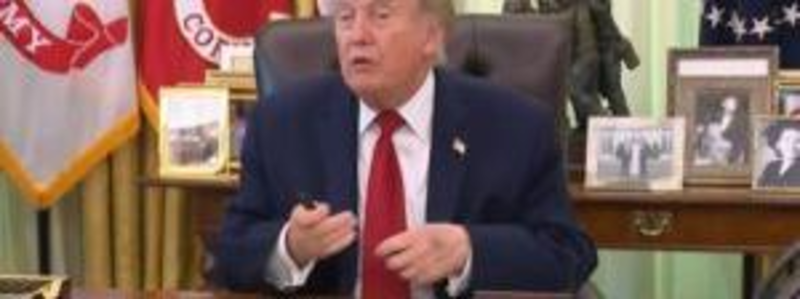
Trump signs ‘Freedom to Fix’ memo focused on emission repairs

President Donald Trump Monday signed a “Freedom to Fix” memorandum that asks the Environmental Protection Agency (EPA) to clarify how people can conduct emission repairs and deprioritize tampering enforcement actions against anyone who fixes their vehicle to its original configuration.
While multiple media sources have attached the memorandum to right to repair, the memorandum focuses on a past administration’s regulation that prohibited tampering with emission controls.
Part of the confusion could be from Trump mentioning a meeting he had with automakers during an Oval Office event held earlier this month. Following his mention of the meeting he said, “They don’t want people to fix their car.”
He then discussed pardoning a man who was sent to prison for seven years for fixing his vehicle.
The following day during a Roundtable on Agriculture, Trump expanded on this comment by saying Democrats were the ones who didn’t want vehicles fixed. He said “Democrats” restrict tractor and vehicle repairs. He also repeated his story about pardoning the man.
Additionally, during the signing of the “Freedom to Fix” memo, it was noted that the Trump Administration would not be going after people for fixing their vehicles like the previous administration.
“It came to my attention because I noticed they were arresting people for fixing their car,” Trump said. “They were arresting people for fixing. That’s not even believable. Anyway, so it’s right to fix and I think it’s really common sense.”
Trump’s “Freedom to Fix” memo discusses the past environmental regulatory burdens made by the previous administration. He notes that his administration rescinded regulations concerning greenhouse gas emissions for light, medium, and heavy-duty vehicles and “affirmed the right to fix agricultural and non-road equipment.”
“Consumers and aftermarket-parts manufacturers and resellers, however, face continuing regulatory uncertainty concerning whether aftermarket parts may be used in repairs due to the Clean Air Act’s (CAA) prohibition on tampering with emissions controls,” the memo states. “The California Air Resources Board (CARB) has the only certification process for aftermarket parts currently recognized as sufficient under the CAA, but that process is faulty.”
Trump’s memo notes that obtaining a CARB Executive Order certifying that a part does not increase vehicle emissions can take more than a year. It adds that the process limits the supply of compliant parts creating a bottleneck.
“To further ensure vehicle affordability, it is the policy of my Administration that consumers should be able to fix their vehicles with affordable parts without being deemed to have circumvented emissions controls,” the memo states.
The memo orders the EPA to provide guidance within 30 days by clarifying what actions individuals may take on their own vehicles to conduct emission repairs or emission repairs conducted consistent with the CAA.
It also tells the EPA to encourage the submission and act on any requests from organization capable of testing aftermarket parts for conformance with the CAA.
The memo specifically adds that the EPA should do this while protecting manufacturers’ intellectual property and confidential business information. It further adds that it should deprioritize civil tampering enforcement actions against anyone who “in good faith, attempts to fix his or her own vehicle to its original configuration.”
A fact sheet on the memo released by the White House notes that in February, the EPA released guidance affirming farmer’s ability to lawfully fix their own agricultural and non-road equipment saving an estimated $33,000 per repair on average.
The Alliance for Automotive Innovation (Auto Innovators) President and CEO John Bozzella said in a press release that the organization is on the same page with Trump.
“Today’s White House memorandum reaffirms these principles: protecting both automotive intellectual property and confidential business information,” Bozzella states in the release. “That’s an important acknowledgement and builds on the longstanding commitment from automakers to provide consumers and independent repair shops with the same repair instructions, tools and diagnostic codes they provide franchised auto dealers.”
Bozzella states that the Trump directive should “end the confusion and controversy around automotive repair once and for all.”
The release goes on to note that automakers committed to providing independent vehicle repair shops with the same repair instructions and information provided to franchised dealers in a letter to U.S. Sen. Bryon Dorgan (D-ND) in 2003.
A 2014 Memorandum of Understanding between automakers, independent repairs, and aftermarket part retailers reaffirmed that commitment, the release states. A 2023 agreement with the Automotive Service Association and the Society of Collision Repair Specialists also reaffirmed the 2014 MOU on automotive right to repair.
Lastly in May, the House & Energy Committee codified the MOU as part of H.R. 7389.
Image
Screenshot from White House Youtube.