
IIHS: Crash tests encouraging vehicle improvements equal nearly 50,000 lives saved since 1995

Vehicle improvements spurred by the Insurance Institute for Highway Safety (IIHS)’s testing program have saved nearly 50,000 lives since its launch in 1995, according to the results of a newly released IIHS study.
IIHS says that translates to an estimated cost savings of more than $500 billion.
“These results highlight the role of IIHS ratings in driving many of the key vehicle safety improvements of the past 30 years,” said Joe Nolan, IIHS chief operating officer, in a press release. “Our ratings program, in turn, has only been possible because of the unwavering support of our member companies in funding our work.”
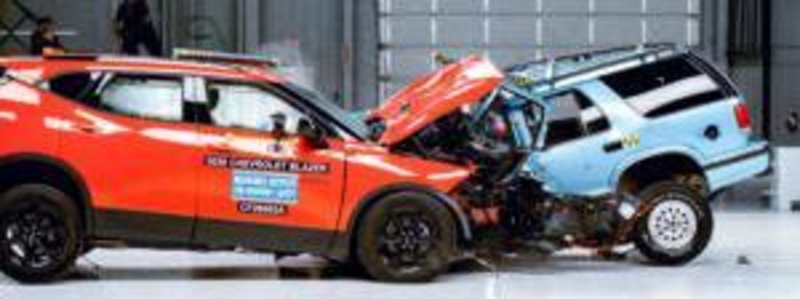
A recent head-to-head moderate overlap front crash test held to mark the 30th anniversary of the IIHS crash testing program illustrates how dramatic the safety improvements have been, the release states.
The demonstration pitted a 1996 Chevrolet Blazer against the 2026 model. IIHS’s last test of this nature featured a 1959 Chevrolet Bel Air and a 2009 Chevrolet Malibu. IIHS says that test “exploded the myth that older vehicles were built like tanks and therefore safer for their occupants.”
“The latest head-to-head crash test presented just as stark a contrast,” the release states. “The driver of the new Blazer would likely have walked away with bumps and bruises. The driver of the 1996 model would have suffered serious, potentially fatal injuries.
“The occupant compartment of the 2026 model remained intact. All but one of the injury measurements taken from the driver dummy showed minimal injury risk. The risk of injury to the driver’s right foot or lower leg was a little elevated but still in the acceptable range.”
In contrast, the impact crushed the occupant compartment of the 1996 model, pushing the dashboard and steering column into the dummy’s lap. The fully inflated airbag hit the dummy in the chin, snapping its head back and toward the window.
As shown in the crash video, this caused the nodding joint of the dummy’s upper neck to break, and the head was detached from the body. IIHS noted that while this isn’t likely to happen to a human driver, it illustrates the extreme forces the dummy absorbed.
IIHS engineers use specific metrics collected by instruments inside the dummy, rather than visible damage, to estimate injury risk, according to the release. Based on those metrics, IIHS determined that the crash almost certainly would have caused serious injuries to the driver’s head or neck and both legs.
“In the actual original moderate overlap evaluation, the 1996 Blazer earned a poor rating, showing the same problems illustrated by the head-to-head test,” the release states. “That rating applies to models built between 1995 and 2004. Blazers built after Chevrolet reintroduced the model in 2019 earn good ratings.
“On the road, differences like those save a lot of lives. To estimate how many, IIHS researchers examined the effects of five crashworthiness evaluations — the moderate overlap front, driver-side small overlap front, passenger-side small overlap front and side crash tests, as well as the roof-strength evaluation.”
IIHS noted that several of the tests have been updated or discontinued in the years since their introduction. Researchers used the original versions for their calculations.
They compared the real-world fatality rates for vehicles rated good with those rated acceptable, marginal, or poor in each test. Then they calculated the potential fatalities that would have occurred if the percentage of good-rated vehicles had not risen.
The results showed that vehicle improvements made in response to the tests saved an estimated 48,352 lives from 1999 to 2024.
To gauge the program’s financial impact, researchers relied on the U.S. Department of Transportation’s historical estimates for the value of a statistical life (VSL), which represents the amount that society would be willing to pay for the safety improvements needed to prevent a single fatality.
VSL doesn’t include direct costs like medical bills, which would increase the total economic impact.
IIHS determined its crash tests has saved $538 billion.
“For comparison, the total funding that IIHS received from its insurance company members for those years was $600 million, meaning the crash testing program has had a nearly 900-fold return on investment,” the release states.
Amy Schumacher, IIHS statistician and lead author of the study, added that while it feels strange to talk about the monetary value of a person’s life, it’s a useful way to weigh the cost-effectiveness of different crash interventions.
Improved performance in IIHS’s original three front crash tests saved 28,697 lives, with the majority coming from the earliest one — the moderate overlap test used in the head-to-head crash of the Blazers.
IIHS launched this test in 1995. It represents an offset crash between two identical vehicles traveling in opposite directions at a little under 40 mph each. The vehicles overlap by 40% of their width. The test was updated to include protection for back seat passengers in 2022.
IIHS introduced the driver- and passenger-side small overlap front tests in 2012 and 2017. They simulate offset crashes in which the two vehicles, or a single vehicle and a fixed object like a tree, overlap by 25%. The two tests were combined into a single rating in 2024.
The side crash test program, introduced in 2003, saved another 18,224 people, according to IIHS’s recent findings. This evaluation simulates a T-bone crash in which a modern SUV broadsides the test vehicle. It was updated to address more severe crashes and changes in SUV design in 2021.
The roof-strength evaluation, designed to address rollover crashes, has saved 1,432 lives. IIHS conducted this test from 2009 to 2022. The IIHS test used a machine that pressed an angled metal plate down on the roof of the test vehicle to measure the crushing force it could withstand.
The test was discontinued after the federal government adopted standards similar to the IIHS requirements.
“Few vehicles on the market performed well when IIHS introduced these tests,” the release states. “But virtually every new model earned good ratings by the time they were updated or discontinued. That progress is unmistakable in the remnants of the two Blazers.”
Nolan concluded: “It’s inspiring to think that there are thousands of parents, children, and friends alive today because of the safety improvements that IIHS has promoted.”
Images
Featured image provided by IIHS