
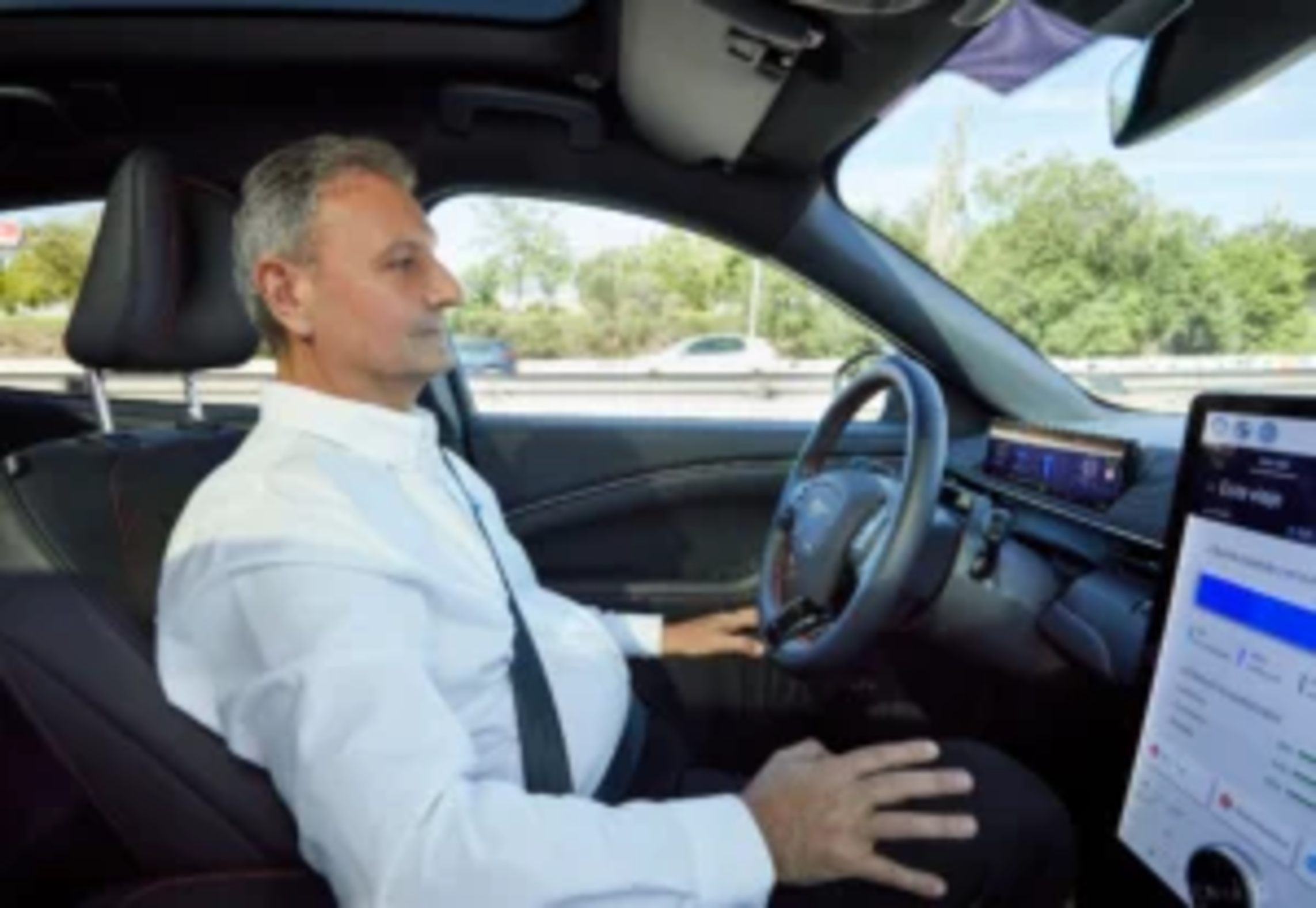
NTSB determines cause of 2 fatal BlueCruise-involved crashes, notes system safety limitations

As a result of its investigations, the National Transportation Safety Board (NTSB) has determined the probable causes of two fatal crashes involving the Ford BlueCruise hands-free, partial automation system.
It also unanimously approved 20 findings from the investigations during its meeting on Tuesday.
Both rear-end crashes occurred in 2024, one in San Antonio, Texas, and the other in Philadelphia, Pennsylvania. Ford Mach-Es using BlueCruise struck stationary vehicles at highway speeds in both cities.
In San Antonio, the Ford electric SUV was traveling east in the center lane of Interstate 10 when it struck a stationary 1999 Honda CR-V. The Honda driver was killed, and the Ford driver sustained minor injuries.

NTSB says the probable cause of the San Antonio crash was the driver’s failure to respond to the stationary vehicle ahead due to distraction, likely from the in-vehicle navigation system. It says the driver over-relied on the vehicle’s hands-free partial automation system and disengaged from driving.
“Contributing to the crash was the inability of the Ford vehicle’s partial automation system, including its automatic emergency braking system, to detect and respond to the stationary vehicle ahead,” the NTSB said. “Also contributing to the crash was the location of the stationary vehicle, which may have been stopped in the center lane of the highway due to the impairment of its driver.”
The NTSB determined that none of the following were factors in the crash:
-
- The licensing of either driver
- The Ford driver’s experience with his vehicle
- Intoxication of the Ford driver
- The mechanical condition of the Ford
- Highway factors
- Weather
NTSB Chairwoman Jennifer Homendy said Tuesday that emergency responses to both crashes were timely and adequate.
“In the San Antonio crash, the reasons for the Honda being stopped in the center lane could not be determined, but the Honda driver’s alcohol impairment could have contributed,” she said. “The Ford driver in the San Antonio crash did not respond to the stationary vehicle ahead, despite having adequate opportunity to identify the hazard and initiate an evasive maneuver due to distraction from use of the vehicle’s infotainment system and over-reliance on the vehicle’s partial automation.”
In Philadelphia, the Ford was traveling north in the left lane of Interstate 95 when it struck two stationary vehicles — a 2012 Hyundai Elantra and a 2006 Toyota Prius — causing them to collide with a passing Toyota Corolla. The drivers of the Prius and Elantra were killed. The Ford driver sustained minor injuries, and the Corolla driver was uninjured. In both crashes, no driver-applied or system-initiated braking or steering was recorded in the moments before impact, according to NTSB.

The probable cause of the Philadelphia crash, according to NTSB, was the driver’s failure to respond to the stationary vehicles ahead due to alcohol impairment that may have been worsened by cannabis use, as well as distraction, likely from cell phone use stemming from over-reliance on and misuse of the vehicle’s hands-free partial automation system.
“Contributing to the crash was the driver’s operation of the vehicle about 27 miles per hour over the speed limit in a work zone,” NTSB said. “Further contributing to the crash was the Ford Motor Company’s inadequate integration of its active speed management system with this partial automation system, which permitted excessive speed, including in a work zone.”
It says none of the following were factors in the crash:
-
- The licensing of the Ford driver
- The mechanical condition of the Ford
- Highway factors
- Weather
“The Ford driver in the Philadelphia crash did not respond to the stopped vehicles ahead, despite having adequate opportunity to identify the hazard and initiate an evasive maneuver due to a combination of potentially interacting factors, including impairment from substance use, disengagement from the driving task likely due to cell phone use and over-reliance on the vehicle’s partial automation and speeding, which reduced the duration of clear line of sight to the stopped Elantra,” Homendy said.
She added that NTSB concludes NHTSA’s failure to meet the statutory final rule deadline to require all new passenger vehicles to be equipped with advanced impaired driving technology “continues to expose the public to dangers posed by impaired drivers.”
“If the Ford and the Philadelphia crash had been traveling at the posted speed limit of 45 miles per hour instead of 72 miles per hour, the Ford collision warning and automatic emergency braking systems would have been more likely to alert the driver sooner or mitigate the crash based on the Ford Mach-E performance in the existing testing protocols,” she said.
“The circumstances of the San Antonio and Philadelphia crashes, a stationary lead vehicle, a striking vehicle traveling at highway speed, and nighttime conditions were likely outside the capabilities of the Ford vehicle’s collision avoidance systems, forward collision warning, and automatic emergency braking available at the time of the crash, but are addressed in the performance parameters of the recently issued Federal Motor Vehicle Safety Standard 127.”
The board found that both crashes revealed limitations in Ford Motor Company’s telematics data collection program design when direct crash parameters, such as airbag deployment, weren’t transmitted.
The limitations restrict the automaker’s ability to identify relevant crashes and comply with the reporting requirements of the National Highway Traffic Safety Administration’s SAE International Level 2 Standing General Order.
The board also found through its investigations that:
-
- “There were delays in manufacturer awareness of crashes involving active SAE International Level 2 systems and reporting disparities across manufacturers in the number of incidents reported.
- “The completeness of Level 2 Standing General Order incident data cannot be assured, and the automaker’s ability to investigate these incidents and the safety risks associated with L2 systems is likely to be limited.
- “The circumstances of the San Antonio and Philadelphia crashes demonstrate that without federal requirements for the recording of SAE International Level 2 data, critical pre-crash information, such as L2 or advanced driver assistance systems activation, and crash information such as driver or system evasive actions and system hazard detection, remains inconsistent and inaccessible to the local law enforcement, safety investigators, regulators, and automakers.
- “Inaction by the U.S. Department of Transportation and NHTSA in establishing requirements for recording automated vehicle control system data, including the supporting advanced driver systems features, continues to enable non-standardized and inconsistent data collection, hindering crash investigations and NHTSA’s oversight of potential safety defects associated with SAE International Level 2 systems, as well as limiting the broader usefulness of NHTSA’s L2 standing general order incident database in revealing incidents and crashes involving partial automation.
- “Ford’s driver monitoring system implementation, which allowed brief driver glances to the forward roadway to reset the distraction alert timer, does not effectively mitigate visual distraction and driver disengagement following off-road glances.
- “In the San Antonio crash, the Ford driver’s repeated off-road glances combined with his insufficient brief on-road glances to detect the stationary vehicle ahead, demonstrate the risks of accumulated glances away from the roadway and highlight the need for prolonged glance pattern evaluation and driver monitoring system implementation.
- “In the Philadelphia crash, the limitations of the Ford Motor Company’s driver monitoring system (DMS) in distinguishing between forward roadway attention and attention to objects’ position and the driver’s line of sight to the roadway would have permitted the Ford driver to use her phone in a distracting manner without receiving a DMS alert.
- “An urgent need exists for standardized US-based driver monitoring system DMS performance requirements as demonstrated by the DMS deficiencies observed in the San Antonio and Philadelphia crashes and in previous National Transportation Safety Board investigations, the National Highway Traffic Safety Administration’s ongoing research and plans to develop objective and repeatable procedures for assessing DMS effectiveness in eliminating driver distraction, and the more stringent performance testing protocols already implemented by the European New Car Assessment Program and Insurance Institute for Highway Safety.
- “The San Antonio and Philadelphia crashes revealed implementation deficiencies, including allowing drivers to disable the automatic emergency braking system, not requiring the current engagement of vehicle equipped intelligent, adaptive cruise control, ACC, active intelligence speed assistance, permitting hands-free partial automation and work zones with reduced speed limits and allowing intelligent ACC to be configured with cruise speed tolerances up to 20 miles per hour above posted speed limits.
- “The lack of federal guidance for SAE International Level 2 systems and passenger vehicles has led to safety-critical design gaps in mitigating known system limitations, enhancing safety redundancy by ensuring concurrent engagement of safety technologies, and promoting driver engagement by design.”
The NTSB issued recommendations to the U.S. Department of Transportation, NHTSA, and Ford calling for:
-
- Stronger federal guidelines and performance standards for safety features of partial automation systems;
- Crash data recording and automatic crash notification requirements;
- Improved driver monitoring systems to detect distraction; and
- Changes to Ford’s BlueCruise system to reduce excessive speeding and improve driver attention.
Traffic safety funding
On Monday, NHTSA announced an investment of $665 million into traffic safety initiatives that it says will protect Americans on roadways.
The funding provides state highway safety offices with critical resources to address their most challenging traffic safety issues, such as distracted driving, unbelted driving, impaired driving, and excessive speed, a NHTSA press release states.
States can use the resources for traffic enforcement activities, child safety seat clinics, post-crash care, and public education.
“Under Secretary Duffy, we are supporting states, law enforcement, and paramedics with the resources they need to do their jobs and keep American families safe,” said NHTSA Administrator Jonathan Morrison in the release. “We are partnering with states across America to target traffic risks and save lives.”
NHTSA also launched the second major element of its modernized electronic grants management system, known as eGrants, to ease the application process.
“Thanks to NHTSA’s new-and-improved eGrants software, states can more seamlessly apply for, manage, and track federal safety resources,” Morrison said. “This launch marks a pivotal step in NHTSA’s efforts to modernize its formula grant program, streamlining how states access funding.”
Images
Featured image: Ford BlueCruise in use. (Provided by Ford)
Side-view illustration of the likely maximum engagement of the Ford (right) and Honda (left) during the Feb. 24, 2024, San Antonio crash.
Overhead illustration of the likely maximum engagement of the Ford (right) and Elantra (left) during the March 3, 2024, Philadelphia crash. (Source: NTSB)