
Hyundai plans 36 new or enhanced vehicles in U.S., Canada, and Mexico through 2030

Hyundai plans the launch of 36 all-new or significantly enhanced vehicles in the U.S., Canada, and Mexico through 2030, according to a press release.
The company has also announced a goal to have about 80% of Hyundai vehicles sold in the U.S. assembled domestically by 2030. This would include increasing the U.S. supply chain content from about 60% to 80%.
The new or enhanced vehicles will include passenger cars, SUVs, trucks, and commercial vehicles, the release says. They will include core models and expanded trims, including XRT and N performance derivatives. Models will include internal combustion engines, hybrid electric, electric, and extended-range electric (EREV) powertrains.
“Hyundai is accelerating across North America,” José Muñoz, Hyundai Motor Company president and CEO, said in the press release. “By expanding our product portfolio and offering a wider range of powertrains in North America, we’re giving customers more choice while continuing to strengthen our long‑term investment in U.S. manufacturing, jobs, and the broader automotive ecosystem.”
The company previously announced a $26 billion investment in the U.S., which will include a state-of-the-art steel mill in Louisiana and a robotics innovation hub.
“Together, Hyundai’s expanded North American product lineup, growing U.S. production footprint, and increased parts localization position the brand for sustained growth, greater flexibility, and stronger alignment with customer priorities across the U.S., Canada, and Mexico,” the release says.
More U.S. production would limit Hyundai’s exposure to tariffs.
An Automotive News analysis has found that automakers have spent $35.4 billion on tariffs since 2025.
The analysis includes a full-year tariff for 2025 and projections through March of this year and involved a review of automakers’ financial reports.
It found that Toyota is carrying the largest tariff bill with a projected $9.1 billion in costs in its fiscal year, which ends March 31. General Motors, Ford Motor Company, and Stellantis have $6.5 billion of tariff costs in 2025, it says.
Other automakers expected to pay more than $1 billion include BMW, Honda, Hyundai-Kia, Mazda, Mercedes-Benz, Nissan, Subaru, and Volkswagen.
Automotive News says that automakers are still “trying to decipher which tariffs might stick and which might be negotiated down or go away.”
Image
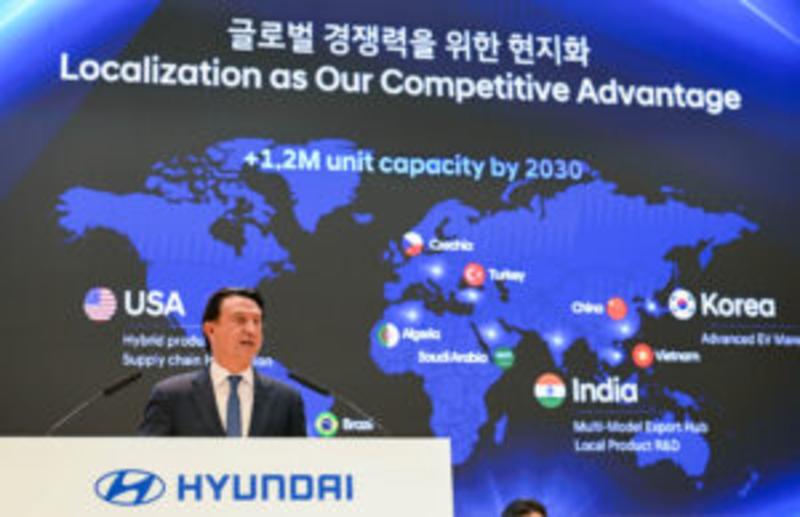
Featured image: José Muñoz, President and Chief Executive Officer of Hyundai Motor Co., delivers remarks at the 58th Hyundai Motor Company General Shareholders Meeting held March 25 in Korea/Hyundai