
Minnesota bill requires insurance to provide reasoning for denying repairs

A Minnesota bill would require insurance companies to provide written notification to consumers and, when applicable, repair facilities, when vehicle repair costs are reduced.
The bill, Senate File 2209, requires that the notification provide specific policy provisions and reasoning behind the decision.
A reduction is prohibited if the repair or cost was caused by the incident giving rise to the claim and is related to the vehicle’s safety or operation.
The written statement must include an itemized list of repairs or costs recommended by the repair facility or in accordance with the manufacturer’s recommendations. The offer for settlement, identifying any recommended repairs or costs that have been denied related to vehicle safety systems, safety restraints and air bag systems, braking systems, structural components, and assessed driving or driver management systems.
The statement also should include confirmation that a denied repair or cost is not material to the vehicle’s safe operation and that the insurer assumes liability for a denied repair or cost that directly causes a safety hazard.
Other language in the state’s law would be changed to include storage costs as part of the costs covered by insurance companies. It also changes existing language that requires insurance to cover a “satisfactory repair” to require coverage “returning the vehicle to pre-loss condition.”
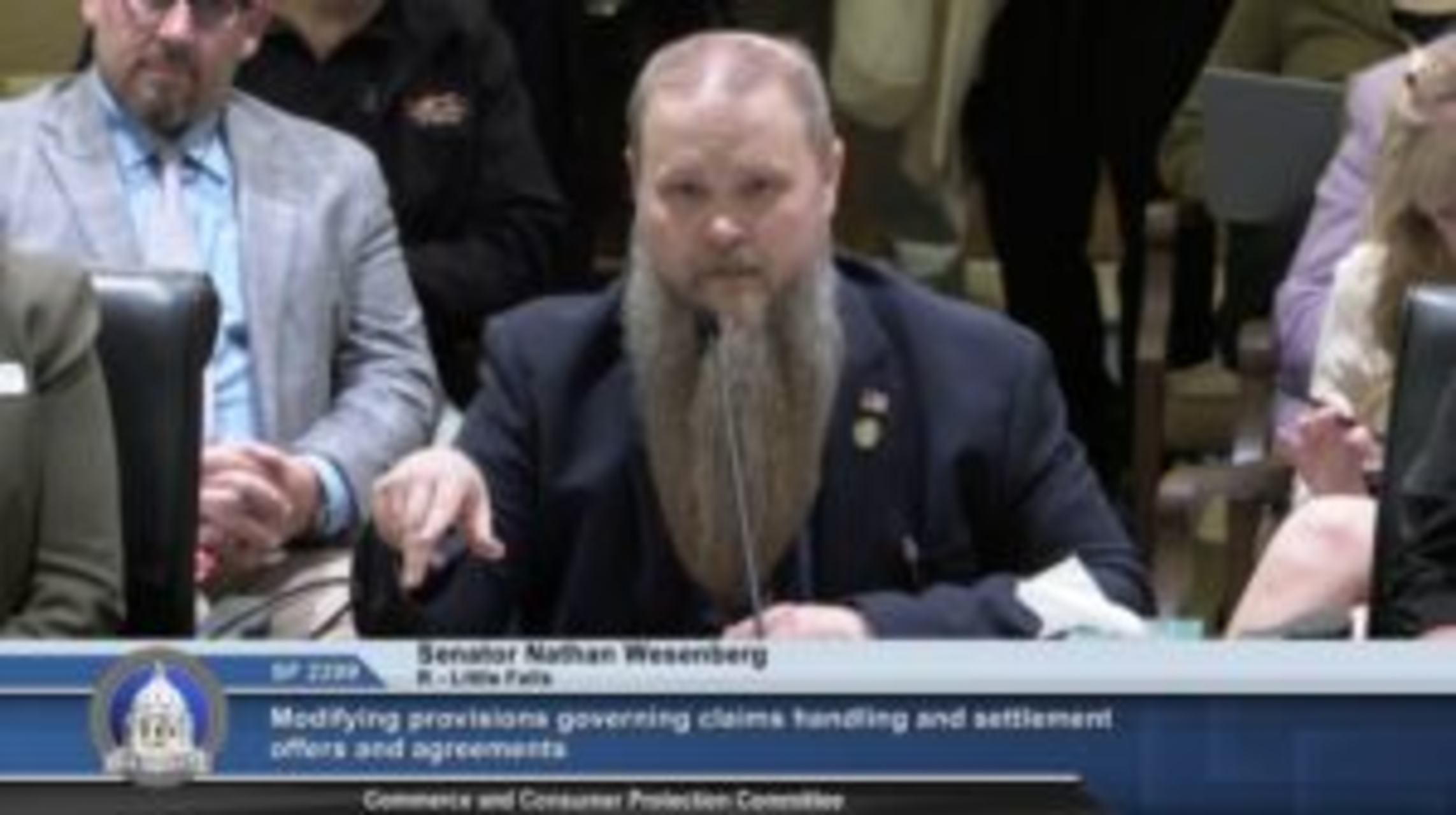
Sen. Nathan Wesenberg (R-District 10) told the Senate Commerce and Consumer Protection Commission last week that he brought the bill partly after his constituents voiced concerns and he experienced a personal incident.
He said constituents were telling him that small repair shops were having to cover costs because of insurance short-payments.
Wesenberg said he brought the bill, then dropped it, but later decided to reintroduce it after his wife’s vehicle was damaged in a collision with a deer.
“We had $10,000 worth of damage on her car,” Wesenberg said. “I literally lived what they were talking about.”
We had her vehicle fixed, and the insurance company wouldn’t pay for the paint. He said the insurance company also didn’t want to pay for OEM parts and, instead, wanted aftermarket parts to be used.
“They wanted me to eat a $2,000 cost,” Wesenberg said.
Wesenberg said God works in mysterious ways.
“I found out why they are bringing this bill forward because insurance companies are not paying what they should pay,” Wesenberg said.
Sara Czech told the panel that she’s owned and operated a body shop with her husband for 36 years.
“I’m here to advocate for the Minnesota consumers who are struggling every day to get a fair and safe repair covered by the auto insurance company,” Czech said.
The process has become frustrating, delayed, and in most cases ends with a short payment, she said.
Current statutes have a gray area that insurance companies are using to avoid paying for a complete and proper repair, she said.
Czech noted that today’s vehicles are highly advanced with complex materials, sensors, and safety systems that require repairs to follow manufacturer procedures.
“They amount of insurance companies denying safety features is concerning,” Czech said. “We had an adjuster recently tell us there was no need to replace an air bag sensor after a front impact.”
When Czech provided the insurer with manufacturer procedures requiring the replacement of an airbag sensor, she said the adjuster responded that the procedures were fancy wording from the manufacturer to sell more parts.
Linden Wickland, executive director of the Alliance of Automotive Service Providers Minnesota, said that states for many years have benefited for the strength of the state’s statutes. However, staffing changes and insurance companies require that the statute be strengthened, she said.
The use of post-pandemic AI has made it difficult for shops to work directly with the insurance company.
The bill would provide consumers with information about what and why a denial is coming from an insurance company, she said.
Aaron Cocking, president of the Insurance Federation of Minnesota, said that insurance companies share the goal of protecting consumers and ensuring vehicles are properly repaired.
“This bill goes well beyond consumer protection and instead creates significant unintended consequences that will raise repair costs and raise premiums for everyone and further harm Minnesota’s insurance market,” Cocking said.
He said that the bill mandates insurers to cover all costs necessary to return vehicles to pre-loss condition, including towing and storage, and other related expenses.
The bill removes the insurance companies’ ability to evaluate cost reasonableness and negotiate fair pricing, he said.
“At a time when affordability and fraud are concerns, this bill moves us in the wrong direction,” Cocking said.
Image
Senator Nathan Wesenberg speaks before the Minnesota Senate Commerce and Consumer Protection Commission last week/screenshot