
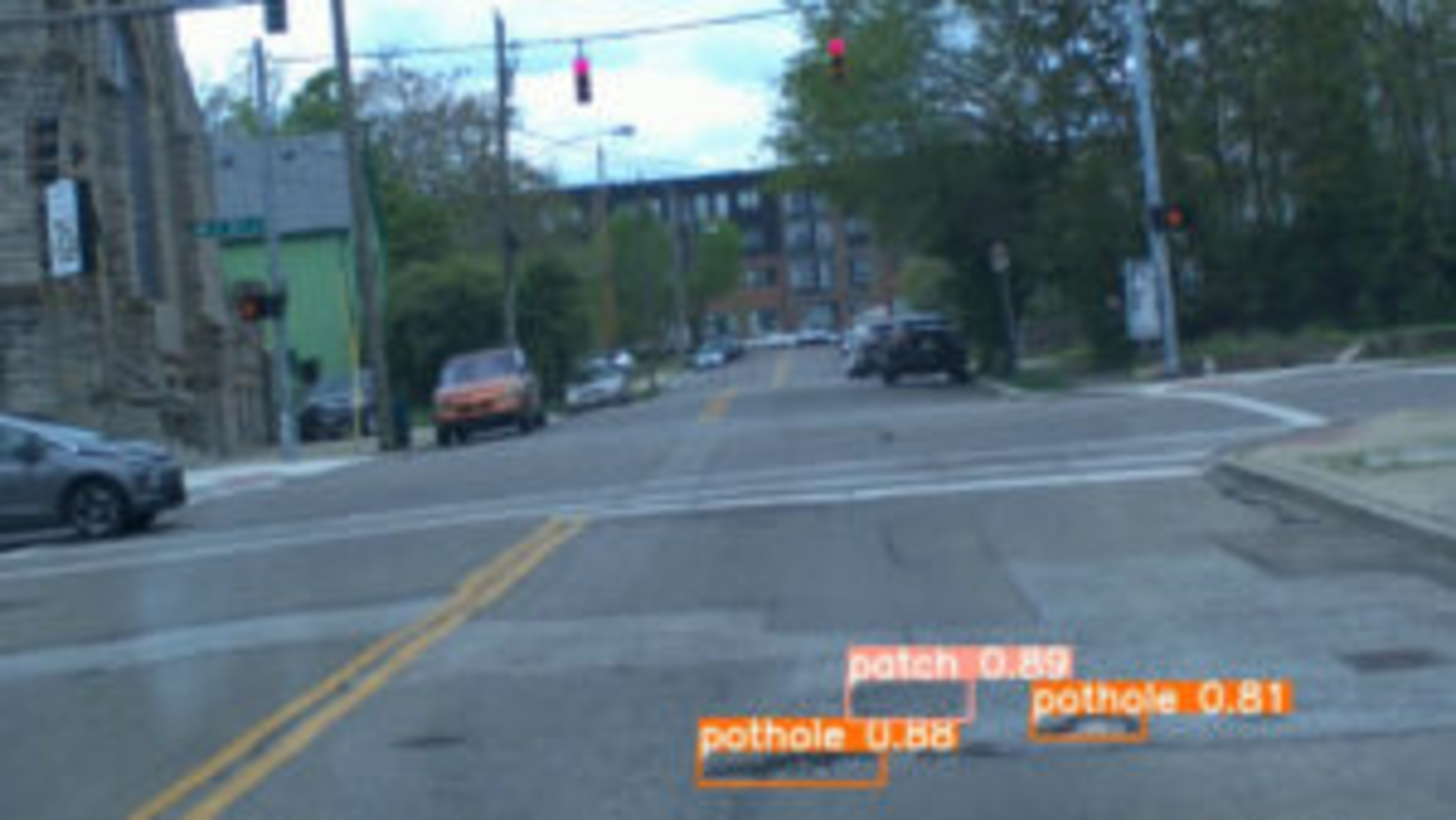
Honda works with DriveOhio, others to develop vehicle-generated data system for road improvements

Honda and DriveOhio, the smart mobility hub of the Ohio Department of Transportation (ODOT), have completed a first-of-its-kind pilot project demonstrating how real-time vehicle-generated data can detect and report road deficiencies, according to a Honda press release.
Conducted in collaboration with technology partners i-Probe Inc., Parsons, and the University of Cincinnati, the project verified the feasibility of an automated road conditions management and reporting system to help state DOTs proactively optimize maintenance to reduce costs and create safer roadways.
“Honda is committed to advancing safety for everyone sharing the road,” the release states.” Under its global safety slogan ‘Safety for Everyone,’ Honda is expanding its focus to include advanced safety and driver assistive technologies, efforts to enhance safety awareness to influence driver behavior, and improve the traffic safety ecosystem by working with government, industry, and community partners, including new initiatives such as the Proactive Roadway Maintenance System.”
Honda has been advancing the development of its prototype Proactive Roadway Maintenance System since 2021.
During the pilot, ODOT team members drove Honda test vehicles equipped with advanced vision and lidar sensors to monitor 3,000 miles of roads in Central and Southeastern Ohio.
The vehicles operated under a wide range of real-world conditions, including multiple road types in rural and urban environments, varied weather, and different times of the day.
The system detected road conditions, pavement markings, and infrastructure deficiencies, and roadside assets to provide ODOT with actionable insights by identifying the following:
-
- Worn or obstructed road signs;
- Damage to guardrails and cable road barriers;
- Pothole development, including size and location;
- Condition of shoulder drops, including the percentage and depth of drop off;
- Insufficient roadway striping that affects the functionality of some driver-assistance features, such as lane-keeping assist functions; and
- Rough road quality, regardless of the vehicle’s age or condition.
ODOT operators were able to review the deficiencies in real time through web dashboards developed by Honda and Parsons. ODOT then used the data to cross-reference its regular visual inspections.
Data collected by the vehicles was processed using Edge AI models, transmitted to a Honda cloud platform for analysis, and integrated into Parsons iNET Asset Guardian system. This implemented a pipeline that can automatically generate prioritized work orders by severity and proximity for ODOT maintenance teams.
i-Probe provided data validation and analysis expertise for road roughness and lane-marking conditions.
The University of Cincinnati helped Honda integrate the sensors onto the test vehicles; led development of the damage detection feature, including potholes, guardrails, signs, and shoulder drops; and provided system maintenance service to ODOT during the trial operation.
Results verified that automated detection with the Proactive Roadway Maintenance System achieved high accuracy for signs, guardrails, and shoulder drop-offs, and delivered strong pothole detection across most road types, including:
-
- 99% accuracy for damaged or obstructed signs
- 93% accuracy for damaged guardrails
- 89% average accuracy for potholes

An AI feedback loop pipeline was built that enabled ODOT team members to flag misdetections, helping the system learn and improve over time, the release states. It also states that insights from testing showed a small percentage of roads had insufficient lane markings, suggesting that restriping schedules could be optimized.
“Vehicle sensor data also reliably measured road roughness levels and provided valuable insights for maintenance planning,” the release states. “The Proactive Roadway Maintenance System further detected high‑severity shoulder drop‑offs that were difficult to identify through routine visual inspection.
“By reducing the need for manual inspections, the system enhances safety for maintenance crews and minimizes their exposure to traffic hazards. The project team estimates that automated road condition detection could save ODOT over $4.5 million annually through less manual inspection time, optimized maintenance schedules, and prevention of costly deferred repairs through proactive inspection.”

As part of the next phase of testing, the project team is exploring ways to scale the prototype Proactive Roadway Maintenance System for real-world operations.
Honda’s other recent road safety initiatives
Honda Motor Co. and Mythic, an analog AI computing company, have announced a joint development agreement to co-develop an automotive-grade AI system on chip (SoC) for Honda’s next-generation software-defined vehicles (SDVs) by the late 2020s or early 2030s.
In line with Honda’s safety approach, Mythic’s intelligent, ultra-efficient analog compute-in-memory architecture will enable advanced driver-assist and autonomous features, a press release states. Honda R&D Co. Ltd., Honda’s research and development subsidiary, will license Mythic’s Analog Processing Unit (APU) technology.
“The goal is to dramatically boost on-board AI capabilities while minimizing power draw — a critical factor as Honda pursues its global goal of zero traffic collision fatalities involving Honda motorcycles and automobiles by 2050,” the release states.
“Mythic’s cutting-edge analog compute technology makes them a strategic partner for Honda as we develop the next generation of intelligent, safe vehicles,” said Atsushi Ogawa, chief operating officer at Honda R&D Co., in the release. “This relationship will continue to grow as we jointly develop, test, and integrate Mythic’s unique capabilities across our future vehicle lineup, supporting Honda’s commitments to safety and innovation.”
Honda says vehicles are fundamentally power-limited systems, so achieving leap-ahead AI performance requires unprecedented energy efficiency. Mythic’s analog compute-in-memory technology delivers about 100 times higher energy efficiency than conventional digital AI chips by combining memory and computation into one layer, much like the human brain, according to the release.
“This efficiency advantage translates into roughly 100x more AI processing within the same power budget,” the release states. “The joint development envisions future vehicles with over 100,000 TOPS (trillions of operations per second) of AI compute — a level of performance within a strict low power envelope that only neuromorphic architectures like Mythic’s APU can achieve.”
The companies say that the new AI SoC will be capable of running state-of-the-art machine learning models to make Honda’s vehicles smarter and safer through perceptive awareness, physics-informed neural networks for vehicle dynamics and control, and cloud-free large language models for in-car assistants.
“Cars are quickly becoming petascale supercomputers on wheels — in the near future, the most powerful computer in your home will be parked in your garage,” said Dave Fick, Mythic’s co-founder and CTO, in the release. “Vehicles will soon require computing performance on par with data centers, but with far tighter energy budgets. That’s exactly what Mythic’s analog technology delivers. We’re thrilled to partner with Honda to usher in a new era of energy-efficient automotive computing, where every vehicle can have the AI brainpower of a data center, without the power draw.”
Mythic Chairman and CEO Taner Ozcelik, and former founder of NVIDIA’s Automotive Division, added that digital computing architectures can’t meet the combined performance and power-efficiency requirements of safe autonomous driving, while Mythic’s analog technology can.
“Much as GPUs transformed computing by accelerating AI next to CPUs, Mythic’s incredibly energy-efficient APUs will be the accelerators that democratize full self-driving across all vehicles,” he said. “We are the only company delivering a computing architecture with the efficiency needed to enable the level of AI intelligence that truly safe autonomous vehicles demand for everyone.”
Initial prototype chips from the Honda-Mythic collaboration are expected to be tested in vehicles by the late 2020s/early 2030s, with the jointly developed analog AI SoC slated to enter production shortly after completing successful trials.
The companies envision their collaboration as accelerating the realization of Honda’s “Safety for Everyone” mission and setting a new benchmark for on-board AI performance-per-watt and performance-per-watt-per-cost in the automotive industry, the release states.
Images
Images of the Proactive Roadway Maintenance System in action provided by Honda