
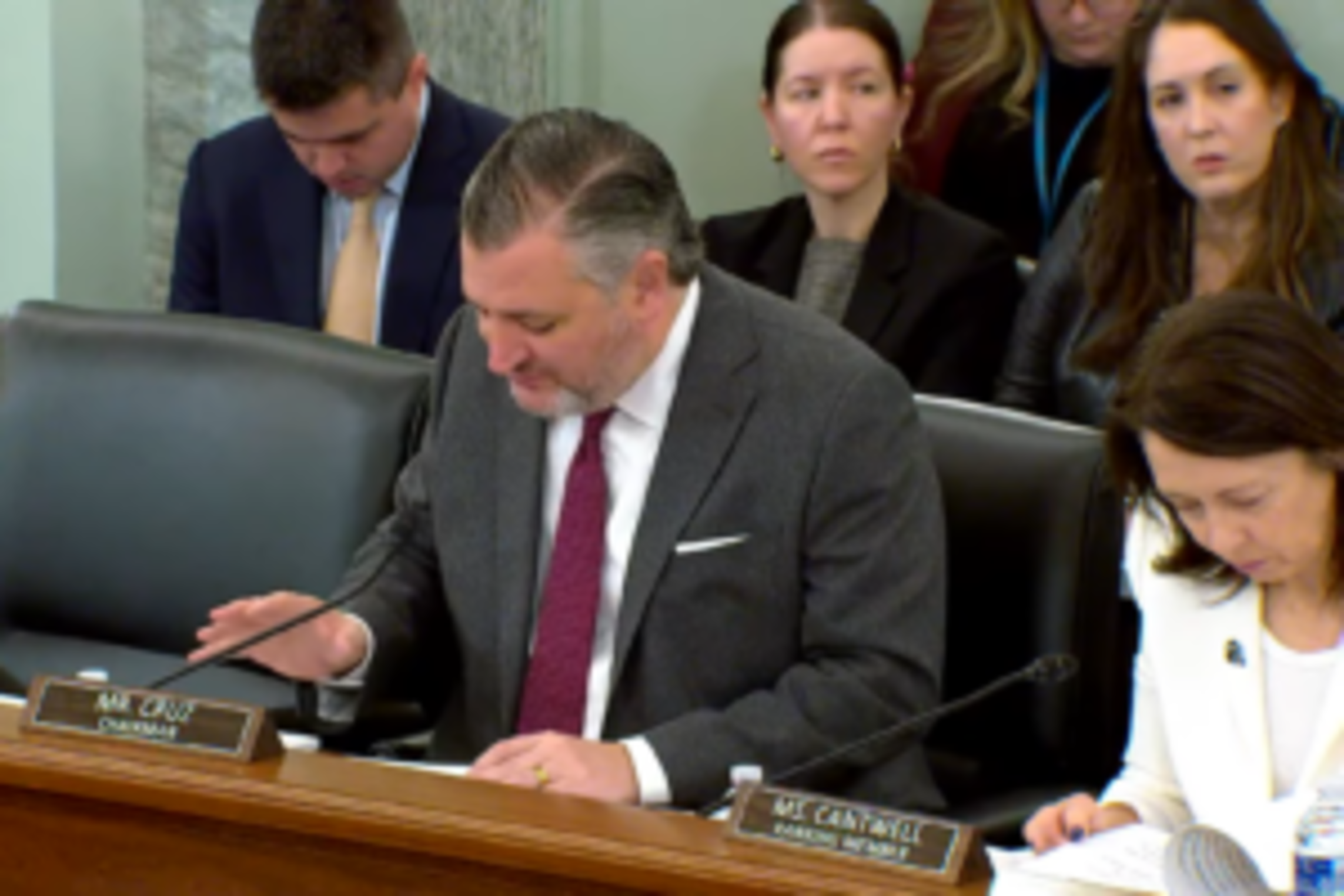
U.S. Senate committee hearing weighs ‘human factor’ of AVs, federal legislation

The U.S. Senate Committee on Commerce, Science, and Transportation heard from Tesla, Waymo, and the Autonomous Vehicle Industry Association during a hearing Wednesday on self-driving vehicle technology and its effect on consumer privacy and safety to surmise how a federal legislative framework could benefit all of the above.
“America is at a crossroads in transportation policy,” said Committee Chair Sen. Ted Cruz (R-Texas) in his opening statement. “Autonomous vehicles, or AVs for short, are no longer theoretical. Like it or not, they are here, and they will be central to the future of roadways… If Congress fails to act, we’re not going to stop innovation; we’ll simply push it elsewhere… The American consumer will decide what they choose to drive.”
Discussion and questioning of the witnesses centered on the potential for AVs to reduce the country’s traffic-related deaths and how the implementation of federal legislation could standardize collision liability, whether a person should be in the driver’s seat of AVs (the “human factor,” as Republican Wyoming Sen. Cynthia Lummis called it), and how personally identifiable information is collected, shared, and stored.
The National Highway Traffic Safety Administration (NHTSA) was also criticized for its reportedly decades-old regulations.
“The Federal Motor Safety standard has prevented over 18 million crashes; however, the Federal Motor Safety standards were designed to regulate bumpers and car doors, seatbelts, and a variety of things that they’re not on top of today,” said Committee Ranking Member Sen. Maria Cantwell (D-Washington). “The law was passed 20 years before the first Windows computer was ever sold, so it’s time for us to get a nitsa that understands technology and knows what to do with it. This revolutionary technology needs a new approach to safety that provides for flexible guardrails for beta testing and a clear path to safe commercial deployment.”
When asked how AV technology helps improve road and vehicle safety and reduce fatalities, AVIA CEO Jeff Farrah testified that, without a federal AV framework, innovators are being asked “to fight with one hand behind their back.” He said safety is the driving force behind the AV industry.
“We want to make our roads safer,” Farrah said. “We reject this idea that we just have to accept all the fatalities, accept all the injuries, accept millions of Americans being held back because vehicles are not accessible enough. And fundamentally, what we’re trying to do with safety is we’re trying to overcome human error. We’re trying to overcome the things that Chairman Cruz talked about in his opening statement.”
He added that 26 states proactively authorize AV technology.
When asked how Tesla collects and stores data, Vice President of Vehicle Engineering Lars Moravy testified that the automaker collects data to improve its products using an opt-in policy, which occurs when users select the advanced driving systems.
“We always aggregate and anonymize the data to ensure customer privacy,” he said, adding that the data isn’t stored.
Committee Member John Curtis (R-Utah) asked Mauricio Peña, Waymo’s chief safety officer, how many cameras the robotaxi company’s vehicles are equipped with, citing the potential amount of data that could be collected as “staggering.” Peña said the vehicles have a total of 29 cameras, some mounted inside and the rest on the exterior.
“We have strong privacy protections for our riders,” Peña said. “We don’t share any personally identifiable information. And when we are driving, we collect information to make our Waymo driver better. That is the only purpose of collecting data.”
Moravy said Tesla vehicles are equipped with nine cameras.
Collision and traffic incident liability
Cantwell confronted Peña about Waymo’s binding arbitration agreement in relation to liability, stating the family of a man who was run over by a Tesla on Autopilot claims it didn’t see his motorcycle. She asked him if he approves of the agreement.
Peña answered that it isn’t his area of expertise, but he would get back to her with an answer.
Bryant Walker Smith, University of South Carolina associate professor of law, agreed with Cantwell that the agreements are binding contracts and said they’re very common in industry. She then asked him how true liability can be reached so that people will be held accountable for the products they build.
“The reality is that we all do sign these agreements every day agreeing to arbitration, and we don’t realize it,” Smith said. “We don’t realize it matters until we’re hurt, until we’re the victims. And then we realize that we can’t use the courts, and no one else realizes it because arbitration is often secret, and therefore, that information is not coming out.
“The companies in this field are necessarily saying to regulators, to the public, trust us and that needs to come with substance… They need to say here’s what we’re doing, here’s why we believe it’s safe, and here’s why you can trust us. And then that needs to be interrogated… The idea that our [U.S. Department of Transportation] automated driving office could fit in a McDonald’s or our [NHTSA] defects agency could fit in a warehouse is astounding to me for a country of this size and sophistication.”
Cruz then asked Moravy to name the risks associated with the AV regulatory gap and why a clear national framework is necessary sooner rather than later.
“As an original equipment manufacturer up here of autonomous vehicles, a patchwork of state regulations really presents a lot of uncertainty for us in producing those vehicles,” Moravy said. “When we talk about FMVSS [Federal Motor Vehicle Safety Standards], it’s important that we homogenize them for purpose-built AVs so that we have certainty and we have a path forward that is consistent across all 50 states.”
Cruz then touched on AV safety scrutiny when AV-involved incidents occur. He specified an incident from last week when a Waymo vehicle nearly hit a child near an elementary school in Santa Monica, California. He also noted issues in Austin, Texas, with Waymo vehicles failing to stop for school buses.
“We take those incidents very seriously,” Peña said. “Safety is our top priority, especially the safety of children and pedestrians. We’re evaluating every one of those events and developing fixes to address them. We have already incorporated many changes to our software to dramatically improve our performance.
“We are working with the Austin Independent School District to collect data from different lighting patterns and different conditions, and we’re also incorporating those learnings into our system. We do safely navigate thousands of school bus encounters every single week, and we’re continuously learning and improving because our work is safety; safety is never done.”
He added that the Waymo vehicle involved in the Santa Monica incident detected the girl, then braked hard and reduced its speed, to mitigate harm.
Peña later testified that, compared to human drivers, AVs are 10 times less likely to be involved in collisions that cause serious injuries and 12 times less likely to be involved in pedestrian-involved incidents that cause injuries.
“I think we’re making a difference already,” he said.
Committee Member Sen. Todd Young (R-Indiana) asked Farrah which components Congress should focus on as part of a federal AV deployment framework.
Farrah responded that USDOT should be directed to require safety cases and establish certain driving competencies. He said a national AV safety data repository should be established and housed with NHTSA, then shared with state regulatory partners. Lastly, Farrah said the U.S. needs to evolve some of the standards that apply to human-driven vehicles.
“We can have safety but also innovation at the same time,” Farrah said.
Insurance industry response
While the American Property Casualty Insurance Association (APCIA) didn’t testify, it did submit a statement for the record and shared a press release shortly after the hearing ended.
In the release, APCIA says it’s “calling on policymakers to prioritize roadway safety, preserve state regulatory authority, and ensure responsible access to vehicle-generated data.” It also urged the committee “to consider stakeholder views on vehicle safety, efficient data access, and consumer choice in vehicle repair.”
Sam Whitfield, APCIA’s senior vice president of federal government relations and political engagement, added, “As automated vehicle technologies evolve, we must not lose sight of the fundamentals that keep people safe. Consumers deserve clear safety standards, strong state-based insurance protections, and confidence that crash-related data will be available when needed to determine what happened. Innovation must go hand in hand with accountability, transparency, and a regulatory framework that continues to put people first.”
Images
U.S. Senate Committee on Commerce, Science, and Transportation Chair Ted Cruz (R-Texas) speaks during a Feb. 4, 2026, hearing on autonomous vehicle standardization. (YouTube screenshot)