
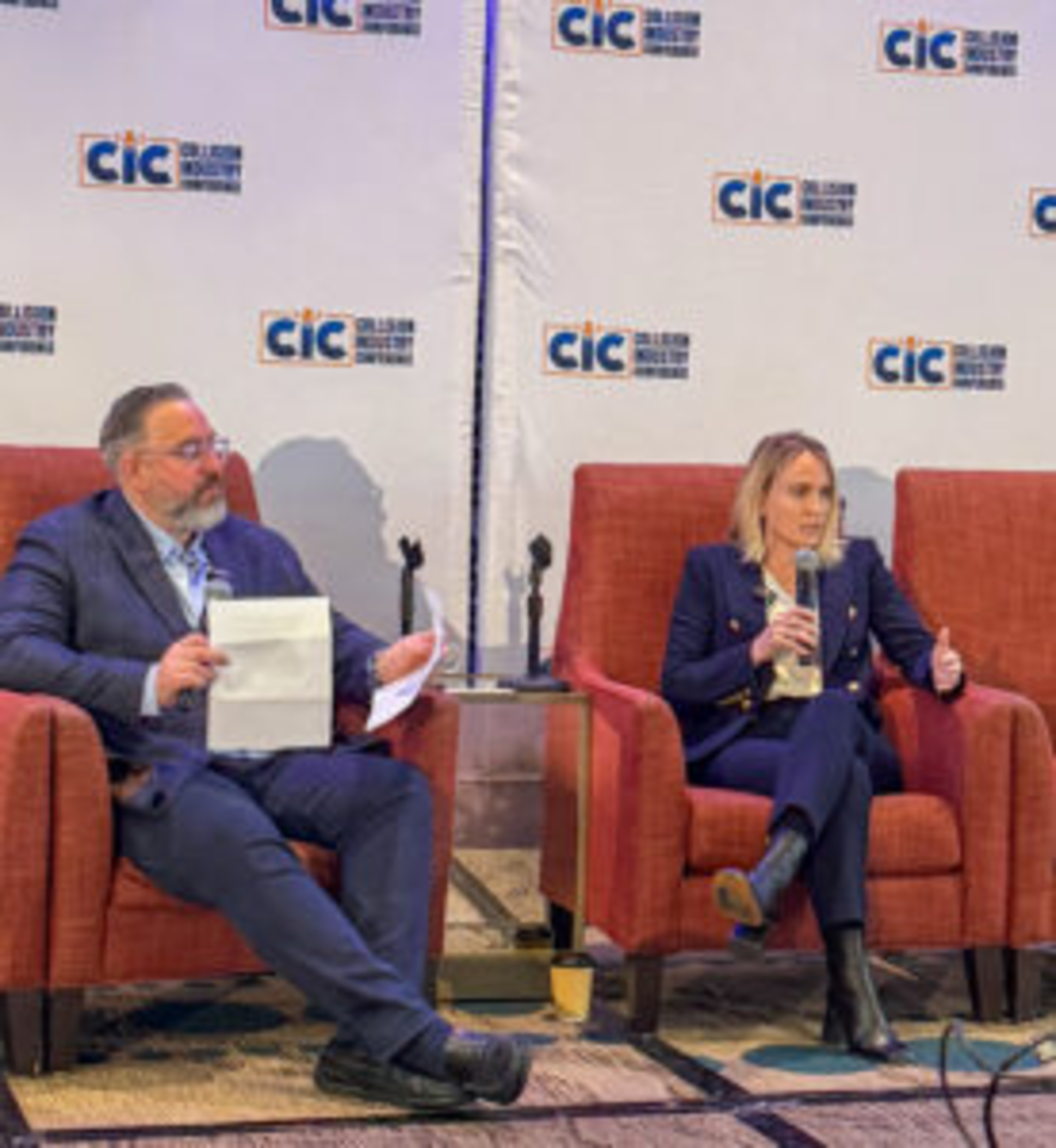
Attorney explains the real risks of not following OEM procedures during CIC

A 16-year-old driver loses control of a vehicle and strikes a tree, his side airbag doesn’t deploy, he hits his head on the B-pillar, ultimately dying from his injuries, Rebekah Cooper, The Cooper Firm partner, explained to the Collision Industry Conference (CIC) audience about a case she’s litigated.
“The question is why did the young man die in a wreck that he could have survived?” Cooper said. “And the answer is because his airbag didn’t deploy.”
She followed this by asking if the airbag didn’t deploy because of design or was the vehicle repaired in a way that kept the airbag from deploying.
If it’s the repair, then it’s a repair defect, she said during CIC’s new Industry Experiment segment hosted by Aaron Schulenburg, Society of Collision Repair Specialists executive director. The segment focuses on current industry issues while using a conversational approach verse panel style.
“I love that you have that chair representing who I am here to really talk about, which is the consumer,” Cooper said during the conversation, acknowledging that CIC traditionally has an empty chair on stage to represent consumers.
The Cooper Firm focuses on product liability, with some of the cases focused on a product design failure and others where repairs weren’t performed correctly. She’s previously worked as an insurance defense attorney and in consumer advocacy.

Improper repair cases are changing as more emerging technology, such as ADAS features, become prominent on vehicles, she said. She said the legal system currently sees dozens of ADAS cases annually and that number is expected to increase.
She told the story of a case where a repair involving a bumper necessitated a calibration that wasn’t completed by the repair shop.
The firm discovered this by looking at what technology was on the vehicle and the repair procedures to see how it’s supposed to be repaired. They tracked the vehicle back to the last place it was repaired. It was discovered the business didn’t do the repair needed, she said.
The failed repair caused the collision warning not to work, she said. The consumer was a quadriplegic following the crash. She lived in a mobile home for three years waiting for accountability, Cooper added.
OEM repair documents, including position statements, are the first documents her firm looks for in a case, she said. Shops are questioned about the documents during depositions.
“There are times we ask a shop for those, and the OEM has it, but the shop does not,” Cooper said. “Have you seen this before? When is the first time? Are you seeing it if for the first time right now? If the answer is yes, that’s a problem.”
Sometimes shops will answer that they have years of experience and are knowledgeable on how to repair vehicles, she said.
“But this ADAS wasn’t here 25 years ago,” Cooper said. “So you need to be looking at these now. You’re industry knowledge or institutional knowledge isn’t going to help in that situation.”
Cooper gave another example of discovering a calibration wasn’t done correctly because during a deposition she asked where a calibration was completed.
“We assumed they sublet it out,” Cooper said.
She said it was obvious there was not a dedicated space to do a calibration in the shop. However, the service manager said the calibration was completed at that location.
“We pulled out the literature and went through it,” Cooper said. “You have to know what you are talking about. It is a specific procedure.”
Schulenburg asked if it would be worse to say you haven’t seen the OEM repair documents or to say you did see it but didn’t follow it.
Cooper paused in her response, clearing weighing the degree of infraction, “If I’m litigating that case, I’m not mad about either answer.”
She gave an example of a case involving a forklift repair. Three repairers had never seen the manual. A corporate representative was brought in and said that the repairers were experienced and didn’t need the manual.
Cooper said there is a difference about a top down culture where the top decision maker didn’t provide the information and a guy who was trained, who made a mistake and took a shortcut.
“This person is just a symptom of the overall problem that the company has,” Cooper said.
Schulenburg further asked if wording in documents, such as recommended or required, plays a part in litigation.
Cooper responded that legally “shall” is a mandate and recommended is best practices. However, a jury is likely to think that a repair professional should do both.
“Are you acting reasonably in the best interest of the consumer,” Cooper asked. “Both of those suggestions and mandates matter.”
Schulenburg added to the conversation by saying that consumers expect professional repair shops to follow best practices.
He followed-up by asking how disregard for OEM repair standards impact a liability case.
Cooper responded that a case is started with the goal to get on a trial calendar and get in front of a jury.
“If you pick 12 of your friends that aren’t in this industry, that aren’t lawyers, they’re not sophisticated in this space, you just pick 12 people, put them in a dinner party and say, these are some facts, people don’t like that,” Cooper said. “Especially with insurance companies and car repair companies. Politically in this climate, people don’’t want the wool pulled over their eyes.”
Not following the repair procedures feels scammy, Cooper said.
“You’re asking consumers to give you five-star Google reviews, but when people come in, you’re doing shortcuts and you’re not looking at OEM best practices,” Cooper said.
Cooper said this discussion could also involve OEM tools verse aftermarket.
However, there’s not a rule that if you don’t follow these you are liable. A technician could, for example, say they discussed an issue with the documents with the OEM and found a work-around that seemed to work.
“From a technical standpoint it is case specific,” Cooper said.
Schulenburg asked about cases where the repair procedures don’t exist.
“I think my next question would be, how did you decide what you were going to do?” Cooper said. “What did you choose to do for this repair, and how did you make that decision?’
Documentation is important for shops, Cooper said. This includes documenting the training your staff has.
Cooper said the first thing her firm will do is look at the name on the bottom of any documentation given to the consumer. It will then look up training for that person, she siad.
“If you’re hiring someone what is your protocol for hiring?” Cooper said. “What do you look at? What do you require? And if they’ve been trained how do you validate that?
Schulenburg responded that her comments highlight the importance of creating a business culture that puts training on a pedestal.
He asked Cooper who owns the product for a repair? The insurance company or repair facility?
“When I go to the hospital, if I had a scan and there needs to be a decision made about treatment, I want a trained medical doctor to make that decision,” Cooper said. “I don’t want a Kaiser representative to make that decision.”
This can put a shop between a rock and a hard place, Cooper said.
“If that is happening, document it and communicate it,” She said. “Communicate it to the insurance company, communicate it to your client, to your customer, communicate it in the repair records.”
Cooper said, ultimately, the repair shop will be the one named in a lawsuit, if it doesn’t follow the OEM documents.
This includes contracting business out for services, such as ADAS calibrations, she said.
Repair shops should vet the company the vehicle is being contracted to for the service the same way they do employees.
“A 5 star google review isn’t enough,” Cooper said. “Have a reason for why you choose them including documented training. A 12 person jury is going to see that a vehicle was brought to a shop for a repair to make a profit.”
Cooper said she doesn’t support that the system puts all the fault on the repair shop. However, that is how a jury will see it.
“If you go to 12 people, saying, ‘I know that the safest way was to follow the position statement, but I couldn’t get that covered and they didn’t want to pay out of pocket,’” Cooper said. “That’s a tough sell because you still let something leave your body shop with a repair that’s not what the OEM is telling you to do.”
Cooper asked, in an ending note, for the industry to be responsible for the person sitting in the empty chair.
“Keep this in mind as you go through your process,” Cooper said. “I just encourage you guys every day to find ways to follow practices to make people safer.”
Image
Feature photo of Aaron Schulenburg, Society of Collision Repair Specialists executive director and Rebakah Cooper, The Cooper Firm partner, during CIC in Palm Springs courtesy of CIC.
Embedded photo of The Cooper Firm courtesy of The Cooper Firm.