
IIHS launches new seat and head restraint evaluation

The Insurance Institute for Highway Safety (IIHS) has launched a new seat and head restraint evaluation targeting neck injuries stemming from rear-end crashes.
Only four out of the first 18 small SUVs tested earn a “good” rating, according to an IIHS press release.
“Neck sprains and strains are the most frequently reported injuries in U.S. auto insurance claims,” said IIHS President David Harkey in the release. “This new test challenges automakers to further improve their seats and head restraints to provide better protection in the rear impacts that typically cause these injuries.”
The vehicles that rated “good” in the new whiplash prevention test include the Audi Q3, Hyundai Ioniq 5, Subaru Forester, and Toyota RAV4.
Nine more models — the Buick Encore GX, Chevrolet Equinox, Honda CR-V, Jeep Compass, Kia Sportage, Mercedes-Benz GLB-Class, Mitsubishi Outlander, Volkswagen Taos and Volvo XC40 — earned “acceptable” ratings.
The BMW X1 and Nissan Rogue rated “marginal.” The Ford Bronco Sport, Hyundai Tucson, and Mazda CX-50 rated “poor.”
Except for the CR-V, which was a 2024 model, the tested vehicles were 2025 models. Many of the ratings extend to the 2026 model year, as indicated in the table below.

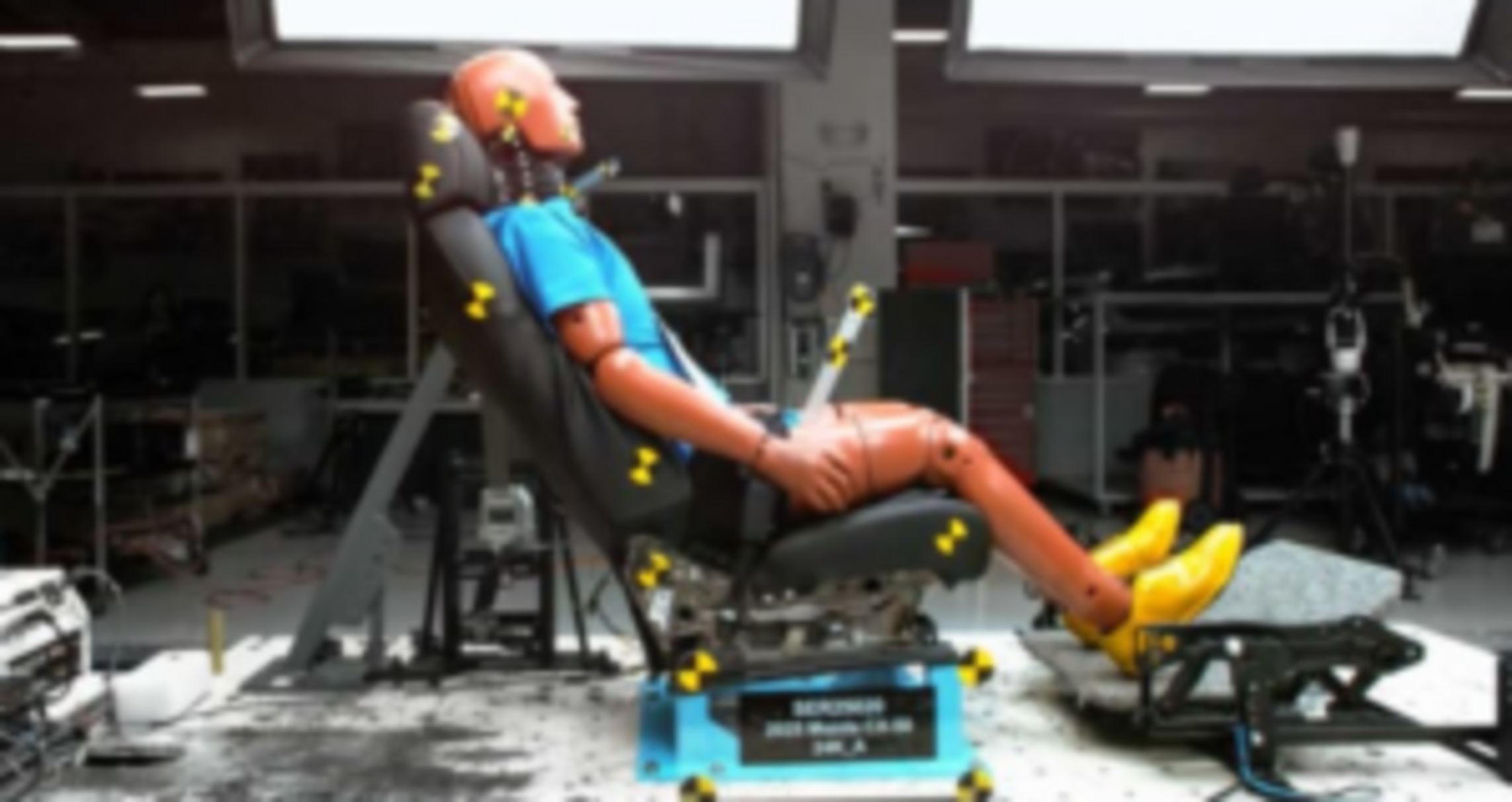
“Like the Institute’s original head restraint evaluation, the new test involves a simulated rear impact that is less destructive than a crash test,” the release states. “In this type of test, the driver seat is removed from the vehicle and secured to a sled. A midsize male dummy designed for rear impact testing, complete with an articulated spine, is positioned in the driver seat. The sled delivers a sudden pulse of acceleration to simulate the effect of a stationary vehicle being struck from behind.
“The original IIHS head restraint test involved a single pulse equivalent to being struck at 20 mph by a vehicle of the same weight. That evaluation was discontinued in 2022 because automakers had improved their designs so that virtually all the vehicles tested now earned ‘good’ ratings.”
IIHS notes that while the improvements reduced injury rates, it was clear a new test was needed to continue that progress, especially since occupants of good-rated vehicles were still suffering from whiplash injuries.
“Variations in insurance claim rates for different models showed that some designs provided better protection than others — even if the original test could not identify them,” the release states.
To figure out how to measure those differences, IIHS tested the seats used in 36 late-model vehicles at three different impact speeds. Data was collected about the stresses exerted on the test dummy and its motion during the test.
IIHS then looked for correlations between the metrics and increased injury claim rates in insurance data supplied by the IIHS-affiliated Highway Loss Data Institute.
“The analysis showed that several key metrics recorded at impact speeds of 20 mph and 30 mph provided useful information, so the new test uses separate acceleration pulses to simulate both types of crashes,” the release states. “Additional research tests were conducted to zero in on the metrics that appear to influence injury risk most directly.”
IIHS found that some of the criteria used in the earlier test remained relevant and were significant predictors of injury claim rates at the higher impact speed, including head contact time.
IIHS defines head contact time as the length of time it takes for the head restraint to reach the back of the dummy’s head, and the acceleration of the T1 vertebra, the last vertebra of the upper spine where it joins the neck.
The research also led to the addition of several new metrics.
Pelvis displacement, for example, is a measure of how well the seat absorbs the crash energy, the release states.
“Ideally, a person in a vehicle that is rear-ended should sink into the seatback so that the pelvis is prevented from moving forward relative to the head,” the release states.
“Measures of the tilting or bending force, known as the moment, of the head relative to the neck, either forward or backward, were also incorporated. An effective head restraint should keep the head in its natural upright position. If the restraint pushes on the head below or above the head’s center of gravity, the chin will jerk up and away from the chest or down and toward the chest.”
Marcy Edwards, the IIHS senior research engineer who developed the new evaluation, added that the mechanisms that cause whiplash injuries aren’t yet fully understood.
“But our research makes us confident that reducing these types of movements and stresses should cut down on whiplash injuries in the real world,” she said.
For the new evaluation, the measures are combined to gauge three aspects of injury prevention: head and spine support, the interaction of the head with the head restraint, and how well the seat manages the energy transferred to the occupant’s body.
In general, the three vehicles rated “poor” fell short in all three areas at both impact speeds and performed extremely badly in at least one.
In contrast, IIHS says the four vehicle rated “good” provided excellent protection across nearly all the metrics at both impact speeds.
The vehicles rated “acceptable” faltered slightly in multiple areas, while the “marginal” ones exhibited more serious flaws, IIHS said.
“In the poor-rated vehicles, the dummy’s head moved a great deal relative to the spine,” the release states. “Ideally, the upper eight vertebrae that comprise the cervical spine should retain their natural curvature. Instead, video footage clearly shows these vertebrae stretching and straightening.”
For example, in the Tucson, the head restraint pushed the chin down toward the chest. In the CX-50, it allowed the head to slide backward and upward.
IIHS also found that the Bronco Sport provided particularly poor support for the head and spine. It took a long time for the head restraint to contact the head, and the difference in velocity between the pelvis and head was very high, the release says.
In the good-rated vehicles, the seat and head restraint kept the head and spine in alignment. Little motion of the head relative to the spine could be observed in the video or test metrics, and the cervical spine retained its natural curve, IIHS said.
Images
Featured image provided by IIHS