
IDEAS: Entegral VP Encourages Industry Connectivity to Improve Customer Experience

Joe Rector, Entegral vice president, urged collision industry stakeholders to break down silos and better connect their systems, arguing that stronger collaboration across the ecosystem is key to improving outcomes for both businesses and consumers.
The IDEAS Collide Showcase presentation, hosted by the Society of Collision Repair Specialists’ IDEAS Collide showcase at the 2025 SEMA Show, where Rector demonstrated how to overcome and avoid example of disharmony in the auto industry – such as widespread shortages in parts and microchips that led to disruptions in car production. He added this caused the loss of billions of dollars in sales.
“The way they weathered that storm was to look within their value chains, their partners, their entire ecosystem to come up with new ways to bridge the gaps and tear down the silos that they found to exist,” Rector said.
They worked across their entire ecosystem to connect everyone through system integrations, so they could move data faster to make decisions more accurately the first time. This allowed them to evolve their inventory practices.
The collision industry is made up of many partners as well, Rector said. There are OEMs, insurance providers, tow, glass and salvage companies.
“Collision repair facilities are very unique in the fact that you have your own value chain outside of just the partners across the industry,” Rector says.
He gave other examples of ADAS sublets and paint, parts and equipment providers.
Currently, the industry faces complexity and challenges including labor, supply and increase cost for parts.
“It feels a little bit like the OEM analogy I just provided you,” Rector said. “The way through is to look to each other, not just within our own operations but to look around the industry and find better ways to connect to each other.”
Customers are the middle of the ecosystem, he explained.
“The customer doesn’t care about the entire value chain that surrounds them,” Rector said. “These are all back-end services. They may not know every company that level of customer service that they expect. What they are looking for is a timely repair and one that’s done safe and in proper manner.”
This means one company is not more important than the other, he said. This also means that multiple shop operators, sole proprietors and direct repair programs all look the same to the customers.
“But what is interesting about our customers is that they are not just in the middle of our industry, they’re actually an active participant helping connect and move information around,” he said.
When a customer has a claim, they have to contact the insurance company and select a repair facility, schedule an appointment with the shop, schedule transportation while their car in for a repair, and possibly arrange for a tow to the proper location, he said.
“There’s a lot of information being exchanged before the car is even repaired with a number of parties in our ecosystem,” Rector said. “It all runs through the customer. It doesn’t run around the customer. The customer is interacting with each of these other businesses to get on their way.”
If something goes wrong, for example, the repair facility can’t complete the repair needed, this means numerous extra steps the consumer must take. For example, they have to schedule a new repair shop, a new tow and inform the insurance company.
“I think we honestly can do better than that,” he said. “If you go just beyond the onset of the repair, look at what happens when the customer is within the repair,” Rector said. “They’re relying on an accurate estimate, completion date to pick the car back up and get on the road. But that information is equally valuable to the rest of the industry as well and getting it not just in the hands of the customer but also the rental car providers, to the insurance carriers to handle invoicing appropriately.”
If the information is inaccurate to one of the members, then the consumer has to make more phone calls, he said. and added that every member of the industry has to start calling each other.
“It sounds a little chaotic,” he said. “It does not sound like harmony.”
What would happen if all of the partners were connected? He asked.
“Let’s say the body shop and their scheduling and their data on their drop off and repair status is connected seamlessly to the rental car providers and to the insurance carriers,” Rector said. “When the customer makes selections throughout the process everyone is informed without the need to call each other.”
Rector said this is already in motion.
“We’re actively working with parties across the company to help make some of these connections behind the scenes for customers and for businesses and for shops,” he said. “But its a mindset for the industry. It’s one that we have to not just look within our business but look around the entire industry and ask what we can do better for each other in the interest in our customer.”
He suggested everyone to have a conversation with the businesses they interact with and look for ways to do better.
“How can we integrate our systems better behind the scenes” Rector said. “It’s not that hard to do. We just need to talk about how we can improve the overall experience for ourselves.”
Image
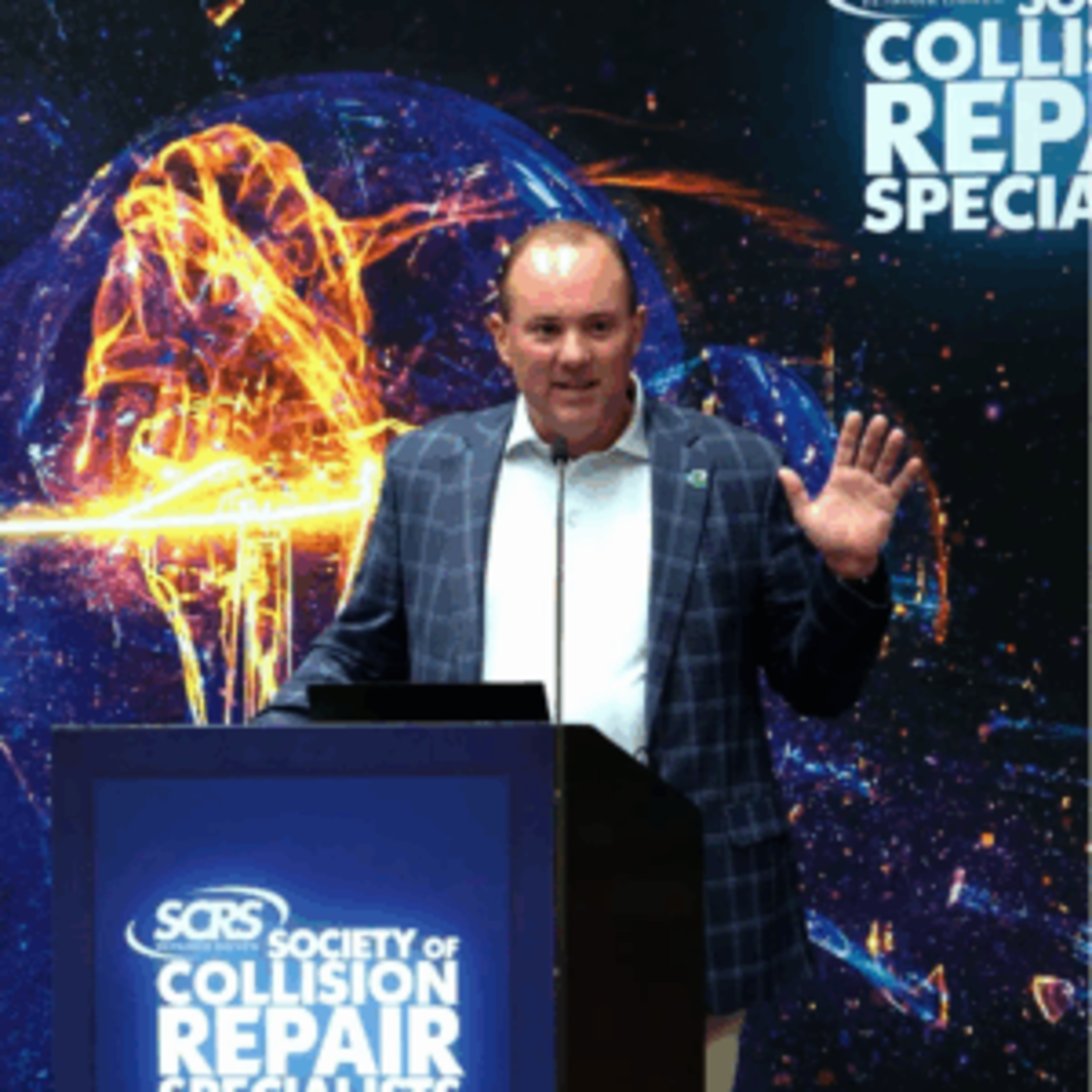
Photo of Joe Rector, Entegral vice president, during IDEAS Collide/SCRS.