
Rivian shares ‘AI-centric’ autonomy plans, in-house chip manufacturing

Rivian CEO RJ Scaringe announced Dec. 11 that the automaker will begin producing its own silicon chips, and outlined the automaker’s roadmap for AI-centric next-generation vehicle autonomy.
During its first “Autonomy & AI Day” at its Palo Alto offices, Scaringe said it became clear a few years ago that Rivian’s approach to autonomy needed to shift.
“With innovations around transformer-based encoding and the design of large parameter models, the approach has moved to building a neural-net-like understanding of how to drive, instead of following a classical rules-based approach,” he said. “Recognizing this massive shift in how we approach autonomy, in early 2022, we began the process of a clean-sheet design to our platform.
“This first embodiment of this work was in our Gen 2 R1 vehicles, which we launched in mid-2024. With this updated platform, our Gen 2 vehicles now have 55 megapixels of cameras, five radars, and run on an inference platform that was a 10X improvement over our Gen 1 vehicles. This platform was designed around an AI-centric approach, and with the deployment of our Gen 2 R1s, we began the process of building our data flywheel to grow and build our large driving model.”
Scaringe compared it to putting on glasses and adding radar and lidar. Then, your brain, or the compute, expands in capability by an order of magnitude.
“You wouldn’t forget the things you’d learned, the rules of the road, how to operate a vehicle, but your ability to understand nuance, respond to complex situations, and perceive the world in environments with poor or limited visibility would improve dramatically,” he said. “But your ability to understand nuance, respond to complex situations, and perceive the world in environments with poor or limited visibility would improve dramatically.
“Because this AI-centric approach represents building a model trained end-to-end through the millions and millions of miles driven on our vehicles, enhancing the perception platform or improving the compute is accretive to the capabilities of the model, meaning the model only continues to get better as the perception and compute platform improve.”
According to a Rivian press release, the company’s technology roadmap involves transitioning to an in-house-designed silicon chip specifically for the vision-centric physical AI. Vidya Rajagopalan, Rivian’s electrical hardware senior vice president, said during the event that Rivian chose to develop its own silicon chip to get to market quicker with improved performance and cost reductions.
The first-generation Rivian Autonomy Processor (RAP1) is a custom five-nanometer processor that integrates processing and memory onto a single multi-chip module. This architecture delivers advanced levels of efficiency, performance, and Automotive Safety Integrity Level compliance, the release states.
RAP1 powers the company’s third-generation autonomy computer, the Autonomy Compute Module 3 (ACM3).
According to the release, key specifications of the ACM3 include:
-
- 1600 sparse INT8 trillion operations per second (TOPS)
- Processing power of 5 billion pixels per second
- RAP1 features RivLink, a low-latency interconnect technology, allows chips to be connected, multiplying processing power
- RAP1 is enabled by an in-house developed AI compiler and platform software
In addition to ACM3, Rivian plans to integrate lidar into future R2 models to augment the company’s multi-modal sensor strategy, which would provide detailed, 3D spatial data and redundant sensing to improve real-time detection for the edge cases of driving, the release states.
Rivian’s Gen 3 autonomy hardware, including ACM3 and lidar, is undergoing validation and is slated to ship on R2 models beginning at the end of 2026.
“We’ve designed this entire architecture around an AI-centric approach where the data flywheel of our deployed fleet helps make the model better and better through reinforcement learning,” Scaringe said at the event. “Not only does this sensor set enable a much higher ceiling than what our vehicles have today, it also makes it a much better platform to serve in building our model. We’re going to continue to see improvements on our platform.
“Later this month, we’ll be issuing an over-the-air update to our R1 Gen 2 customers that will dramatically expand our existing hands-free capability, going from less than 150,000 miles of roads to more than 3.5 million miles of roads in North America.”
He added that beginning next year, Rivian will roll out point-to-point autonomous driving capability in R1 and R2 vehicles.
“You can get into the car, plug in the address, and the vehicle will completely drive you there,” Scaringe said.
Next will be eyes-off driving, followed by Level 4 autonomy on personal vehicles, allowing the vehicles to operate on their own, he added.
Rivian also announced its autonomy subscription, Autonomy+, with continuously expanding capabilities, will launch in early 2026 for a one-time cost of $2,500 or $49.99 per month.
Beyond vehicle autonomy, Rivian is harnessing AI across the business with the Rivian Unified Intelligence (RUI). The shared, multi-modal and multi-LLM data foundation is helping the company develop powerful new features, improve service infrastructure, and power predictive maintenance, the release states. The highlight of this new architecture is the Rivian Assistant, a next-generation voice interface, which is slated to launch in early 2026 on Gen 1 and Gen 2 R1 vehicles.
Images
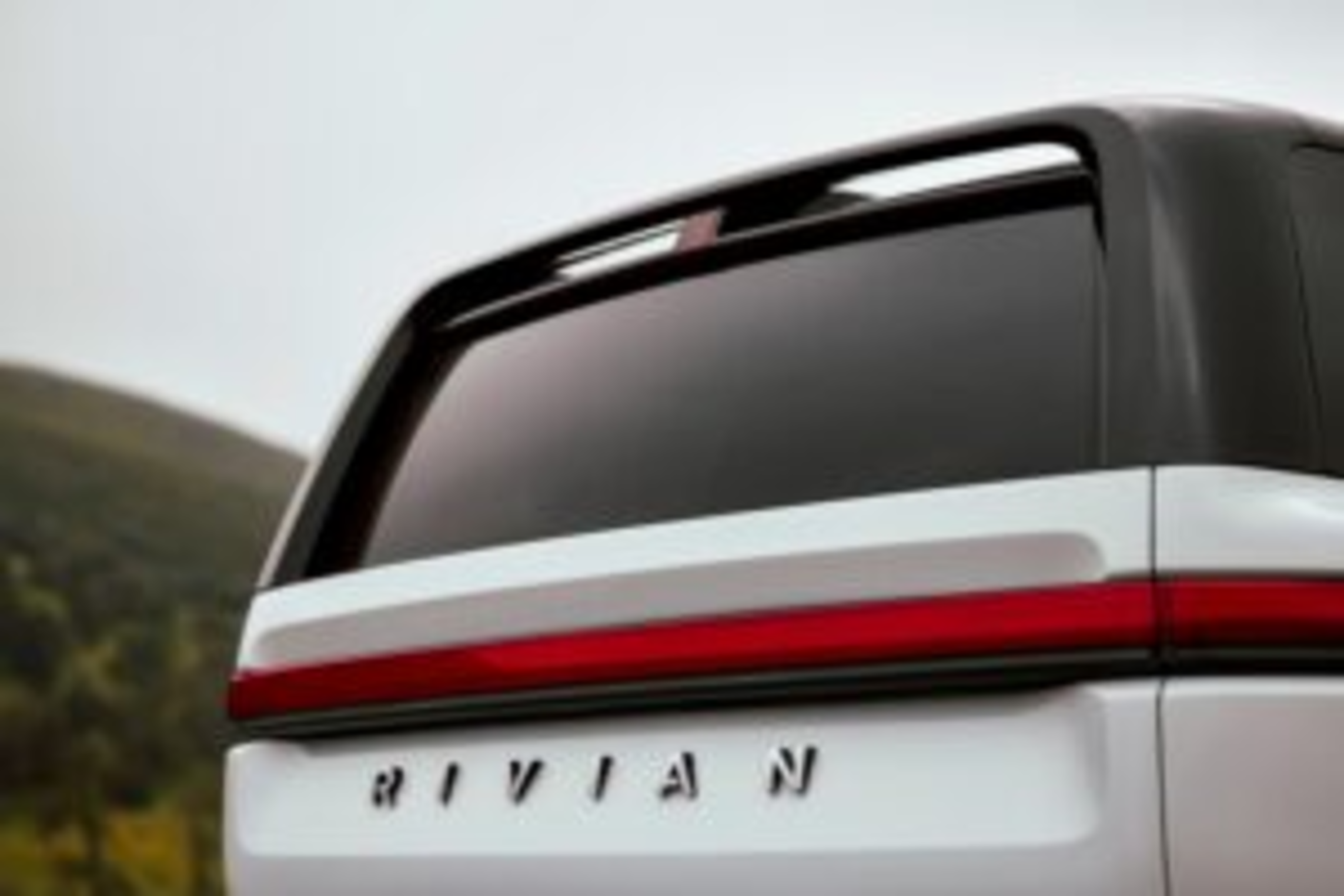
Featured image of R2 provided by Rivian