
How to ensure proper power supply for correct, safe repairs

One of more than a dozen segments from this year’s SEMA Show Collision Repair and Refinish Stage segment focuses on proper electrical power and setups in collision repair facilities to ensure proper repairs.
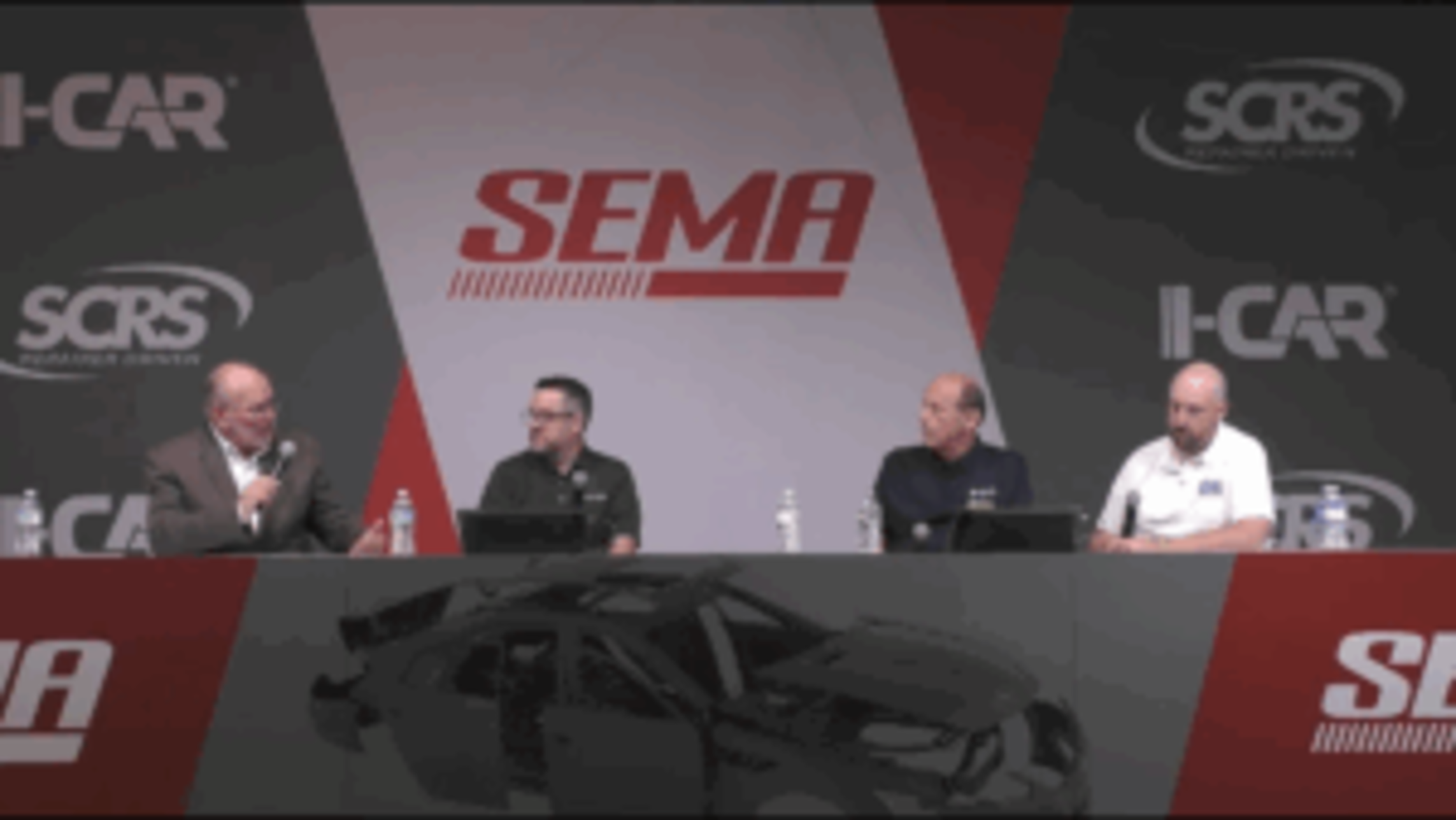
Jeremy Holloway, Spanesi Americas director of aftersales; Dave Gruskos, Reliable Automotive Equipment (RAE) president; and Ron Reichen, Precision Body & Paint owner, sat down with Society of Collision Repair Specialists (SCRS) Board member Justin Lewis to discuss some things business owners should think about when powering their shops.
First, the panel agreed that it’s essential to ensure there is up-to-date wiring and a true electrical ground before adding outlets to an existing building or when designing a new building.
“It’s easier to control on a new build [when] we’re involved at the beginning of the process to put the right power in a facility,” Holloway said. “Everybody’s trying to be as economical as possible when they’re designing that new building. We specify the wire size, the receptacles, how far the run should be, and how many outlets there should be. You might have to spend a little bit more than you were planning to make this function properly.
“You could easily put a welder in a building with old power that’s not going to function properly. It’s going to cause problems with your welder, and then you’re going to exhaust yourself with service calls trying to overcome that.”
Reichen added that important considerations include electrical demand from paint booths and EV charging stations.
“We remodeled an existing building and planned for it, but the new paint booth had a higher demand, and then by the time we considered that we needed to add some charging stations, we were underpowered,” he said. “It delayed our startup. It really was a hiccup that, financially, we hadn’t really budgeted for.”
Gruskos noted that some facilities may have “dirty power” — when high voltage legs are split off throughout the power grid, causing unequal voltage at different points in the wiring. This comes into play with lower-quality equipment that requires “perfection” from its power supply to operate correctly, he said. Without it, additional equipment will have to be installed.
“The highest quality of the welding equipment has the highest quality components and some of them will adapt to that dirty power, but the equipment that’s of lesser quality all of a sudden just doesn’t seem to work because it needed perfection [from] what was going into it,” Gruskos said. “That’s just the way the grids work.”
He added that sometimes it’s necessary to involve the power company, which may need to replace the transformers at the street.
Reichen noted that if an air compressor and welder are on the same circuit supplied with dirty power and the compressor kicks on during a weld destruction test, for example, the amperage to the welder is starved, making the weld defective.
“If you’re underpowered, you’re not getting that penetration, especially if you’re running a spot welder,” he said. “Maybe you’re welding three or four panels in a stack together; you’ve got to get penetration through all of those. If you’ve had a hiccup in your amperage, if you’ve got a drop in that, you’re not going to penetrate all of those. So even though you might have passed that structural destruction test because the compressor wasn’t on and somebody else wasn’t doing something else that was demanding that power, now you’ve got this liability, and you may not even be aware of that.”
Gruskos said welds can appear to be done properly, but if not done under the right conditions, they won’t hold up correctly or safely.
“You’re putting the life of the person in the car in your hands when you’re putting a weld that’s supposed to protect exactly the way it’s supposed to,” he said. “It’s supposed to tell the airbags, every single component, how the car is going to react in the collision. And God forbid
something doesn’t work right, it’s the easiest thing in the world to prove that you did it wrong.”
There are kits available that can be used to check welders, he said.
The panel shared some things to think about and look for to ensure proper power when moving into a building, or building new:
-
- What are you expanding?
- What are your business operations and equipment power needs? Think lifts, resistance welders, conventional welders, EV charging stations, and HVAC systems.
- Bring in a professional electrical planner to determine if panels or wiring need to be replaced.
- Add 20% to the current demand to account for future changes, such as additional EV charging stations
“In an ideal situation, you want to draw 80% of whatever your input panel is drawing,” Reichen said. “If you had a 200-amp panel, you don’t really want to have any more drain on that system than 180 amps. You’re always supposed to have 20 amps of extra.”
He said power companies can perform power drain analyses on shop buildings to determine maximum usage under their current setups.
Gruskos compared electricity to sand moving through a sieve.
“It’s slowly trickling out,” he said. “If you punch a hole in it, the sand just flies out of the hole. What you’re doing when you’re turning on your welder — maybe your HVAC system kicks on, maybe the spray booth kicks on — that’s all holes getting punched… The power is going to
vanish that you needed to operate the weld properly. If you have some new state-of-the-art welder that’s constantly measuring the voltage going in and the amperage coming out, great. But 80% of the shops probably don’t have that.”
Oftentimes, the welder is blamed when the problem is actually bad electricity, Gruskos said.
“The newest welders will adjust, to an extent, for the power,” he said. “If you do have a low power supply that comes into it, it will stop working… because it’s trying to protect the different components in it that will be inclined to go bad. But if it’s forcing itself to work every time you turn it on, the duty cycle is going to be terrible, and it’s going to start breaking components it shouldn’t.”
Holloway noted that the duty cycles specified on welders only apply when a proper power supply is present, allowing them to operate efficiently and as designed. When smart welders don’t receive an adequate power supply, they can overheat and damage their components, he said.
Scan tools and vehicle battery voltage can also be affected by power shortages, which can cause inaccurate scans and calibrations, Reichen said.
“It seems small, but if you’ve got somebody at one end of the building setting up to do an intake scan… and somebody fires up the paint booth and you have a 10 or 15 second amperage draw, then it could affect the [scan] ability, could even disconnect your scan,” he said.
Holloway added that spray booth computers and touch screens could also be destroyed if the power flickers or a breaker pops.
Images
Featured image: Ron Reichen, Precision Body & Paint owner; Jeremy Holloway, Spanesi Americas director of aftersales; Dave Gruskos, Reliable Automotive Equipment (RAE) president; and Justin Lewis, Society of Collision Repair Specialists (SCRS) board member, participate in a panel discussion from this year’s SEMA Show Collision Repair and Refinish Stage.