
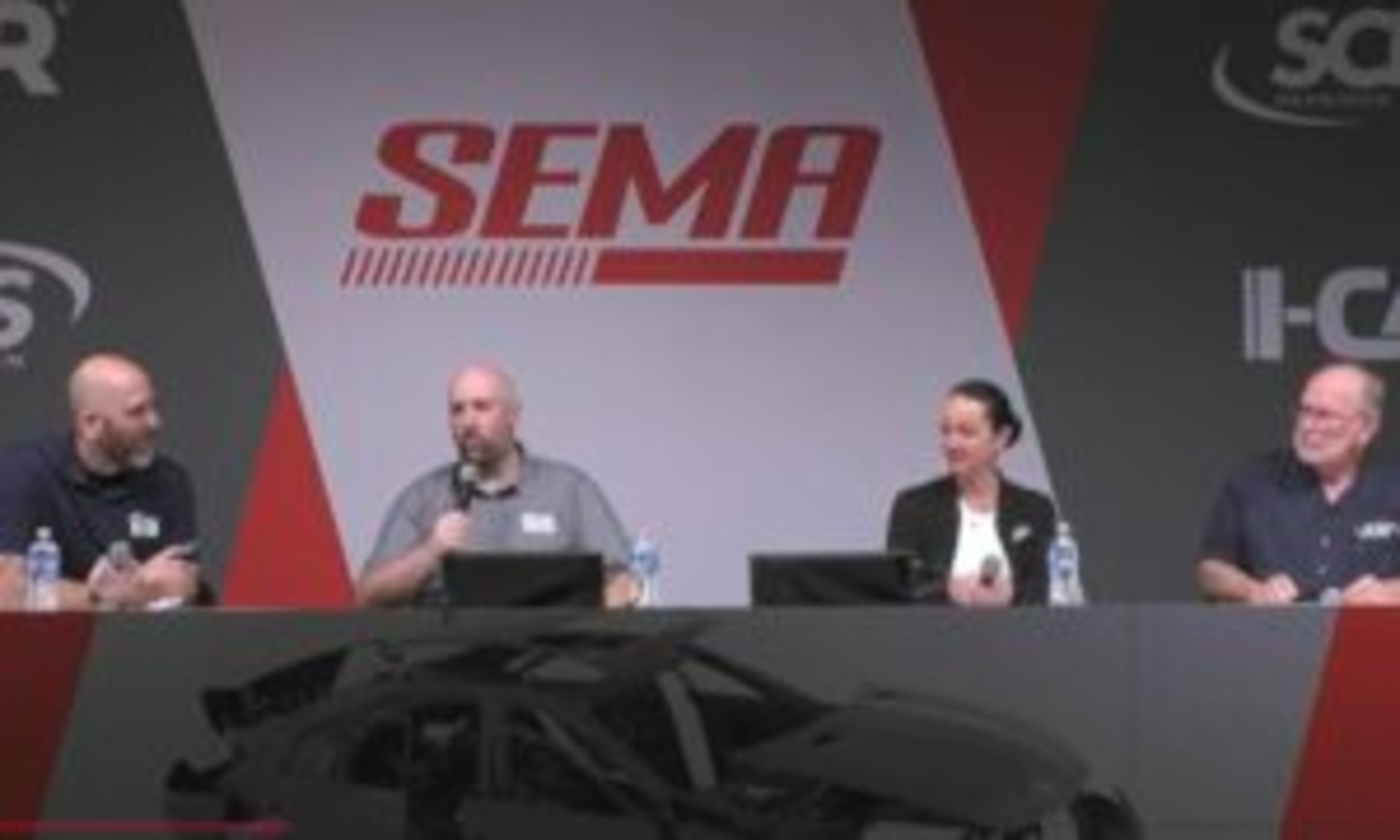
Collision repair panel at SEMA offers tips to drive business in downturns

A Society of Collision Repair Specialists (SCRS) panel held on the Collision Repair and Refinish Stage during the 2025 SEMA Show discussed how shops can drive work into their bays when business is slower.
“Virtually everybody’s shop that I talk to across the country says that there’s not enough work,” Andrew Batenhorst, Pacific BMW Collision Center manager, said to start the conversation. “I am dealing with a little bit of a slowdown. So today we want to start to review what are some effective strategies and things that shops can do to help make sure the technicians aren’t standing around pushing a broom and getting antsy for work.”
Ron Reichen, owner of Precision Body & Paint, said a majority of his business’s work comes from sponsoring certified dealerships.
“We actually are physically present at the car dealerships, building relationships and maintaining relationships with the service advisors,” Reichen said.
He said the time is used to teach them about certified repairs.
Amber Alley, manager at Barsotti’s Body & Fender, said she works with her paint company to receive market information about her shop’s region. She said the company breaks down information about specific vehicles and how many vehicles are owned per household.
“You can maybe invest more wisely in what dealer or what OEM you’re going to pursue,” Alley said.
Justin Lewis, Accurate Auto Body president, said he also uses information from his paint company for market demographics. He said it helps his business determine which OEMs to target and be certified in.
When it comes to marketing, the panelists each used a variety of methods from radio and TV to reviews and community grassroots efforts.
Alley said her shop’s using social media, specifically Instagram.
“I don’t know that it really drives the business in, but it definitely helps with the shop culture and identity,” Alley said. “I don’t think it’s an immediate answer, but I do think long term there’s something there.”
Lewis said his business is running radio advertisements. They target times around sporting event talk radio shows, he said.
During COVID, the business ran television commercials.
“It was a pretty big investment, but I think the return on that was really good because we’re able to educate at a television level,” Lewis said. “People could see people in our business.”
Lewis said he’s also seen a lot of his EV business coming from conversations on Reddit.
Reichen said businesses have to remember community engagement.
“Never forget about the chamber meetings,” Reichen said. “About embedding yourself within the community.”
He said this could be sponsoring a sporting team or holding a barbecue for a car club.
Batenhorst mentioned his business has started doing over-the-top (OTT) advertisements, which plays advertisements on streaming services.
“A lot of people have obviously cut the cord for cable these days and watch all their media through one of those streaming services,” Batenhorst said. “I’ve had some good luck with that in my shop.”
Alley said it is also important to remember the online reviews.
“I think it is by far the easiest thing to do,” Alley said. “Be proactive and ask your customers to leave you reviews because this is a tough business.”
A three-star review on a restaurant would likely steer consumers away, Alley said. She said that’s the same for collision businesses.
Lewis said it is also important for businesses to engage with reviewers.
“Giving responses to those reviews is huge because then it shows the thank you or ‘Hey, we understand, we’re going to work on this,’” Lewis said. “I think people feed a lot on that. When you have an active administrative part of your business that’s really focused on the customer service side of it, it goes a long way. And when people can see the reviews and see the responses, I think that speaks a lot to what your business stands for.”
The panelists agreed that customer service is key to driving good reviews.
Reichen said his business has created consultations with customers to discuss the repair process through scheduled appointments. The scheduled appointments allow his team to have a dedicated time where they can discuss repair plans.
“We talk about the benefits of a certified repair and walk them through the expectation of how this repair process is going — the good, bad, and the ugly,” Reichen said. “People just want you to be transparent. They want to see that truthfulness.”
Internally, employee uniforms can be used as a way to market shops, Reichen added.
Alley said her shop elected to remove the traditional uniforms and replace them with T-shirts and hoodies. She said potential consumers will see employees picking up their kids at school wearing the shirts or even at weekend events.
Lewis said a marketing team can help a business build their brand and figure out the best options for marketing.
“You can hire someone young that’s a Facebook savvy person that can start making posts and start drawing attention to your business,” Lewis said. “If you want to look at the radio side of it, we had no clue what we were doing and ended up getting a radio contact and they helped us build our commercial. They helped us build the whole soundtrack and put it together. There’s people that do this for a living that are happy to help. It might be worth paying a little bit of money to help take that off of your workload and let someone that it is their profession do it.”
After finishing a job, each panelist said it is important to stay in front of the customer.
Lewis said his business sends out six-month and one-year follow-ups.
Alley said her shop invites customers back for 30-day or 90-day details.
“That gives us an opportunity to catch anything that may have been missed, or address anything that they may have a concern with and then at that point, you do have a lot more casual conversation with the client, and you can start to continually maintain that relationship.”